


BB
Benedikt Bischof
World Congress 2023
•
Sep 27, 2023
Reality and Beyond: Coding a Drone Using {Unity 3D .NET} and ChatGPT AI!
- Discuss this with your agent
- Open in Claude
- Open in ChatGPT
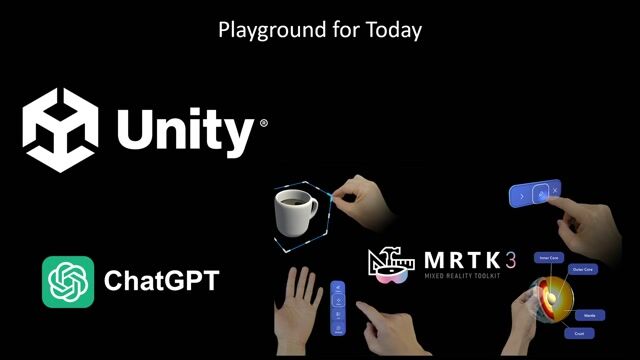
Move beyond a printed hello world and control a physical drone. Master mixed reality by combining Unity 3D, .NET, and ChatGPT to build spatial computing apps.
Matching moments
5:48 min
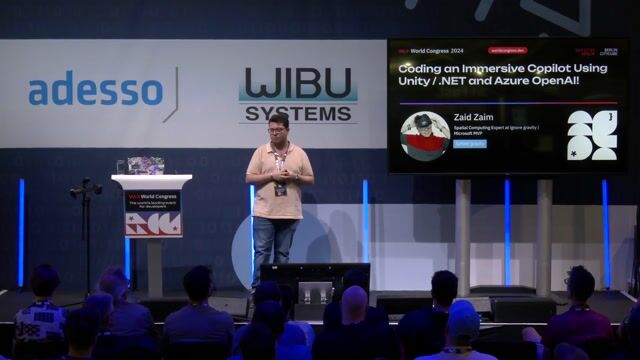
Demonstrating holographic artificial intelligence copilot live interactions
 Zaid Zaim · World Congress 2024
56 sec
Core technology stack for mixed reality copilots
Zaid Zaim · World Congress 2024
2:39 min
Transitioning toward immersive spatial computing technologies
 Bastian Schütz · World Congress 2024
2:31 min
Outlining the hardware and software architecture of mixed reality
 Nahed Hatahet · World Congress 2024
4:24 min
Exploring the capabilities of mixed reality headsets
Bastian Schütz · World Congress 2024
1:48 min
Role of immersive technologies in AI copilots
Zaid Zaim · World Congress 2024
More from World Congress 2023
Related videos
Related articles
CH
Chris Heilmann

CH
Chris Heilmann
BB
Benedikt Bischof
.gif)
From learning to earning
Jobs that call for the skills explored in this talk.
about 2 months ago
Senior Fullstack AI Engineer (React, C#)

TeamViewer Germany GmbH,
Austin, TX, United States
Expert
ReactJS
Databases
Microservices
16 days ago
Senior AI Developer

PwC
United States
Expert
Remote
Docker
Github
Fastapi
about 1 month ago
•
Verified
Software Engineer, Fullstack

Sciforium
San Francisco, United States
Expert
$165k–210k
Python
about 2 months ago
Software Engineer - Video

Twilio
Austin, TX, United States
Experienced
$138k–203k
Remote
NoSQL
Nagios
Twilio
about 1 month ago
Senior Software Engineer, Sandboxes (Eu Or East Coast Preferred)

Docker, Inc.
Madrid, Spain
€94k–155k
Remote
Docker
Adobe InDesign
Virtual Agents
about 2 months ago
MLOps AI Engineer
TeamViewer Germany GmbH,
Austin, TX, United States
Expert
Caching
Routing
Standard Sql