

World Congress 2023 Sep 27, 2023

How to ignore bugs (safely)

Anja Kunkel

Chasing a zero-bug policy is a trap that kills engineering velocity. Learn a data-driven triage framework to safely ignore trivial defects and prioritize what actually impacts revenue.

Pause
Mute Enter Fullscreen
#1 about 2 min

Defining software flaws and their overall relevance

A standard definition of a software fault establishes context for determining which system errors require attention.

#2 about 3 min

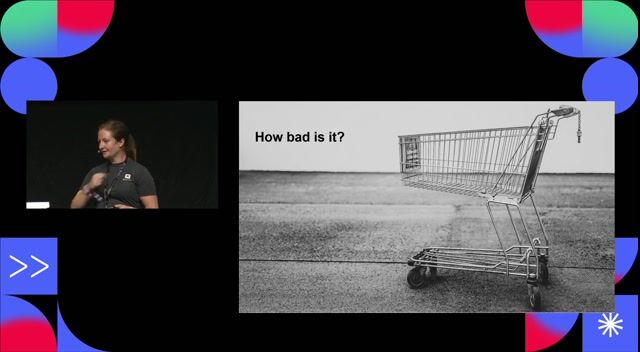
Using a physical shopping cart to evaluate bug severity

Assessing broken physical parts on a shopping cart demonstrates how context determines if a flaw is truly critical.

#3 about 4 min

Applying medical triage principles to software incidents

The medical START method categorizes system problems by urgency using a straightforward color-coded prioritization model.

#4 about 4 min

Calculating business risk with probability and severity metrics

Multiplying issue probability by the number of affected users and total downtime creates an accurate risk assessment.

#5 about 2 min

Evaluating issue probability, user impact, and revenue loss

Measuring user happiness and system trust ultimately highlights financial consequences like lost revenue.

#6 about 5 min

Tracking recovery time metrics to evaluate monitoring maturity

Combining the time to notice an incident with deployment speed aligns engineering workflows with standard DORA metrics.

#7 about 3 min

Prioritizing new software features over minor layout issues

Comparing the business value of new capabilities against minor glitches prevents teams from wasting effort on unimportant details.

#8 about 3 min

Understanding the pitfalls of a strict zero bug policy

Enforcing blanket fixes for all system errors allows teams to bypass essential conversations about business priorities.

#9 about 2 min

Handling safety platforms and customer acceptance testing requirements

Constructive dialogue aligns engineering data with exact user expectations during customer acceptance testing and critical platform evaluations.

Matching moments

3:08 min

Preventing catastrophic failures in high-stakes software

Lars Hupel · WWC 2023

2:56 min

The impact of minor user interface bugs on trust

Ramona Schwering Ramona Schwering · LIVE

3:28 min

Applying the Boy Scout rule to software maintenance

timtebeek timtebeek · WWC 2024

1:54 min

Embracing failures and analyzing high-profile software engineering mistakes

Christian Seifert · WWC 2022

5:30 min

Identifying non-coding software vulnerabilities and organizational risks

Tino Sokic · WWC 2023

6:44 min

Balancing technical debt reduction with feature delivery

Jens Happe Jens Happe · LIVE

Upcoming sessions on this topic

Open session

World Congress 2026 North America

How to generate business value through performance optimizations

Nikolai Sidiropulo

Software Engineer at Meta

Nikolai Sidiropulo
Open session

World Congress 2026 North America

Evals Are Infra: Building AI Systems Developers Can Actually Trust

Phoebe Wang

Member of Technical Staff at OpenAI

Phoebe Wang
Open session

World Congress 2026 North America

Your Evals Passed. Your Agent Just Emptied a Database.

Tejas Pravinbhai Patel

IEEE Award-Winning Researcher | Best Keynote Speaker | Sr. Software Engineer at Amazon | AI Systems & Agent Architect

Tejas Pravinbhai Patel
Open session

World Congress 2026 North America

Give the Agent a Budget, Not a Token

Sachin Malhotra

MTS @Anthropic

Sachin Malhotra
Open session

World Congress 2026 North America

On the Public Clock: Open-Source Defense When You're Not in the Club

Nicholas Muy

VP Engineering Platform and Security at Scrut.io

Nicholas Muy
Open session

World Congress 2026 North America

Agents Can't Iterate Against Tests That Lie

Rocky Warren

Senior Staff Software Engineer at Clipboard

Rocky Warren