




CH
Chris Heilmann
World Congress 2023
•
Sep 27, 2023
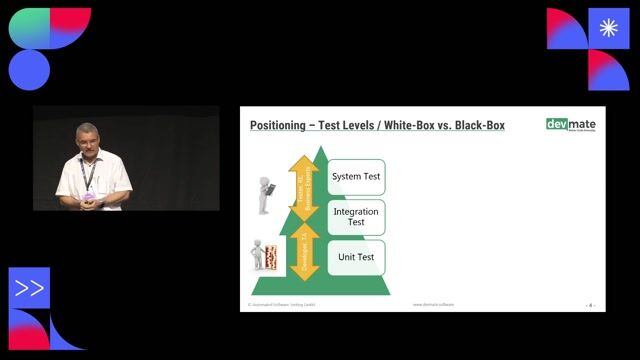
Are you still programming unit tests or already generating?
Johannes Bergsmann , Daniel Bauer
- Discuss this with your agent
- Open in Claude
- Open in ChatGPT
Are your AI-generated unit tests just reinforcing your own syntax mistakes? Discover how to automatically generate intelligent, risk-based unit tests directly from system requirements instead.
Matching moments
7:57 min
Demonstrating automated unit test generation for legacy java
 Neel Sundaresan +1 · World Congress 2026 Europe
2:39 min
Evaluating automated approaches for generating unit test cases
Evelyn Haslinger · LIVE
3:32 min
Iterating automated unit test generation with coverage metrics
 Eric Jadi +1 · World Congress 2025
1:51 min
Bridging the gap between AI code generation and verification
 Christian Heilmann +3 · World Congress 2026 Europe
59 sec
Automating epic generation and semantic analysis for test management
 Rene Schenk · World Congress 2026 Europe
2:27 min
Using automated tests to validate AI generated codebases
 YK Sugi · World Congress 2025
More from World Congress 2023
Related videos
Related articles

LM
Luis Minvielle

EY
Elena Yakimova

LM
Luis Minvielle
.png)
From learning to earning
Jobs that call for the skills explored in this talk.
3 days ago
•
Verified
AI Software Engineer (Germany)

Sunhat
Berlin, Germany
Expert
€70k–100k
Remote
REST
TypeScript
AI Frameworks
6 days ago
Senior Test Automation Engineer - BundesMessenger

BWI GmbH
Bonn, Germany
Expert
€71k–104k
Docker
Backend
Test Data
about 2 months ago
Senior Fullstack AI Engineer (React, Java)

TeamViewer Germany GmbH,
Austin, TX, United States
Expert
ReactJS
Backend
TeamViewer
about 2 months ago
Senior AI Frontend Engineer
TeamViewer Germany GmbH,
Austin, TX, United States
Expert
ReactJS
TypeScript
Material UI
about 2 months ago
MLOps AI Engineer
TeamViewer Germany GmbH,
Austin, TX, United States
Expert
Caching
Routing
Standard Sql
about 2 months ago
Bank Platform Transformation - Test Execution Leader - Sr Associate

PwC
Atlanta, GA, United States
Expert
$77k–202k
Software Systems
Agile Methodology
Testing (Software)