





World Congress 2023 β€’ Oct 6, 2023

How computers learn to see – Applying AI to industry

Antonia Hahn

Ditch brittle manual feature engineering. Discover how transfer learning and cloud-based CNNs shrink computer vision training requirements to just 1,000 images for scalable industrial anomaly detection.

Pause
Mute Enter Fullscreen
#1 about 2 min

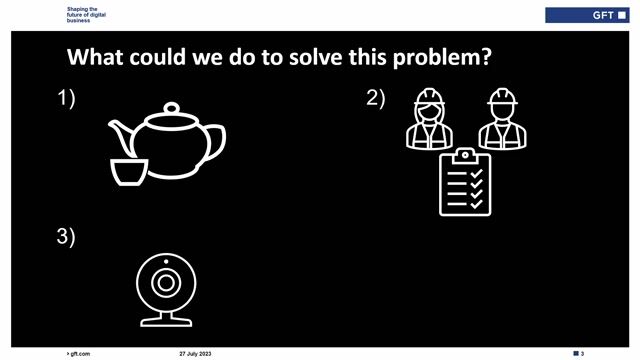
Automating quality control in car seat manufacturing

Automating visual inspection of assembly differences resolves significant efficiency challenges for human operators.

#2 about 3 min

Advantages of AI over classical computer vision

Automated AI algorithms bypass complex feature engineering to reliably detect manufacturing anomalies.

#3 about 5 min

Preparing data and labeling for supervised learning

Collecting, labeling, and slicing image data sets the foundation for a robust predictive model.

#4 about 2 min

Understanding layers in a convolutional neural network

Convolutional and pooling layers automatically downscale image data to recognize structural object features.

#5 about 2 min

Utilizing pre-trained models from service providers

Utilizing pre-built algorithms from cloud vendors significantly reduces the required volume of training data.

#6 about 3 min

Evaluating model performance using confusion matrices

Confusion matrices track false negatives to calculate and minimize the rate of undetected physical defects.

#7 about 3 min

Iterating the model to optimize visual inspection results

Adjusting physical lighting conditions and fine-tuning parameters via validation sets fixes model training inaccuracies.

#8 about 3 min

Architecture for deploying AI inspection on the assembly line

Networked cameras feed a specialized classifier which triggers automated robotic sorting based on probability thresholds.

#9 about 3 min

Lessons learned and strategies for image data collection

Authentic factory floor data is critical because generic internet imagery fails to train robust manufacturing models.

Matching moments

2:35 min

Deploying AI-driven foreign object detection in manufacturing environments

Dean Oren Dean Oren +1 Β· WWC 2025

2:52 min

Introduction to safety-critical machine learning in automotive contexts

Jan Zawadzki Β· WWC 2022

3:23 min

Integrating artificial intelligence across the automotive production lifecycle

Katrin Lehmann Katrin Lehmann +1 Β· WWC 2025

2:25 min

Navigating automotive complexity with AI runtime environments

Daniel Graff +1 Β· WWC 2021

2:07 min

Applying hybrid AI to knowledge graphs and safety controls

Jan Schweiger Β· WWC 2022

1:29 min

The virtuous cycle of machine learning in connected cars

Jan Zawadzki Β· LIVE

Upcoming sessions on this topic

Open session

World Congress 2026 North America

You Can’t Re-Run Sunlight: Designing ML Data Architectures for Physical AI

An Phan

Senior Data Infrastructure Engineer @ Hippo Harvest

An Phan
Open session

World Congress 2026 North America

Who Tests the AI? Building Trustworthy AI Systems at Enterprise Scale

Him Raj Singh

PayPal, Manager, Software Engineer

Him Raj Singh
Open session

World Congress 2026 North America

AI ROI: The Hard Unit Economics of AI-Native Engineering

Manu Gurudatha

Manu Gurudatha, VP of Engineering at PagerDuty

Manu Gurudatha
Open session

World Congress 2026 North America

Closing the Visibility Gap: Lessons from Safety Critical Agentic Systems

Vivek Pandit

Principal Engineer at Cadence

Vivek Pandit
Open session

World Congress 2026 North America

Engineering the Pivot: How Creative Strategy Solves the Hard Problems of AI Accuracy and Scale

Shruti Tiwari

AI/ML product manager, Dell

Shruti Tiwari
Open session

World Congress 2026 North America

Beyond the Code: Human-AI Synergies in Product Development

Ajita Kanchivakam Ananth

Staff Technical Program Manager at Google

Ajita Kanchivakam Ananth