


WeAreDevelopers LIVE Nov 17, 2023

What comes after ChatGPT? Vector Databases - the Simple and powerful future of ML?

Erik Bamberg

How do you ground ChatGPT in private enterprise data without hitting strict token limits? Discover how vector databases use deep-learning embeddings to search unstructured content and eliminate AI hallucinations.

Pause
Mute Enter Fullscreen
#1 about 3 min

ChatGPT context limitations and the struggle with custom datasets

How maximum token sizes prevent large language models from analyzing extensive custom documents.

#2 about 4 min

Database evolution and the funding behind vector databases

Identifying the shift toward vector databases to handle unstructured data that relational and document stores cannot accommodate.

#3 about 5 min

Challenges of manual metadata tagging for unstructured content

Why categorizing audio, images, and video through human-assigned text tags fails to capture semantic meaning or context.

#4 about 7 min

Translating unstructured data into vector embeddings using ML models

How machine learning models convert text, images, and code into high-dimensional numerical arrays representing conceptual similarity.

#5 about 5 min

Visualizing semantic similarity within a multi-dimensional vector space

Examining an interactive visualization of neural network embeddings to observe how semantic relationships map directly to spatial distances.

#6 about 3 min

Mathematical search techniques for locating similar dataset embeddings

Applying mathematical formulas like cosine similarity and Euclidean distance to calculate the contextual relatedness of search vectors.

#7 about 4 min

Storing and querying multi-dimensional arrays inside vector databases

Leveraging approximate nearest neighbor algorithms to rapidly search unstructured content alongside structured metadata filters.

#8 about 5 min

Evaluating open-source and cloud-based vector database vendors

Comparing deployment options and API architectures among popular semantic data stores like Pinecone, Weaviate, Milvus, and Postgres.

#9 about 4 min

Replacing constant model retraining with database update operations

How anomaly detection and facial recognition systems avoid expensive GPU retraining cycles by updating stored vector records instead.

#10 about 7 min

Architecting a semantic long-term memory system for LLMs

Chunking enterprise information into a vector database to fetch context-specific answers and prevent language model hallucinations.

#11 about 3 min

Alternative domain use cases for vector similarity matching

Expanding application horizons into document deduplication, recommendation engines, and high-frequency time series anomaly tracking.

#12 about 7 min

Managing concurrency and scalability in multi-node vector architectures

How vector stores implement document-based replication techniques to isolate asynchronous operations and seamlessly scale queries across clusters.

#13 about 3 min

Adapting pre-trained embedding models for domain specific terminology

Fine-tuning baseline language models with specialized datasets to accurately reflect niche industry nomenclature and financial semantics.

#14 about 4 min

Substituting traditional classification models with search-based AI architecture

Why vector databases will democratize enterprise machine learning by replacing expensive manual training epochs with rapid embedding lookups.

Matching moments

3:06 min

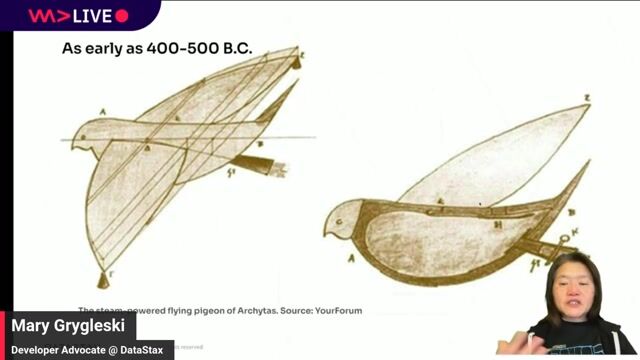
Storing machine learning data with specialized vector databases

Mary Grygleski Mary Grygleski · LIVE

2:04 min

Storing and querying vector data with native database features

Damir Damir · WWC 2025

1:36 min

Understanding vector databases and retrieval-augmented generation pipelines

Sandra Ahlgrimm Sandra Ahlgrimm +1 · WWC 2024

2:29 min

Retrieving semantic context using vector databases

Kevin Klues Kevin Klues

3:37 min

Demonstrating semantic latency reductions using Spring AI configurations

8:02 min

Mitigating language model costs with vector search patterns

Chris Heilmann +3 · LIVE

Upcoming sessions on this topic

Open session

World Congress 2026 North America

You Can’t Re-Run Sunlight: Designing ML Data Architectures for Physical AI

An Phan

Senior Data Infrastructure Engineer @ Hippo Harvest

An Phan
Open session

World Congress 2026 North America

Building Stuff with GenAI - The Open Minded Workshop beyond OpenAI

Andreas Erben

CTO for Applied AI and Metaverse at daenet

Andreas Erben
Open session

World Congress 2026 North America

Understanding LLM Architectures: Inside the Design of Modern Models

Jofia Jose Prakash

Enterprise AI Architect at American Chemical Society

Jofia Jose Prakash
Open session

World Congress 2026 North America

Beyond SQL Generation: How to Teach Agents What Your Database Actually Means

Kris Jenkins

Lead Developer Advocate at Snowflake

Kris Jenkins
Open session

World Congress 2026 North America

AI Agents are Only as Smart as their Context: Building a Real-Time Context Engine at Intuit

Bharat Patel

Lead Software Engineer at Intuit

Bharat Patel
Open session

World Congress 2026 North America

Making Science Larger, not just Faster

Yuval Dvir

Commercial Executive, SandboxAQ

Yuval Dvir