




WeAreDevelopers LIVE Dec 1, 2023

Creating a routing app with Google Maps API from scratch

Germán Álvarez

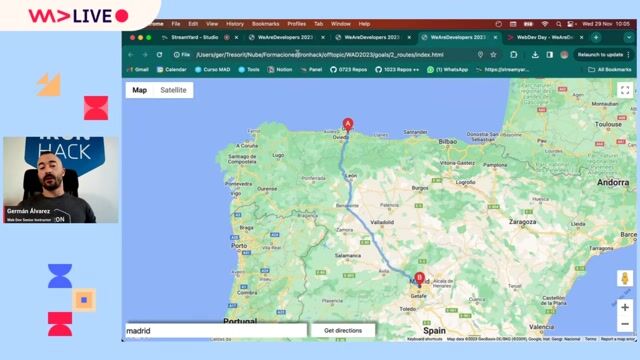
Transform a simple HTML element into a robust location-aware application. Master the Google Maps API, asynchronous geolocation, and dynamic route rendering from scratch.

Pause
Mute Enter Fullscreen
#1 about 2 min

Overview of the three Google Maps routing applications

Three instructional applications demonstrate foundational API capabilities spanning custom visual styling, physical geolocation tracking, and algorithmic route generation.

#2 about 8 min

Setting up the HTML structure and external dependencies

Setting up the foundational HTML document requires injecting third-party scripts, obtaining authentication keys, and explicitly defining container heights.

#3 about 4 min

Rendering the map instance and adding location markers

Generating a basic map view relies on specifying baseline zoom levels and geographical coordinates prior to appending location markers.

#4 about 3 min

Applying custom JSON styles to the map components

Map visual aesthetics are entirely overwritten by supplying a comprehensive JSON configuration object to the internal settings.

#5 about 12 min

Fetching and implementing device geolocation data via API

The internal navigator API prompts browsers to supply local device coordinates which dynamically reposition the digital map center.

#6 about 7 min

Creating the user interface for the routing application

Expanding the foundational HTML introduces interactive input elements and event listeners capable of capturing destination data strings.

#7 about 10 min

Fetching route details using the Directions Service API

The programmatic Directions Service instance accepts precise origin and destination values to algorithmically calculate optimal travel paths.

#8 about 3 min

Drawing the calculated route with the Directions Renderer

Validated navigational data sequences are physically sketched across the map topology using dedicated Directions Renderer instances.

#9 about 10 min

Final code walk-through and audience Q&A session

A summarized architectural review precedes discussions on maintaining API rate limits, masking authentication credentials, and deployment safety.

Matching moments

2:59 min

Rendering geographical maps with React Map GL

Daisy Muyldermans · LIVE

3:22 min

Demonstrating on-device indoor navigation in real time

Precious Osaro Precious Osaro · WWC Europe 2026

2:46 min

Migrating legacy mapping tools to current geocoding systems

Chris Heilmann +5 · LIVE

2:42 min

Executing a live multicloud routing demonstration

Alex Soto Alex Soto · LIVE

1:40 min

Building a modern interactive map with AI agents

Angie Jones Angie Jones · WWC 2025

2:20 min

Building a location-aware city sightseeing mobile application

Mario Bodemann Mario Bodemann

Upcoming sessions on this topic

Open session

World Congress 2026 North America

API = Some REST and HTTP, right? RIGHT?!

Rustam Mehmandarov

Passionate computer scientist

Rustam Mehmandarov
Open session

World Congress 2026 North America

Architecting AI in Angular: WebMCP, A2UI, and the Agent Experience

Ankita Sood

Sr. Principal Engineer @ Secureworks | Angular GDE

Ankita Sood
Open session

World Congress 2026 North America

How to generate business value through performance optimizations

Nikolai Sidiropulo

Software Engineer at Meta

Nikolai Sidiropulo
Open session

World Congress 2026 North America

Building Stuff with GenAI - The Open Minded Workshop beyond OpenAI

Andreas Erben

CTO for Applied AI and Metaverse at daenet

Andreas Erben
Open session

World Congress 2026 North America

Designing APIs That Survive AI Agents at Scale

Phani Pendurthi

Mastercard, Principal Software Engineer

Phani Pendurthi
Open session

World Congress 2026 North America

AI-Driven API Design

Mike Amundsen

Author, Adviser, Trainer

Mike Amundsen