Why chain abstraction is the best way to build successful web3 solutions for users
What if users could interact with any blockchain from a single account, without ever switching networks?
#1about 6 minutes
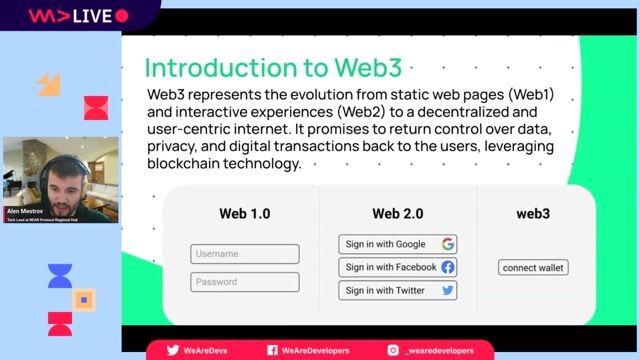
Understanding the evolution to Web3 and its fragmentation
Web3 offers user ownership through decentralization, but the current landscape of isolated blockchain islands creates significant barriers for users and developers.
#2about 2 minutes
Illustrating the poor user experience of fragmentation
A practical example demonstrates how a user must navigate multiple applications, wallets, and chains to complete a series of tasks, leading to a broken experience.
#3about 4 minutes
How chain abstraction creates a unified Web3 layer
Chain abstraction simplifies blockchain interactions by creating a unified layer that handles interoperability, allowing developers and users to focus on application functionality.
#4about 2 minutes
Reimagining the user journey with a single application
The previous user story is revisited to show how chain abstraction enables a seamless, single-app experience where all cross-chain actions happen in the background.
#5about 2 minutes
Empowering developers to innovate beyond technical barriers
Developers can access a broader user base across multiple chains and focus on creating value instead of managing complex cross-protocol communication.
#6about 3 minutes
NEAR's technical approach using chain signatures and EigenLayer
NEAR uses chain signatures, powered by EigenLayer, to allow smart contracts on its network to sign and execute transactions on other blockchains like Ethereum.
#7about 2 minutes
Envisioning a future powered by chain abstraction
The ultimate goal of chain abstraction is to create a fully interoperable digital ecosystem where users can interact with any application on any chain without friction.
#8about 7 minutes
Q&A on security, user experience, and interoperability
This section addresses transaction security through a dual quorum model with EigenLayer, the positive impact on user experience, and how chain signatures handle data interoperability.
#9about 6 minutes
Q&A on scalability, costs, and adoption goals
Discussion on handling different token standards via EigenLayer, how NEAR's architecture was built for scalability, and the method for batching transactions to manage costs.
#10about 9 minutes
Q&A on blockchain's impact and fundamental concepts
An overview of how blockchain brings transparency and ownership to traditional industries, how users interact with dApps, and the basics of transaction verification via consensus mechanisms.
#11about 7 minutes
Q&A on NEAR's advantages and the future of Web3
A summary of NEAR protocol's key advantages like scalability and low cost, the essential components for successful chain abstraction, and a look at future use cases.
Related jobs
Jobs that call for the skills explored in this talk.
Why Blockchain? A Developer’s PerspectiveFor many developers, blockchain feels like that one friend who keeps trying to sell you on their side hustle: persistent, occasionally confusing, and often surrounded by hype. But behind the buzzwords and market noise lies a technology with real engi...
Algorand Foundation
From Hype to Code: Real Blockchain Use Cases for DevelopersSo you’ve wrapped your head around why blockchain exists . You’re on board with the concepts: decentralization, immutability, and trust-minimized infrastructure. But now comes the real question:
What can you actually build with it?
This post is for d...
Christina Schaireiter
Why Attend a Developer Event?Modern software engineering moves too fast for documentation alone. Attending a world-class event is about shifting from tactical execution to strategic leadership.
Skill Diversification: Break out of your specific tech stack to see how the industry...