

BB
Benedikt Bischof
- Discuss this with your agent
- Open in Claude
- Open in ChatGPT
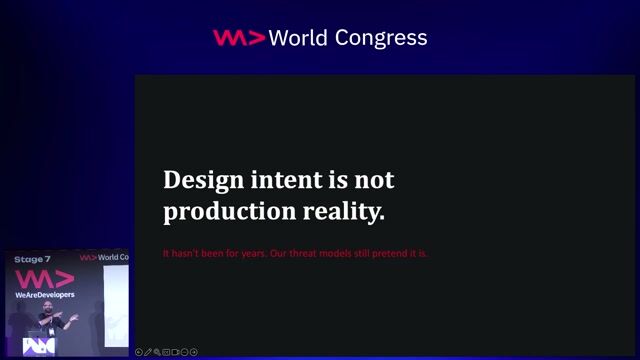
Stop treating security as an afterthought. Shift left with the STRIDE framework to catch and eliminate critical vulnerabilities before a single line of code is written.
Matching moments
3:07 min
Introducing collaborative threat modeling workshops in engineering teams
Bruno Amaro Almeida · World Congress 2022
1:32 min
Pairing with teams for continuous threat modeling
Nazneen Rupawalla · World Congress 2022
2:31 min
Addressing insecure design through early threat modeling
 Christian Wenz · World Congress 2026 Europe
4:07 min
Implementing a continuous threat modeling pilot program
 Farshad Abasi · World Congress 2026 North America
2:35 min
Integrating security across the application development lifecycle
 Niels Tanis · World Congress 2022
2:00 min
Evolution of software development and threat modeling methodologies
Farshad Abasi · World Congress 2026 North America
More from World Congress 2024
Related videos
Related articles
.gif)
DC
Daniel Cranney

DC
Daniel Cranney

AB
Andre Braun, GitLab

From learning to earning
Jobs that call for the skills explored in this talk.
about 2 months ago
Senior Threat Intelligence Analyst

ZEISS Group
Jena, Germany
Expert
Profiling
Cybercrime
Mitre Att&ck
about 1 month ago
•
Verified
SoC Offensive Security Staff Engineer

Arm
Austin, United States
Experienced
$198k–268k
Remote
Network Security
21 days ago
•
Verified
Senior Product Security Architect

Expedia
Austin, United States
Expert
Remote
Agentic AI
Security Architecture
22 days ago
Security Engineer - Product - Remote

Qdrant
Madrid, Spain
Remote
Pulumi
DevOps
Terraform
11 days ago
Penetration Tester / Red team Specialist

Raiffeisen Bank International AG
Stans, Austria
€47k
Linux
OAuth
Scripting
2 months ago
Staff Developer Advocate, GitHub Security Lab

GitHub
United States
Experienced
$121k–323k
Remote
Git
Github
Databases