
World Congress 2024 Aug 20, 2024 Session details

Beyond Autocomplete: Local AI Code Completion Demystified

Daniel Savenkov

Stop risking proprietary code in the cloud. Discover how deeply integrated, quantized local models deliver lightning-fast, hallucination-free code completion directly inside your IDE.

Pause
Mute Enter Fullscreen
#1 about 2 min

Overview of local AI code completion capabilities

An introduction to a native feature that generates code suggestions without relying on cloud infrastructure.

#2 about 2 min

Analyzing cloud-based AI code completion architectures

How traditional large language models introduce potential security and latency problems by processing code externally.

#3 about 4 min

Designing small AI models for local execution constraints

Transitioning to tiny language models allows partial segment generation while respecting machine hardware limitations.

#4 about 5 min

Evaluating developer experience through early access AB testing

Balancing positive generation volume with explicit cancellation rates prevents feature annoyance from degrading user productivity.

#5 about 3 min

Enforcing semantic correctness via automated validation checks

Verifying model output against local project indexes ensures users never receive non-existent variables or syntactically invalid code.

#6 about 4 min

Predicting suggestion acceptance with intelligent filtering models

Training a dedicated decision tree on typing speed and context averts presenting redundant or ill-placed snippet insertions.

#7 about 2 min

Executing model inference directly on user endpoints

Utilizing low-level open-source engines enables rapid local token generation on modern consumer CPU and GPU architectures.

#8 about 2 min

Training specialized base models with memory quantization

Building language-specific networks from scratch and quantizing parameters to four bits keeps memory footprints under 500 megabytes.

#9 about 2 min

Accelerating pipeline iterations through offline simulated environments

Running the development environment in a headless mode systematically compares pipeline accuracy metrics before fielding expensive real-world tests.

#10 about 2 min

Structuring cross-functional teams for intelligent IDE features

Combining machine learning experts with core developers fosters a full-stack product approach for deploying robust coding assistants.

#11 about 5 min

Querying local execution handling and hardware optimization paths

Details around hardware acceleration support, model fine-tuning limitations, and broader integration roadmaps clarify the feature's future path.

Matching moments

2:41 min

Leveraging AI tooling for accelerated learning and productivity

Dan Mindru · Coffee With Developers

2:28 min

Early experiments in AI-driven developer productivity

Neel Sundaresan Neel Sundaresan +1 · World Congress 2026 Europe

2:19 min

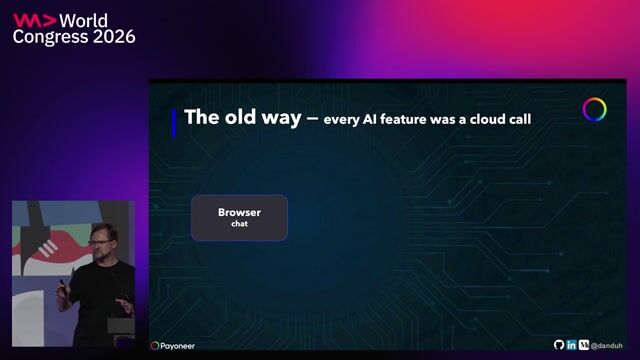
Drawbacks of cloud dependencies and local inference benefits

Christian Liebel Christian Liebel · World Congress 2025

1:49 min

Why developers should run AI models locally

Cedric Clyburn Cedric Clyburn +1 · World Congress 2025

1:21 min

Running local coding agents on consumer hardware configurations

Chris Heilmann +2 · LIVE

5:11 min

Developing a containerized AI code assistant locally

Cedric Clyburn Cedric Clyburn +1 · World Congress 2025

Upcoming sessions on this topic

Open session

World Congress 2026 North America

September 24, 2026 · 14:10–14:40

Stage 5

Edge AI: Running Agentic Intelligence Where Internet Can't Reach

Nitin Eusebius

AWS - Principal Solutions Architect

Nitin Eusebius
Open session

World Congress 2026 North America

September 25, 2026 · 13:30–14:00

Stage 1

The State of Local AI in 2026

Kirah Sapong

Co-founder & CTO at Aquaduck AI

Kirah Sapong
Open session

World Congress 2026 North America

September 24, 2026 · 15:30–16:00

Stage 7

Beyond Vibe Coding: Using CLI Tools as Your AI Counterpart in Pair Programming

Ron Veen

Java enthusiast and Special agent for Team Rockstars IT

Ron Veen
Open session

World Congress 2026 North America

September 23, 2026 · 13:40–14:10

Stage 2

Building an AI-Native Development Workflow

Vanessa Minik

Senior Service Delivery Engineer, GitHub

Vanessa Minik
Open session

World Congress 2026 North America

September 25, 2026 · 13:30–14:00

Stage 4

From Model Selection to Smart Routing: How to Use the Right LLM for Every Task

Viktoria Semaan

Principal Technical Evangelist at Databricks

Viktoria Semaan
Open session

World Congress 2026 North America

September 24, 2026 · 14:10–14:40

Stage 1

Anatomy of an AI Request: Where Latency and Cost Are Really Born

Dan Fu

VP of Kernels at Together AI

Dan Fu