
LM
Luis Minvielle
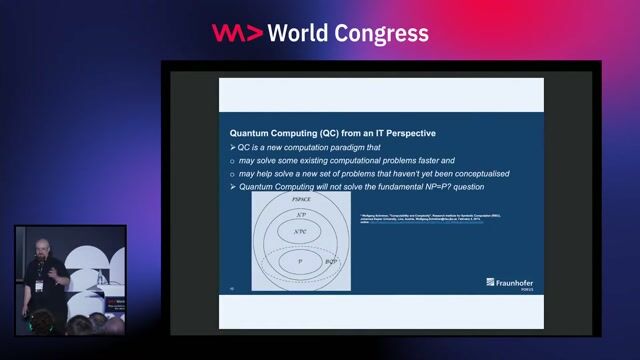
Quantum Computing for Classical Developers
- Discuss this with your agent
- Open in Claude
- Open in ChatGPT
Quantum processors are your next specialized coprocessors. Learn how to leverage superposition and entanglement to solve algorithmic bottlenecks standard hardware simply can't touch.
Matching moments
52 sec
Software development challenges in quantum computing ecosystems
 Alex Waldherr · World Congress 2024
3:00 min
Leveraging large quantitative models for intermediate quantum advantage
 Yuval Dvir +1 · World Congress 2026 Europe
8:17 min
Practical applications and hybrid solutions for quantum computing advantage
 Alexander Glätzle +3 · World Congress 2025
3:32 min
Redefining computing limits with quantum mechanics
Alexander Glätzle +3 · World Congress 2024
1:30 min
Executing tasks across classical and quantum computing systems
 John Fletcher +1 · World Congress 2026 Europe
1:18 min
Validating quantum-inspired methods against traditional computational approaches
Yuval Dvir +1 · World Congress 2026 Europe
More from World Congress 2024
Related videos
Related articles
.webp)
CH
Chris Heilmann

LM
Luis Minvielle
.webp)
DC
Daniel Cranney
From learning to earning
Jobs that call for the skills explored in this talk.
about 1 month ago
•
Verified
LLM Training Engineer

Sciforium
San Francisco, United States
Expert
$155k–220k
Python
about 2 months ago
CPU Technology Architect

ARM
Valbonne, France
Linux Kernel
Data Analysis
Computer Vision
about 1 month ago
•
Verified
Distributed Training and Inference Engineer
Sciforium
San Francisco, United States
Expert
$190k–250k
Linux kernel
18 days ago
Principal Software Engineer, AI Inference Runtime
ARM
Seattle, WA, United States
Expert
$262k
Compilers
Low Latency
Concurrency
about 2 months ago
Staff SoC Performance Architect - Next-Generation Server Platforms
ARM
San Diego, CA, United States
Expert
$198k–268k
SystemC
Profiling
InfiniBand
about 1 month ago
•
Verified
Lead Software Engineer, Model Serving Platform
Sciforium
San Francisco, United States
Expert
$230k–300k
Python