



What happens when a chip gets as hot as the sun? An NVIDIA architect explains how CUDA is solving the power wall problem in modern computing.
#1about 2 minutes
Gaining perspective by using the products you build
Transitioning from a creator to a user of CUDA provides critical insights and humility by revealing the incorrect assumptions made during development.
#2about 3 minutes
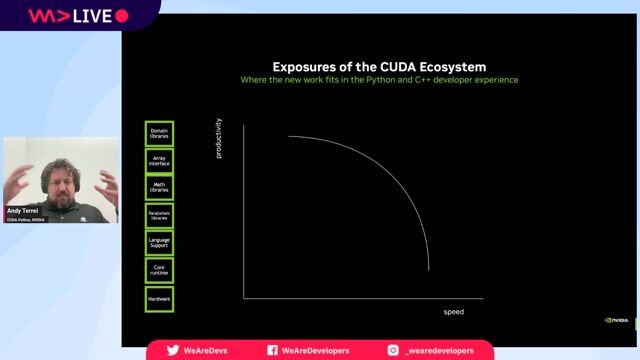
Understanding CUDA as a complete computing platform
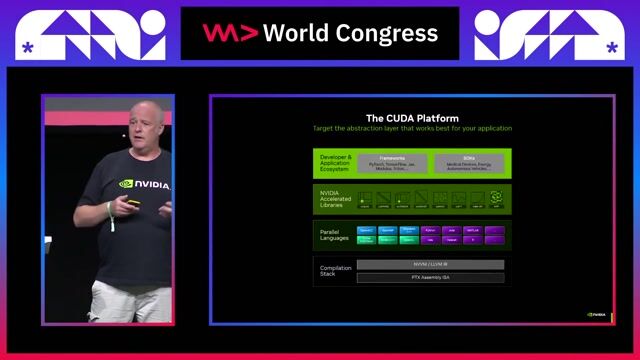
CUDA has evolved from a low-level language into a comprehensive platform of compilers, libraries, and SDKs that enable GPU access for multiple languages.
#3about 2 minutes
Supporting legacy languages like Fortran for scientific computing
CUDA supports languages like Fortran to accelerate existing codebases in supercomputing for fields such as physics and weather forecasting.
#4about 4 minutes
Why Python became the dominant language for AI
Python's large ecosystem, developer productivity, and vast talent pool made it the de facto language for AI, creating new challenges for parallel computing platforms.
#5about 3 minutes
The challenge of aligning long hardware and short software cycles
Developing new chips takes years of predictive work, creating a challenge to meet the rapidly changing demands of software, especially in the AI space.
#6about 3 minutes
How unexpected user adoption drives technological evolution
Technology evolves organically as users find novel applications for existing tools, such as using gaming GPUs for scientific computing and AI.
#7about 3 minutes
Why AI optimizations increase the demand for compute
Advances that make AI models cheaper or more efficient don't reduce overall compute demand; instead, they enable the creation of even larger and more powerful models.
#8about 3 minutes
The end of Moore's Law is a power consumption problem
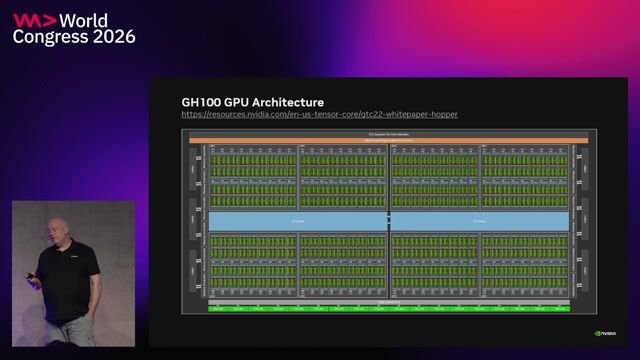
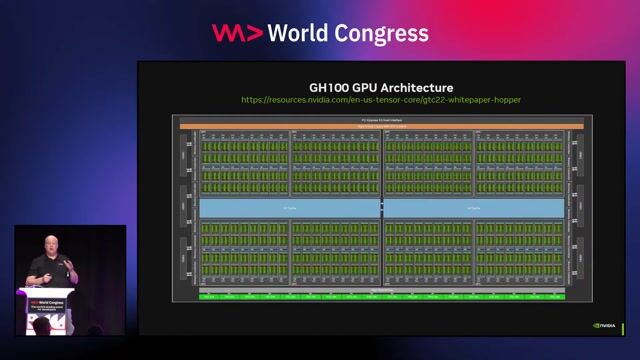
While transistor density still doubles, the power per transistor is not halving, creating a thermal and power delivery bottleneck for chip performance.
#9about 6 minutes
The future of computing requires scaling out to data centers
Overcoming power limitations requires moving from single-chip optimization to building large, networked, data-center-scale systems with specialized hardware.
#10about 4 minutes
The rise of neural and quantum computing paradigms
The future of computing will be a hybrid model combining classical, neural, and quantum approaches to solve complex problems using the best tool for each task.
#11about 3 minutes
How developers can contribute to the open source CUDA ecosystem
While low-level drivers are proprietary, the vast majority of CUDA's higher-level libraries like Rapids and Cutlass are open source and welcome community contributions.
Related jobs
Jobs that call for the skills explored in this talk.

What’s the latest in NVIDIA CUDA PythonPython and NVIDIA CUDA have long been friends. Over the last year, NVIDIA teams are working to improve the Pythonista’s experience. This means a top-to-bottom update to the CUDA Platform is fueling the GenAI movement, e.g. llama3, gpt and nemo. These...
Dev Digest 157: CUDA in Python, Gemini Code Assist and Back-dooring LLMsInside last week’s Dev Digest 157 .
🕹️ Pong in 240 browser tabs
👩💻 Gemini Code Assist free for 180k code completions a month
📰 AI is bad at coding and summarising the news
🕵️ Private GitHub repos show up in AI chats
🐍 CUDA for Python developers
🖥️ ...
Daniel Cranney
Coffee with Developers is Now Available as an Audio PodcastFor the past few years, we’ve had the privilege of meeting fascinating developers and tech professionals from around the world through our Coffee with Developers episodes. While all of the episodes are available in their original video format on our ...
From learning to earning
Jobs that call for the skills explored in this talk.