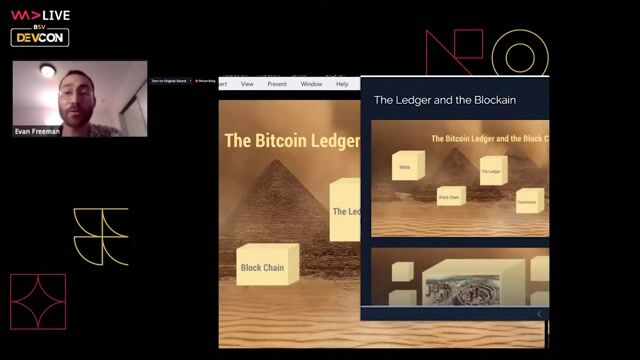
The Bitcoin blockchain isn't the ledger. It's the foundation for a global, triple-entry accounting system with massive scale.
#1about 5 minutes
The historical evolution of ledgers and record-keeping
Ledgers have evolved from ancient tally sticks to the double-entry system, with each advancement fundamentally changing society and commerce.
#2about 4 minutes
How Bitcoin blocks create an ordered public ledger
The Bitcoin ledger is composed of validated transactions, which are ordered and secured within a chain of blocks using hashes and proof of work.
#3about 3 minutes
Understanding the security model of proof of work
Altering a past transaction requires redoing the proof of work for that block and all subsequent blocks, making attacks economically costly and easily detectable.
#4about 2 minutes
How Merkle trees enable efficient data pruning
Nodes can discard old transaction data by using Merkle trees, which summarize all transactions into a single root hash in the block header.
#5about 4 minutes
Bitcoin as the first global triple-entry ledger
Bitcoin enhances the double-entry system by adding a third entry: a permanent, objective, and globally interoperable transaction record on the blockchain.
#6about 1 minute
The responsibility for storing transaction data
Users or specialized data archiving services are responsible for storing their own transaction data, creating a market for data curation and management.
#7about 1 minute
How Simplified Payment Verification (SPV) works
SPV enables users to verify the validity of their transactions by using only block headers, which is crucial for scaling the user experience.
#8about 4 minutes
The ledger as a distributed and specialized ecosystem
The global ledger exists as a distributed collection of data stored by specialized users and services, where any transaction can be validated against the chain of block headers.
#9about 4 minutes
Building a permanent and cooperative digital economy
The Bitcoin SV ledger provides a permanent, transparent, and secure data layer that reduces business costs and fosters global cooperation through shared information.
#10about 12 minutes
Q&A on data storage, nodes, and protocol stability
The discussion addresses community questions regarding node data storage obligations for large UTXOs, the definition of peers versus nodes, and the importance of a stable protocol.
Related jobs
Jobs that call for the skills explored in this talk.
Build With Bitcoin SVAt Bitcoin Association, we work to advance business using the Bitcoin SV (BSV) blockchain. A rebirth of the original Bitcoin, Bitcoin SV has restored the protocol to the specifications of creator Satoshi Nakamoto, resulting in a public blockchain cap...
Algorand Foundation
Why Blockchain? A Developer’s PerspectiveFor many developers, blockchain feels like that one friend who keeps trying to sell you on their side hustle: persistent, occasionally confusing, and often surrounded by hype. But behind the buzzwords and market noise lies a technology with real engi...
Algorand Foundation
From Hype to Code: Real Blockchain Use Cases for DevelopersSo you’ve wrapped your head around why blockchain exists . You’re on board with the concepts: decentralization, immutability, and trust-minimized infrastructure. But now comes the real question:
What can you actually build with it?
This post is for d...
Daniel Cranney
Dev Digest 177: Blockchain, jQuery and a Prompt PlaygroundInside last week’s Dev Digest 177 .
😫 Do AI tools slow down developers by 20%?
📝 The State of DevSecOps
⚠️ 2.3M Chrome and Edge browsers infected by malicious extensions
🤔 Is it still worth using jQuery?
🪦 10 dead influential programming languages
💻...
From learning to earning
Jobs that call for the skills explored in this talk.