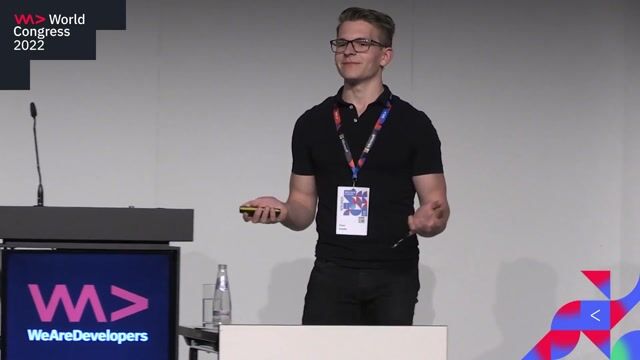
Timo Zander
In the Dawn of the AI: Understanding and implementing AI-generated images
#1about 3 minutes
The rise of advanced AI text-to-image synthesis
AI models like OpenAI's DALL-E 2 can now generate photorealistic and culturally specific images directly from natural language prompts.
#2about 4 minutes
How generative adversarial networks (GANs) work
GANs use a two-player system where a generator creates fake images and a discriminator judges them against real ones, forcing both to improve.
#3about 2 minutes
The mathematical foundation of the GAN training process
The training process is a min-max game governed by a value function, where the discriminator maximizes accuracy and the generator minimizes it by creating better fakes.
#4about 3 minutes
Overcoming mode collapse for diverse outputs
Mode collapse, where the generator produces limited variety, can be fixed by introducing a similarity check that penalizes a lack of diversity in outputs.
#5about 3 minutes
Fixing non-convergence and vanishing gradient issues
Address training deadlocks with a two-timescale update rule and solve the vanishing gradient problem by replacing sigmoid activation functions with ReLU.
#6about 4 minutes
Using progressive GANs for high-resolution image generation
Progressive GANs achieve high-resolution results by starting with a low-resolution image and gradually fading in new layers to increase detail during training.
#7about 3 minutes
Creating controllable landscapes with GauGAN
GauGAN allows users to control image generation by providing a segmentation map for layout and a style image to set the overall mood and color palette.
#8about 8 minutes
The future and ethical challenges of AI image generation
The Q&A session explores the societal impact of AI-generated images, including deepfake detection, AI safety, AI-powered editing, and legal ownership.
Related jobs
Jobs that call for the skills explored in this talk.
Matching moments
Featured Partners
Related Videos
Your imaginations is (no longer) the limit: how Generative AI empowers people to be creative
David Estevez
AI'll Be Back: Generative AI in Image, Video, and Audio Production
Fabian Pottbäcker, Thomas Endres & Martin Foertsch
Deepfakes in Realtime - How Neural Networks Are Changing Our World
Thomas Endres & Martin Förtsch & Jonas Mayer
Multimodal Generative AI Demystified
Ekaterina Sirazitdinova
The AI Elections: How Technology Could Shape Public Sentiment
Martin Förtsch & Thomas Endres
The shadows that follow the AI generative models
Cheuk Ho
DALL·E Flow: when neural search meets generative art
Han Xiao
The shadows of reasoning – new design paradigms for a gen AI world
Jonas Andrulis
Related Articles
View all articles


From learning to earning
Jobs that call for the skills explored in this talk.

Descripción De La Vacante
€40-70K
Azure
Python
PyTorch
TensorFlow
+1

Thalia
Thalia
Münster, Germany
API
GIT
Python
Docker
PyTorch
+4


University of East Anglia
Norwich, United Kingdom
Python
PyTorch
TensorFlow
Data analysis
Computer Vision
+2

MNK Group SA
Mechelen, Belgium
Intermediate
Azure
Python
PyTorch
TensorFlow
Machine Learning
+1


Accenture GmbH
Wolfsburg, Germany
Azure
PyTorch
TensorFlow
Machine Learning
Google Cloud Platform
+1

University of the Arts, London
Sleaford, United Kingdom
£34-41K
Python
PyTorch
TensorFlow

UL Solutions
Barcelona, Spain
Python
Machine Learning