

Stairway to Heaven - Scaling Frontends the Right Way
Are micro frontends the best way to scale your app? This talk explores a powerful alternative: the modular monolith.
#1about 6 minutes
Understanding the purpose and benefits of micro-frontends
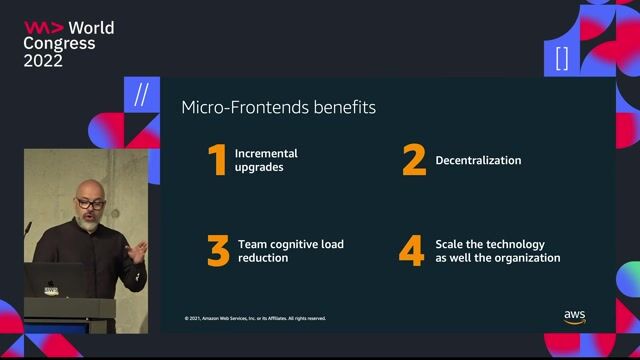
Micro-frontends are a software trend that enables scaling by splitting a large application into smaller parts developed by independent, agile teams.
#2about 2 minutes
Exploring the challenges and downsides of micro-frontends
Adopting micro-frontends can lead to challenges like increased bundle sizes, browser version mismatches, and the operational overhead of managing npm packages.
#3about 4 minutes
Introducing the modular monolith as a practical alternative
The modular monolith, managed within a monorepo, offers a balanced approach by ensuring version consistency and simplifying code sharing across the application.
#4about 6 minutes
Using Nx to manage and scale a frontend monorepo
The Nx toolset helps manage monorepos by visualizing dependencies and enforcing architectural boundaries between different domains using configurable linting rules.
#5about 7 minutes
A practical demonstration of an Nx workspace
This live demo showcases key Nx features, including generating a dependency graph, defining a library's public API, and enforcing domain boundaries with linting.
#6about 4 minutes
A strategic library structure for scaling applications
Organize monorepo libraries into distinct categories like feature, UI, domain, and utility to improve clarity and enforce strict access rules between layers.
#7about 2 minutes
Combining monorepos with micro-frontends for the best results
A hybrid approach uses a monorepo to develop isolated micro-frontends, gaining benefits like shared versioning and faster builds while maintaining deployment independence.
#8about 9 minutes
Q&A on monorepo processes and common challenges
The Q&A session addresses practical concerns such as coordinating package updates, assigning ownership of shared libraries, and managing circular dependencies.
Related jobs
Jobs that call for the skills explored in this talk.

Exploring TypeScript: Benefits for Large-Scale JavaScript ProjectsJavaScript is the backbone of web development, powering everything from small websites to large-scale enterprise applications. However, as projects grow in complexity, maintaining JavaScript code can become increasingly difficult. This is where TypeS...
Benjamin Ruschin
The HTML Elements That You’re Probably Over-EngineeringAs frameworks have become more and more commonplace in the world of web development, so too has the over-engineering of features made possible by our humble old friend, HTML.
The mental models that come with using state management in React, Vue and o...
Christina Schaireiter
Why Attend a Developer Event?Modern software engineering moves too fast for documentation alone. Attending a world-class event is about shifting from tactical execution to strategic leadership.
Skill Diversification: Break out of your specific tech stack to see how the industry...
Chris Heilmann
Micro Components - a different approach to a simpler component-based webThere has been a lot of heated discussion lately in the web community about component based development. One side argued that Web Components are a standard we should follow whereas others complained that they still lag behind in what frameworks offer...
From learning to earning
Jobs that call for the skills explored in this talk.