



Research Assistant - Data-driven analysis of dynamic systems and root cause analysis

Deutsches Zentrum für Luft- und Raumfahrt e. V.
Jena, Germany
14 days ago

Role details

Contract type
Permanent contract
Employment type
Full-time (> 32 hours)
Working hours
Regular working hours
Languages
English

Tech stack

Big Data Computer Programming Decision Support Systems Dynamical Systems Python (Programming Language) Machine Learning Data Driven Tests Information Technology Data Analytics

Job description

Dokumentation Forschung Machine Learning Python Top

At the Institute of Data Sciences in Jena, we are working to make the data backbone for all of DLR’s areas of application (aviation, space, energy, transport, security) a reality. To this end, we conduct interdisciplinary research and development into methods with a focus on applications such as sustainable and circular processes, resilient supply chains, data-driven value chains and robust decision support. The methods developed in this way are put into practice in cooperation with other DLR institutes and external partners, whether as part of joint projects or through technology transfer activities.

What to expect

The DW-DAI department develops and applies methods that enable the analysis of complex and large datasets. It draws on techniques from machine learning and causal inference, as well as domain-specific process knowledge.

The ‘Causal Inference’ group’s scientific objective is to contribute to a data-driven understanding of complex dynamic processes. To this end, the group develops and applies methods and software from the fields of causal inference and statistical learning. In doing so, the group adopts an application-driven approach. In addition to working closely with the users of these methods, this involves identifying needs arising from practical applications and addressing these needs through targeted further development of the methods. The group places a particular focus on time-series data. Furthermore, the group is active in the field of quantum machine learning.

Your tasks

  • Conducting literature reviews with the aim of critically evaluating methods and software from the fields of statistics, machine learning and dynamic systems, and adapting them for use in your own work (current state analysis)
  • Developing concepts for the (further) development of algorithms for data-driven analysis of dynamic systems and root cause analysis, e.g. for so-called root cause analysis
  • Putting these concepts into practice by implementing the algorithms in Python, and applying the implemented algorithms to synthetically generated test datasets and/or real-world datasets
  • Evaluating the performance of the algorithms through systematic assessment of the results of their application using appropriate metrics (e.g. sensitivity, specificity, computation time, etc.)
  • Documenting the implementation, the applications and the evaluation of the algorithms’ performance
  • Assessment of the work results with regard to patentability and, where appropriate, (collaborative) involvement in the patent application process
  • Preparation of the work results in the form of scientific papers for submission to specialist journals and/or scientific presentations for delivery at conferences, workshops, trade fairs, etc.

Requirements

  • A completed academic degree (Master’s / University Diploma) in Mathematics, Physics, Statistics, Computer Science, Data Science or another relevant field of study
  • Specialist knowledge in the areas of dynamic systems and statistical modelling
  • Initial experience in carrying out research tasks, preferably with a focus on dynamic systems as well as statistical and causal modelling
  • Very good programming skills in Python
  • Very good command of written and spoken English
  • Experience in producing scientific publications

Apply for this position

This job is hosted externally. Click below to view the full posting and apply.

Apply on www.get-in-it.de

Good distractions

Talks and stories from around this role — technically off-topic, practically not.

3:28 min

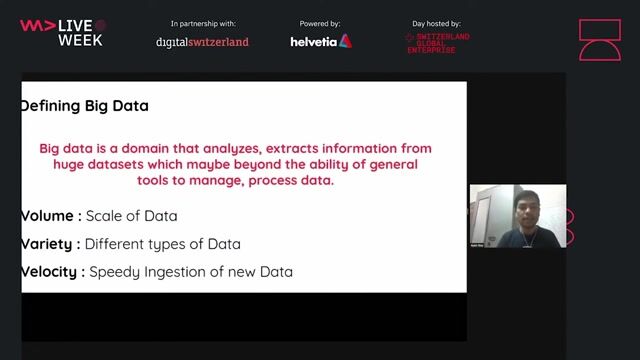
Defining big data and machine learning fundamentals

Ayon Roy · LIVE

1:32 min

Structuring platforms for new services and data analytics

Nevelina Aleksandrova · LIVE

2:36 min

Applying supervised machine learning for practical rule extraction

Katja Träumner

3:09 min

Balancing data science skillings alongside systems engineering rigor

Nico Schmidt · LIVE

2:10 min

Why organizations combine big data and machine learning

Ayon Roy · LIVE

2:35 min

Analyzing current and future IT talent shortages in Germany

Ingolf Teetz Ingolf Teetz · WWC 2024

Videos

See all

Related articles

See all