
After You Ship AI: 5 Signals to Monitor in Production
- Discuss this with your agent
- Open in Claude
- Open in ChatGPT
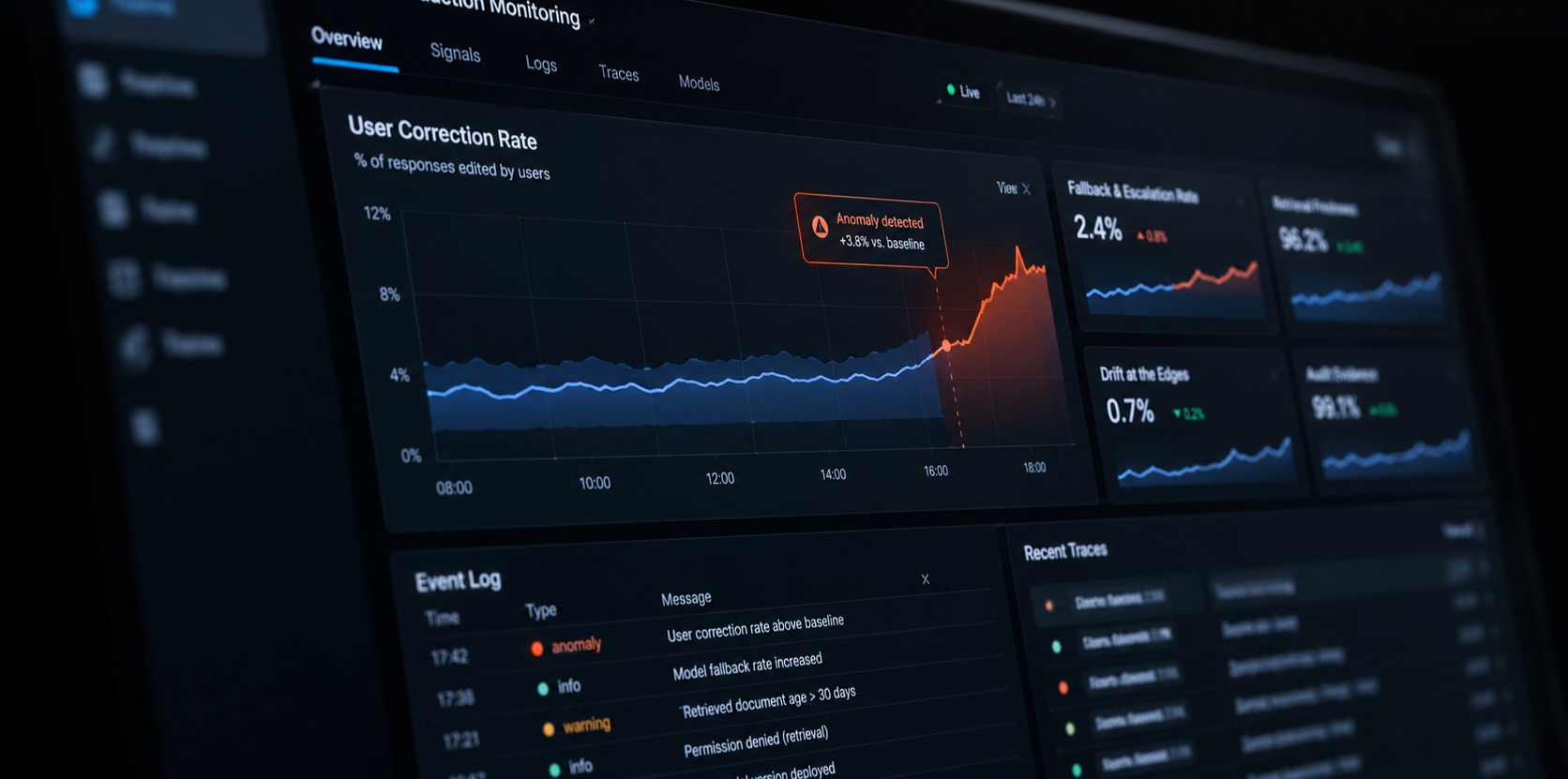
Trustworthy AI isn’t a launch checkbox. It’s something you keep observing.
A launch review can catch a lot of AI risks before users see them, but the launch is not the finish line, instead it is the moment the system meets real users, strange prompts and stale context.
This is where AI features tend to fail quietly. The API is up and latency looks fine, but users are correcting answers, avoiding the feature, or trusting outputs that should have been checked. Here are five signals to monitor once it goes live.
1. User correction rate
The clearest sign of quality degradation isn’t always a thumbs-down button. It’s what users do next. If people keep editing generated text, re-running prompts or discarding suggestions, the feature is making them put in extra effort to get a usable result.
If users have to clean up the output every time, is it saving work, or just moving it somewhere less visible?
2. Fallback and escalation rate: when the safety net does the product’s job
Fallbacks, escalations and refusals are good design. The problem starts when the safety net becomes the main path.
Rising fallbacks can mean more ambiguous or out-of-scope cases than expected. Rising escalations can mean the model is struggling with common workflows, not rare edge cases. A trustworthy system isn’t one that never falls back. It’s one where fallback behaviour is expected, measured and reviewed.
3. Retrieval freshness: when the model sounds right using old context
With retrieval-augmented features, the model often takes the blame for failures that start in the data path. If the retrieved context is stale, incomplete or missing permission checks, you get a confident answer built on the wrong evidence.
Monitor document age, empty retrieval rate and permission-denied attempts. Don’t just ask whether the model answered. Ask whether it answered from the right material.
4. Drift at the edges: when production stops looking like evaluation
Before launch, you test against known examples. After launch, users phrase things differently, policies change and new segments use the feature in unexpected ways.
Are input types changing? Are confidence scores shifting? Are failures clustering around new data or releases? Evaluation defines the baseline. Monitoring tells you whether production is still close enough to trust.
5. Audit evidence: when nobody can explain what happened
When an incident happens, the first question is: what happened? Which model version, prompt template and retrieved context were involved?
Auditability doesn’t mean logging everything, because logging too much sensitive content is a risk of its own. Good audit evidence is intentional: versions, policy triggers and override events. If your team can’t reconstruct why the system produced an output, it can only guess.
What to do next
Before release, you ask what the system is for, how it can fail and how it falls back. After release, those answers need to become live signals.
If you can’t see them, you’re just hoping the launch review was enough. Trustworthy AI starts at deployment, and it continues in production.