World Congress 2026 Europe Jul 10, 2026 Session details

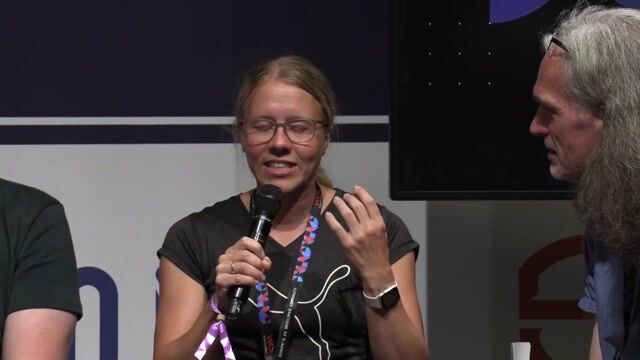
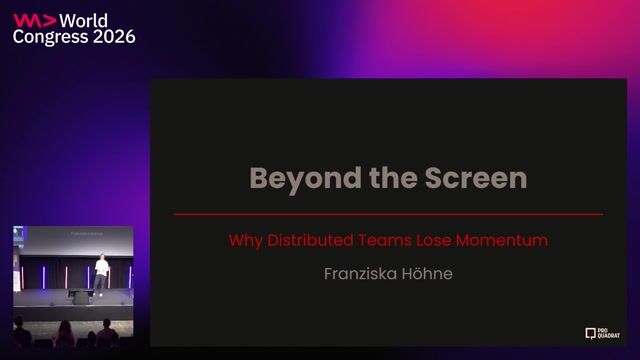
Why Distributed Teams Lose Momentum – Even When Everyone Means Well

Franziska Höhne

Why do well-meaning distributed teams lose momentum? Discover how deliberate vulnerability and explicit asynchronous workflows prevent your remote engineering colleagues from being treated like mere search engines.

Pause
Mute Enter Fullscreen
#1 about 3 min

Recognizing the hidden complexities of virtual team communication

The transition to remote work reveals that casual interpersonal skills are insufficient for complex digital alignment.

#2 about 3 min

Understanding the challenges of invisible virtual meeting environments

Working alongside muted participants and turned-off cameras creates profound uncertainty about attention and agreement.

#3 about 1 min

Recognizing critical information leaks in intercultural distributed teams

Information transfer in remote setups loses vital context through language barriers and environmental blind spots.

#4 about 2 min

Simulating visual deprivation in everyday remote communication

An interactive back-to-back speaking exercise demonstrates exactly how missing visual cues disrupt natural interpersonal dynamics.

#5 about 3 min

Interpreting silence and missing body language in remote calls

Missing physical gestures and obscured background contexts make it difficult to gauge team alignment or unspoken opposition.

#6 about 2 min

Giving spoken words the weight of physical room presence

Deliberate language choices must consciously compensate for the missing physical atmosphere in distributed engineering environments.

#7 about 3 min

Navigating language barriers and untranslatable idioms in international teams

Literal translations and cultural nuances like humor often create severe misunderstandings when non-native speakers collaborate remotely.

#8 about 3 min

Treating remote team members as people rather than functions

Sharing personal insights neutralizes the toxic dynamic of treating colleagues merely as silent information retrieval systems.

#9 about 3 min

Structuring asynchronous collaboration and operational expectations explicitly

Defining clear escalation processes and documentation norms establishes reliable team velocity without requiring constant synchronous meetings.

#10 about 2 min

Adopting a foundational framework of language, structure, and equality

A simple mental triangle helps technical practitioners anchor the three fundamental pillars of healthy distributed teamwork.

#11 about 3 min

Fostering active presence and digital engagement in remote teams

Leading by example and demonstrating authentic vulnerability establishes a robust foundation for inclusive remote workplace communication.

Matching moments

3:22 min

Maintaining team alignment across fully distributed global environments

Sue Quackenbush Sue Quackenbush · World Congress 2024

3:22 min

Navigating team alignment within distributed and remote workforces

Steffen Bosse Steffen Bosse +2 · World Congress 2024

1:47 min

Improving remote collaboration through deliberate documentation strategies

Tom George · LIVE

1:07 min

Addressing managerial resistance and visibility bias in remote teams

Krunoslav Koprivnjak Krunoslav Koprivnjak · Europe 2026 Virtual

3:35 min

Designing interactive social learning experiences for distributed remote teams

Erik Wiedenmann Erik Wiedenmann · Europe 2026 Virtual

2:08 min

Navigating and mitigating the impacts of broken engineering cultures

Oskar Kruschitz Oskar Kruschitz · Europe 2026 Virtual

Upcoming sessions on this topic

Open session

World Congress 2026 North America

September 24, 2026 · 14:10–14:40

Stage 4

Agentic Drift: keeping pace with your agents

John Coghlan

Senior Director, Developer Advocacy at GitLab

John Coghlan
Open session

World Congress 2026 North America

September 25, 2026 · 16:30–16:40

Outdoor Stage

12 Names for the Same Thing: Why Developer Experience Can't Grow Without a Common Language

Artem Mukhin

Software Engineer at Microsoft

Artem Mukhin
Open session

World Congress 2026 North America

September 24, 2026 · 16:10–16:40

Outdoor Stage

When Humans Stop Writing Code: Rethinking Languages, Compilers, and Responsibility

Simon Auer

Organizer of flutter vienna meetup and CEO of marqably

Simon Auer
Open session

World Congress 2026 North America

September 25, 2026 · 11:40–12:10

Stage 3

Culture Doesn't Scale Itself: Leading Engineering Teams Through Hypergrowth and the AI Transition

Thanos Baskous

VP of Engineering and Co-founder of Cogent Security

Thanos Baskous
Open session

World Congress 2026 North America

September 25, 2026 · 11:40–12:10

Outdoor Stage

GitHub’s Team X-Ray: Your Repository Knows More About Your Team Than Your Team Does

Andrea Griffiths

Senior Developer Advocate

Andrea Griffiths
Open session

World Congress 2026 North America

September 25, 2026 · 12:55–13:25

Outdoor Stage

Building the AI Era Through Developer Communities: A Competitive Advantage for Engineers & Teams

John Komarnicki

National Executive Advisor at Code & Coffee | Engineering & AI Community Leader

John Komarnicki