World Congress 2026 Europe Jul 10, 2026 Session details

The AI-Native Software Team: How Agents Are Rewriting the SDLC

Marcin Wawryszczuk

Individual AI coding assistants aren't enough. Orchestrating specialized agents across your SDLC enforces strict spec-driven development, slashing 20-hour architecture mapping tasks down to a single hour.

Pause
Mute Enter Fullscreen
#1 about 2 min

Scaling AI automation beyond code generation

While AI coding assistants offer significant productivity gains, automating the entire software delivery cycle unlocks greater overall project value.

#2 about 2 min

Finding the root bottleneck in software life cycles

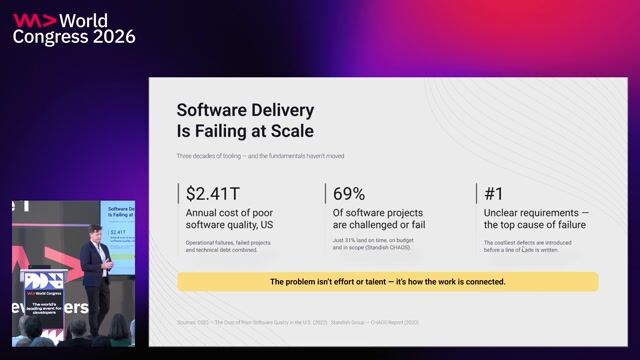
Research reveals that poor project outcomes stem from flawed requirements and excessive time spent on maintenance rather than active implementation.

#3 about 2 min

Shifting towards specification-driven AI development frameworks

The future of autonomous coding relies on strict specification-driven and test-driven development rather than unstructured AI prompting.

#4 about 2 min

Merging traditional workflows with AI-driven execution models

Combining familiar agile requirements with logical AI specifications bridges the gap between business planning tools and automated technical delivery.

#5 about 3 min

Navigating the five stages of AI development maturity

Moving from isolated AI assistance to autonomous delivery requires structured specifications to accurately communicate business intent to coding agents.

#6 about 2 min

Managing unpredictable business inputs with specialized agent triplets

Grouping specialized AI agents as creators, validators, and judges ensures proper requirement decomposition through necessary human-in-the-loop interactions.

#7 about 4 min

Standardizing software architecture with specialized workflow agents

Generating solution building blocks via AI reduces capacity bottlenecks and rapidly standardizes structural layout formats across varying engineering teams.

#8 about 2 min

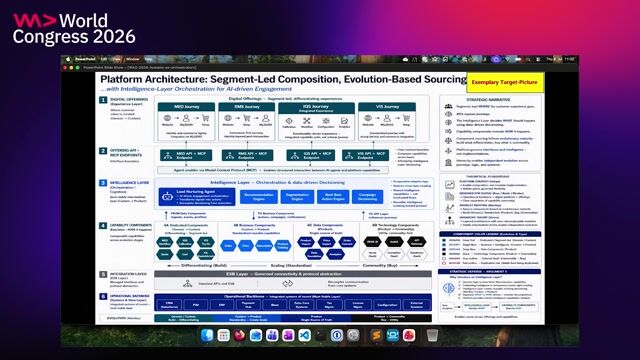
Orchestrating the foundational technology stack for autonomous delivery

Connecting requirements to deployment relies on a deterministic workflow governed by intertwined tools like code repositories and cloud orchestration services.

#9 about 2 min

Implementing skill packs and self-healing deployment routines

Stage-gated execution processes limit token costs while simultaneously equipping infrastructure pipelines with automated self-healing deployment mechanisms.

#10 about 5 min

Generating detailed functional requirements and project edge cases

Intelligent platforms actively prompt users for missing details to define strict acceptance criteria, validation rules, and inflexible infrastructure dependencies.

#11 about 2 min

Estimating implementation costs and managing continuous deployment sprints

Mapping historical duration estimates to AI output scenarios helps teams track absolute automation yield before locking specifications into the coding pipeline.

#12 about 2 min

Handling code generation and branch dependencies automatically

Smart automation systems enforce branch merging prerequisites prior to isolating new functional instances for unassisted code generation.

#13 about 2 min

Securing cluster deployments with continuous vulnerability scanning

Integrating native repository vulnerability scanners alongside dedicated image policies safely halts unverified or flawed deployment configurations from reaching clusters.

#14 about 2 min

Tailoring intelligent automation processes to individual organizational constraints

Initial platform adaptation periods remain essential because unique corporate data and highly custom deployment schemas cannot effectively utilize generic configurations.

#15 about 3 min

Reviewing AI outputs and adapting to compliance constraints

Establishing transparent final approval workflows and encoding strict institutional rules into automation variables minimizes customer hesitation and security risks.

#16 about 2 min

Gauging the required effort to build agentic platforms

Developing robust internal autonomous architecture layers requires substantial development commitments anchored by deep multidisciplinary engineering expertise.

Matching moments

4:08 min

Transitioning software engineering teams to AI-native development workflows

Florian Deter Florian Deter +4 · WWC Europe 2026

1:55 min

Shifting developer workloads and realistic AI productivity gains

Chris Heilmann +2 · LIVE

2:00 min

Integrating human engineers and autonomous agents in the SDLC

Laura Thorson Laura Thorson · WWC Europe 2026

2:34 min

Balancing developer autonomy with the adoption of coding agents

Clemens Wasner Clemens Wasner +4 · WWC Europe 2026

2:06 min

Rethinking team structures around AI agent capabilities

Mike Mike · WWC 2025

2:46 min

Building AI agents for software development life cycles

Shachar Azriel Shachar Azriel · WWC Europe 2026

Upcoming sessions on this topic

Open session

World Congress 2026 North America

AI ROI: The Hard Unit Economics of AI-Native Engineering

Manu Gurudatha

Manu Gurudatha, VP of Engineering at PagerDuty

Manu Gurudatha
Open session

World Congress 2026 North America

The Broken Rung: How AI is Rebuilding Software Development from the Ground Up

Tomislav Tipurić

Chief Technology Officer, Nephos

Tomislav Tipurić
Open session

World Congress 2026 North America

Agentic Drift: keeping pace with your agents

John Coghlan

Senior Director, Developer Advocacy at GitLab

John Coghlan
Open session

World Congress 2026 North America

From Idea to Production with AI: Agentic Development in Practice

Daniel Ostrovsky

UI/UX Architect at Payoneer | AI Architect | Full Cycle Development Expert | Public Speaker | Open Source Contributor |

Daniel Ostrovsky
Open session

World Congress 2026 North America

Beyond the Code: Human-AI Synergies in Product Development

Ajita Kanchivakam Ananth

Staff Technical Program Manager at Google

Ajita Kanchivakam Ananth
Open session

World Congress 2026 North America

Closing the Visibility Gap: Lessons from Safety Critical Agentic Systems

Vivek Pandit

Principal Engineer at Cadence

Vivek Pandit