
CH
Chris Heilmann
ZTA: Zero Token Architecture
- Discuss this with your agent
- Open in Claude
- Open in ChatGPT
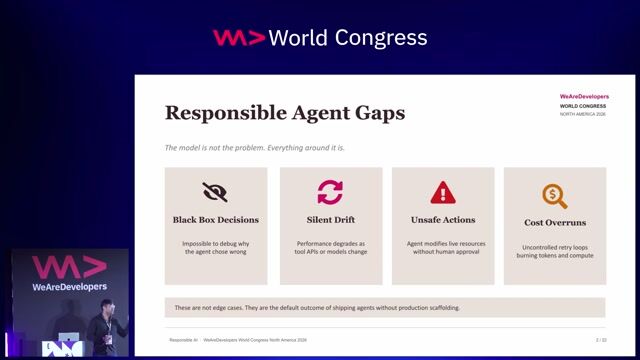
Continuous AI agents burn tokens and break zero trust security. Stop the endless inference loops. Embrace Zero Token Architecture to turn unpredictable AI into reliable, deterministic code.
Matching moments
2:02 min
Redefining the software architect role for AI pipelines
 Ingo Eichhorst · World Congress 2026 Europe
2:01 min
Transitioning toward AI-first coding and managing token costs
 Clemens Wasner +4 · World Congress 2026 Europe
2:34 min
Balancing developer autonomy with the adoption of coding agents
Clemens Wasner +4 · World Congress 2026 Europe
2:06 min
Rethinking team structures around AI agent capabilities
 Mike · World Congress 2025
4:09 min
Why AI tools will not replace human software developers
 Thomas Dohmke · World Congress 2025
3:33 min
Navigating developer bottlenecks and human accountability
 Werner Vogels +1 · World Congress 2026 Europe
More from World Congress 2026 North America
Related videos
Related articles
CH
Chris Heilmann

DC
Daniel Cranney
KP
Kamen Petroff
CH
Chris Heilmann
From learning to earning
Jobs that call for the skills explored in this talk.
26 days ago
Senior AI Developer

PwC
United States
Expert
Remote
Docker
Github
Fastapi
10 days ago
•
Verified
AI Software Engineer (Germany)

Sunhat
Berlin, Germany
Expert
€70k–100k
Remote
REST
TypeScript
AI Frameworks
25 days ago
Principal Software Engineer, AI Inference Runtime

ARM
Seattle, WA, United States
Expert
$262k
Compilers
Low Latency
Concurrency
2 months ago
Software Engineer - Video

Twilio
Austin, TX, United States
Experienced
$138k–203k
Remote
NoSQL
Nagios
Twilio
28 days ago
•
Verified
Head of Agentic AI / Lead AI Engineer

1st solution consulting gmbh
Barcelona, Spain
Expert
€70k–80k
Python
OpenAI API
AI Frameworks
25 days ago
Principal Software Engineer, AI Inference Cloud
ARM
Seattle, WA, United States
Expert
$262k
Pytorch
TensorRT
Kubernetes