

World Congress 2024 Aug 20, 2024

The Future of Computing: AI Technologies in the Exascale Era

Stephan Gillich , Tomislav Tipurić , Christian Wiebus , Alan Southall

Exascale AI demands gigawatt-level power, bottlenecking centralized data centers. Discover why custom accelerators and secure edge inference remain the only sustainable path forward.

Pause
Mute Enter Fullscreen
#1 about 4 min

Defining exascale computing and its relevance to AI

Exploring the origins of exascale computing in performance benchmarks and its impact on AI training capabilities.

#2 about 4 min

Comparing processing architectures for deep learning matrix operations

Specialized accelerators and advanced matrix extensions are essential for handling the massive throughput required by AI models.

#3 about 2 min

Optimizing AI processing capabilities for edge microcontrollers

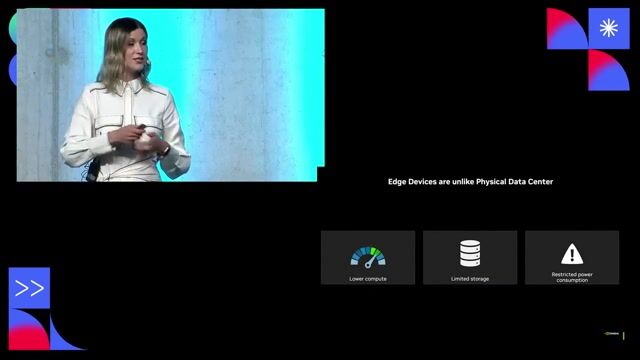
Applying machine learning processors at the edge improves service quality within restricted power budgets.

#4 about 5 min

Managing massive power consumption scaling in AI data centers

Migrating data pre-processing to edge neural processing units helps reduce carbon footprints and optimizes data center power.

#5 about 2 min

Ensuring security and trustworthiness in edge AI deployments

Implementing safe boot protocols and secure connectivity protects edge networks and distilled AI algorithms.

#6 about 6 min

Leveraging large language models for code optimization and development

AI agents and specialized software environments automate debugging, train neural networks, and optimize control algorithms.

#7 about 5 min

Exploring neuromorphic approaches and materials for sustainable computing

Novel materials like silicon carbide and brain-inspired neuromorphic chips address physical power limits for sustainable data processing.

#8 about 4 min

Building collaborative hardware architectures and developer startup ecosystems

Integrating pre-trained models across platforms and providing open environments fosters innovation among early-stage AI developers.

#9 about 4 min

Balancing distributed and centralized processing for energy efficiency

Hybrid cloud architectures minimize latency and energy utilization by performing high-volume data inference locally.

Matching moments

1:25 min

Addressing the sustainability and power consumption of AI

Christian Heilmann Christian Heilmann · WWC Europe 2026

2:26 min

Cost and latency pressures pushing AI to the edge

Moe Sani Moe Sani · WWC Europe 2026

2:35 min

Balancing AI competitiveness with compute efficiency demands

Markus Hacker Markus Hacker +1 · WWC 2025

2:44 min

Navigating power limitations for AI infrastructure

Michael Kagan Michael Kagan +1 · WWC Europe 2026

2:42 min

Dissecting artificial intelligence layers from compute to applications

Christian Nagel Christian Nagel +3 · WWC Europe 2026

3:57 min

Strategies for accelerating innovation and maximizing AI value

Stephan Gillich Stephan Gillich · WWC 2024

Upcoming sessions on this topic

Open session

World Congress 2026 North America

You Can’t Re-Run Sunlight: Designing ML Data Architectures for Physical AI

An Phan

Senior Data Infrastructure Engineer @ Hippo Harvest

An Phan
Open session

World Congress 2026 North America

Autonomous Infrastructure: Building AI Agents for Global-Scale Capacity Efficiency

Gregoire Colin, Tommy Tran

Gregoire Colin
Tommy Tran
Open session

World Congress 2026 North America

Compute for your AI model: GPUs, LPUs, TPUs and beyond..

Kushaagra Goyal

Tech Lead at Rubrik, ex-CTO at Gan.AI, ex-Databricks

Kushaagra Goyal
Open session

World Congress 2026 North America

Building Stuff with GenAI - The Open Minded Workshop beyond OpenAI

Andreas Erben

CTO for Applied AI and Metaverse at daenet

Andreas Erben
Open session

World Congress 2026 North America

Trust, But Verify: Continuous GPU Validation at Scale

Kyle Bell

VP of AI @ TensorWave

Kyle Bell
Open session

World Congress 2026 North America

Making Science Larger, not just Faster

Yuval Dvir

Commercial Executive, SandboxAQ

Yuval Dvir