
World Congress 2024 • Aug 20, 2024 • Session details

AI Factories at Scale

Thomas Schmidt

Generative AI demands a shift from legacy CPUs to high-density GPU clusters. Learn how to architect scalable AI factories that slash compute energy usage.

Pause
Mute Enter Fullscreen
#1 about 3 min

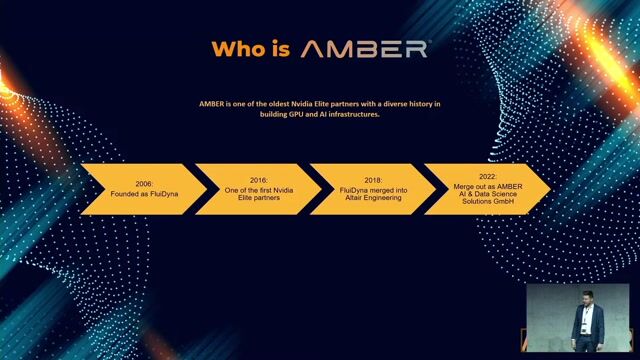
Amber's evolution as a pioneer in GPU acceleration

How early fluid dynamics research evolved into a foundational enterprise partnership with Nvidia for AI infrastructure.

#2 about 3 min

Milestones driving the rapid evolution of generative AI

Landmark computing breakthroughs like CUDA and transformers dramatically accelerated the foundational capabilities of artificial intelligence models.

#3 about 3 min

Financial impacts of generative AI across the enterprise

Pushing early generative artificial intelligence experimentation into real-world use cases creates significant return on investment for enterprises.

#4 about 2 min

Contrasting legacy supercomputers with modern AI clustered infrastructure

The modern DGX H100 provides exponential performance improvements at a fraction of the cost and compute footprint of traditional supercomputers.

#5 about 3 min

Replacing legacy CPUs to reduce data center energy consumption

Transitioning high-intensity workloads from CPUs to specialized GPUs significantly lowers global energy constraints while preventing thermal overload.

#6 about 2 min

Escalating compute demands for production generative AI inference

The transition toward production software integration multiplies infrastructural demands required to serve transformer models asynchronously.

#7 about 3 min

Core infrastructure components required for an AI factory

Essential deployment layers combine internal cluster networking, advanced storage structures, and modular temperature controls to finalize AI architecture.

#8 about 1 min

Deploying an immediate AI center of excellence via superpods

Turnkey clusters establish scalable reference structures directly optimized for massively parallel application training deployments.

#9 about 5 min

Managing the AI cluster using stack synchronization software

Dedicated management software resolves complex stack synchronization, coordinates hybrid cloud workloads, and proactively monitors cluster networking health.

#10 about 1 min

Allocating GPU resources and implementing multi-tenant usage chargebacks

Defining specific multi-instance constraints permits scalable resource allocation while allowing enterprises to accurately attribute processing costs to specific users.

#11 about 2 min

High-performance storage necessities for continuous large LLM training

Specialized high-bandwidth storage tiers bypass input bottlenecks that frequently stall training sequences during comprehensive model checkpointing.

#12 about 3 min

Adapting data center environments for direct liquid immersion cooling

Upgrading physical infrastructure arrays toward integrated immersion tanks safely manages the vast thermal footprints generated by emerging inference parameters.

Matching moments

2:00 min

Shifting from single models to specialized AI infrastructure

Emmanuel Acheampong Emmanuel Acheampong · World Congress 2026 North America

1:25 min

Addressing the sustainability and power consumption of AI

Christian Heilmann Christian Heilmann · World Congress 2026 Europe

2:12 min

Transitioning from data centers to AI factories

Michael Kagan Michael Kagan +1 · World Congress 2026 Europe

1:29 min

Tech infrastructure capacity and AI product innovations

4:03 min

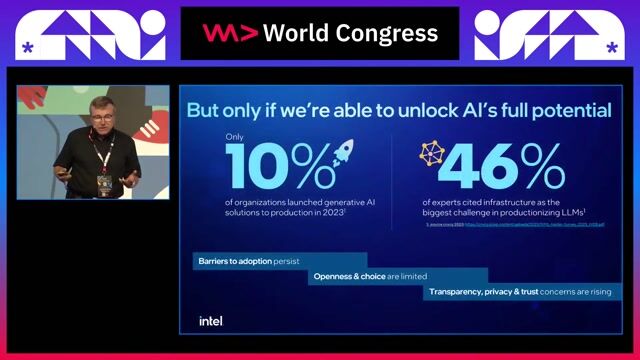
Managing massive power consumption scaling in AI data centers

Stephan Gillich Stephan Gillich +3 · World Congress 2024

2:35 min

Balancing AI competitiveness with compute efficiency demands

Markus Hacker Markus Hacker +1 · World Congress 2025

Upcoming sessions on this topic

Open session

AI Is the Easy Part: Why Faster Engineers Don't Make Faster Businesses

  • Bharat Sharma

    Booking

    Senior Engineering Manager

Open session

Build a Zero-Cost AI Agent in Your Browser

  • Aishwarya Mathuria

    Adobe

    Computer Scientist

  • Nishant Thakur

    Adobe

    Senior Computer Scientist

Open session

From Prompt Engineering to Harness Engineering: Building Observable and Governed GenAI Systems

  • Lakshmi Devi Prakash

    JPMorgan Chase

    VP, Applied AI/ML Lead

Open session

How is SWE & EM roles are changing in the age of AI

  • Amol Sharma

    Stripe

    Engineering Manager

Open session

Architecting Trusted AI: Coupling Multi-Agent Systems with dbt Semantic Store for Zero-Hallucination

  • Pushkar Mishra

    J.P. Morgan

    Senior Vice President

Open session

Teaching AI Coding Agents to Build It Right the First Time

  • Sajeetharan Sinnathurai

    Microsoft

    Principal Product Manager