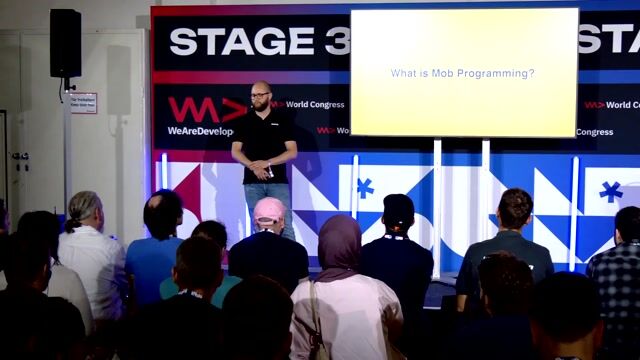
Joshua Töpfer

Remote Mob Programming - At home, but not alone

What if your new hires could ship code to production on their first day? See how remote mob programming makes onboarding incredibly efficient.

Remote Mob Programming - At home, but not alone
#1about 2 minutes

Understanding the core concepts of mob programming

Mob programming involves the whole team working on one task at the same computer, with one person acting as the typist in rotation.

#2about 3 minutes

The tools and workflow for remote mob programming

A remote mob uses a virtual team space, screen sharing, and a git-based tool like mob.sh to hand over control between typists.

#3about 3 minutes

Gaining momentum by focusing on time-to-market

Mob programming accelerates delivery by eliminating context switching, asynchronous code reviews, and unnecessary meetings.

#4about 2 minutes

Making explicit and collaborative architectural decisions

By discussing implementation details openly, teams can make architectural decisions explicit and document them with ADRs when needed.

#5about 4 minutes

Improving code quality and accelerating team learning

Continuous collaboration leads to higher code quality, a pragmatic codebase, a reduced bus factor, and effortless onboarding for new members.

#6about 2 minutes

Navigating the challenges of time zones and conflict

Successful mob programming requires managing time zone differences and addressing team conflicts with the help of a coach and frequent retrospectives.

#7about 2 minutes

Reducing dependencies and understanding personality fit

Teams must have end-to-end responsibility to avoid waiting, and leaders must recognize that this intense collaboration is not suitable for everyone.

#8about 2 minutes

Practical steps for starting with mob programming

Teams can begin by running a full-time experiment for one sprint, attending a workshop, or joining an open mobbing community.

#9about 2 minutes

How mobbing creates focus and high-performing teams

The speaker shares personal benefits including improved focus, continuous learning, stronger team trust, and better work-life balance.

#10about 4 minutes

Answering common questions about mob programming

Key questions are addressed regarding optimal team size (3-5 people), mixing skill levels, and creating a safe space to encourage participation.

Related jobs
Jobs that call for the skills explored in this talk.

Featured Partners

Related Articles

View all articles
DC
Daniel Cranney
Mastering Remote Work: Tips for Developers
Remote work has become the norm for many developers across Europe, offering flexibility, freedom, and access to global job opportunities. Here at WeAreDevelopers, many of our team remotely, based around Europe in a variety of roles, and we’re not the...
Mastering Remote Work: Tips for Developers
CS
Christina Schaireiter
Remote, Hybrid, or In-Office: What’s Really Best for Developers?
Five years ago, in the midst of a global pandemic, it seemed like we were at the beginning of a remote work revolution. At a time of huge uncertainty and mass layoffs impacting every industry, hitting tech particularly hard, companies scrambled to ad...
Remote, Hybrid, or In-Office: What’s Really Best for Developers?
LM
Luis Minvielle
Remote Work: Best Practices for Developers
Anyone who has ever worked remotely knows that it's not a walk in the park (it’s actually a lot of sitting in front of screens big and small).We are here to give you some down-to-earth advice and practical tips to make your remote work experience bea...
Remote Work: Best Practices for Developers

From learning to earning

Jobs that call for the skills explored in this talk.

Fullremote

Devsecops

40-60K
Azure
Linux
Jenkins
Terraform
+3