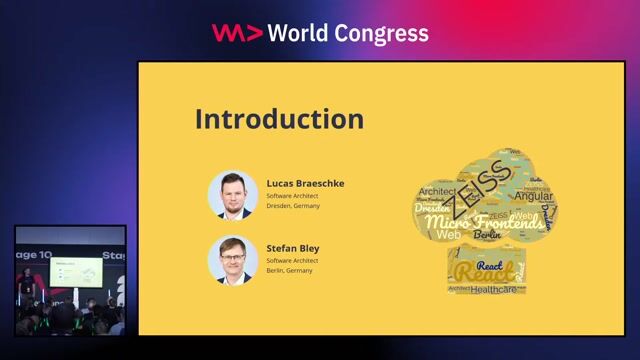
The Dependency Cookbook - Recipes for Micro Frontend success
What happens when a dependency update breaks your entire micro frontend? This talk offers the recipes for a resilient, scalable architecture.
#1about 3 minutes
The challenge of dependencies in regulated micro frontends
A complex healthcare application's move to micro frontends highlights the business risk of dependency conflicts, where technical upgrades can force feature deactivation.
#2about 2 minutes
Four key reasons for sharing dependencies in micro frontends
Sharing dependencies improves performance by reducing bundle sizes, ensures UI consistency, prevents runtime errors from incompatible libraries, and simplifies security patching.
#3about 2 minutes
Categorizing dependencies from easy to very hard
Dependencies can be classified as easy (small, stateless), tricky (large, global state), or very hard (singletons like PDF.js that cannot coexist in multiple versions).
#4about 2 minutes
Defining core use cases for dependency management
A robust solution must support using multiple dependency versions, sharing large libraries like Angular, and unifying versions to apply critical security fixes efficiently.
#5about 3 minutes
Using native browser import maps for dependencies
Import maps offer a native, library-free way to manage dependencies by mapping specifiers to URLs, enabling lazy loading but currently limited to a single map per page.
#6about 4 minutes
Managing dependencies with Webpack's Module Federation
Module Federation provides a bundler plugin to share dependencies, negotiate compatible versions at runtime, and allow micro frontends to use their own fallbacks if a match isn't found.
#7about 4 minutes
Choosing a strategy and final recommendations
The choice between native import maps and a framework like Module Federation depends on scale, but it is critical to plan for dependency management and singleton conflicts early.
Related jobs
Jobs that call for the skills explored in this talk.
Micro Components - a different approach to a simpler component-based webThere has been a lot of heated discussion lately in the web community about component based development. One side argued that Web Components are a standard we should follow whereas others complained that they still lag behind in what frameworks offer...
Daniel Cranney, Chris Heilmann
Dev Digest 215: Agent Memory, JS2026, Googlebot Analysis & Canvas❤️HTMLInside last week’s Dev Digest 215 .
🗿 Make AI talk like a caveman
🧠 A guide to context engineering for LLMs
🤖 Simon Willison on agentic engineering
🔐 Axios supply chain attack post mortem
🛡️ Designing AI agents to resist prompt injection
🎨 HTML in c...