
World Congress 2025 Aug 20, 2025 Session details

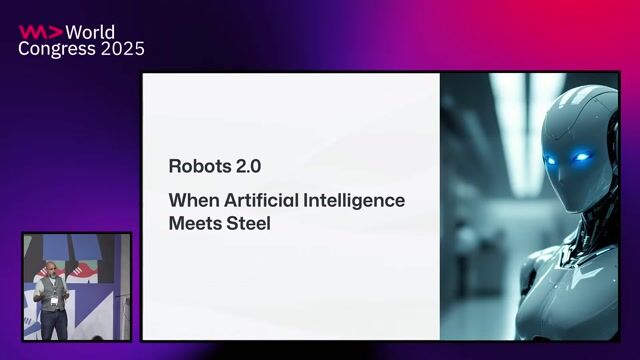
Robots 2.0: When artificial intelligence meets steel

Thomas Tomow

Embodied AI is moving from simulation to reality. Master ROS2, sensor fusion, and hardware abstraction to build the next generation of autonomous robots.

Pause
Mute Enter Fullscreen
#1 about 1 min

AI transcending software to enter the physical world

Artificial intelligence is moving beyond screen interfaces to interact directly with physical environments through robotics.

#2 about 3 min

Historical parallels in technological paradigm shifts

Past innovations like electricity and automobiles demonstrate how skeptical audiences eventually adapt to transformative technological changes.

#3 about 1 min

Transitioning artificial intelligence into physical manifestations

Large language models are evolving from digital chatbots into physical entities that interact with complex real-world environments.

#4 about 2 min

The evolution of artificial helpers and industrial machines

The pursuit of robotic labor spans from visionary historical concepts to highly efficient modern logistical warehouses.

#5 about 4 min

Capabilities of state-of-the-art modern humanoid robots

Leading platforms from companies like Tesla and Boston Dynamics showcase unprecedented robotic dexterity and environmental interaction.

#6 about 2 min

Core drivers fueling modern robotic capabilities

Exponential advances in language models, accelerated hardware chips, and extensive simulation data converge to power cognitive machines.

#7 about 1 min

Processing real-world environments with vision language models

Vision language models act as central intelligence hubs by fusing visual input with semantic understanding for autonomous decisions.

#8 about 2 min

Automating complex industry operations with embodied intelligence

Autonomous robots execute precision tasks across automotive manufacturing, food safety logistics, and sensitive hospital environments.

#9 about 2 min

Navigating hardware constraints and edge computing challenges

Engineering interactive robots requires overcoming significant battery power limits and latency constraints to maintain operational safety.

#10 about 1 min

Leveraging open source frameworks and environmental simulation

Developers construct rapid autonomous systems utilizing specialized operating layers alongside localized small language models and virtual testing environments.

#11 about 3 min

Bridging foundational coding with autonomous robotic navigation

Developing autonomous robotic behavior forces engineers to account for numerous edge cases inherent in uncontrollable physical spaces.

#12 about 4 min

Structuring mechanical commands through software abstraction layers

Standardized operating sets translate high-level software instructions into granular mechanical actions for precise physical execution.

#13 about 2 min

Mapping physical environments via extensive sensor fusion

Synthesizing two-dimensional camera feeds with point cloud data enables machines to construct accurate three-dimensional operational maps.

#14 about 2 min

Processing real-time spatial data for structural navigation

Live ingestion of integrated camera and depth statistics provides immediate feedback loops for accurate trajectory planning.

#15 about 5 min

Executing selective object identification through edge processing

Coupling visual streams with localized language models enables complex filtration commands despite unstable hardware dependencies.

Matching moments

1:20 min

Shifting focus from large language models to physical AI

Sergio Perez Sergio Perez · WWC Europe 2026

3:46 min

Transitioning from rigid machines to autonomous AI robots

Teresa Conceicao · WWC 2022

2:55 min

Moving from AI software buzzwords to building actual robots

Iulia Feroli Iulia Feroli · WWC Europe 2026

2:22 min

Introduction to physical AI and the physical world

Moe Sani Moe Sani · WWC Europe 2026

2:08 min

Progressing from standard robotics to cognitive learning systems

Clemens Schwaiger · LIVE

3:55 min

Technical catalysts driving real-world artificial intelligence

Clemens Wasner Clemens Wasner +3 · WWC Europe 2026

Upcoming sessions on this topic

Open session

World Congress 2026 North America

You Can’t Re-Run Sunlight: Designing ML Data Architectures for Physical AI

An Phan

Senior Data Infrastructure Engineer @ Hippo Harvest

An Phan
Open session

World Congress 2026 North America

Building Stuff with GenAI - The Open Minded Workshop beyond OpenAI

Andreas Erben

CTO for Applied AI and Metaverse at daenet

Andreas Erben
Open session

World Congress 2026 North America

From Software Agents to Physical Devices: Inside the Agentic Hardware Stack

Vivian Hu, Michael Yuan

Vivian Hu
Michael Yuan
Open session

World Congress 2026 North America

RoboCoders: Judgment Day: AI-Assisted Engineering Applied - The Battle of Agents

Viktor Gamov, Baruch Sadogursky

Viktor Gamov
Baruch Sadogursky
Open session

World Congress 2026 North America

The Broken Rung: How AI is Rebuilding Software Development from the Ground Up

Tomislav Tipurić

Chief Technology Officer, Nephos

Tomislav Tipurić
Open session

World Congress 2026 North America

Closing the Visibility Gap: Lessons from Safety Critical Agentic Systems

Vivek Pandit

Principal Engineer at Cadence

Vivek Pandit