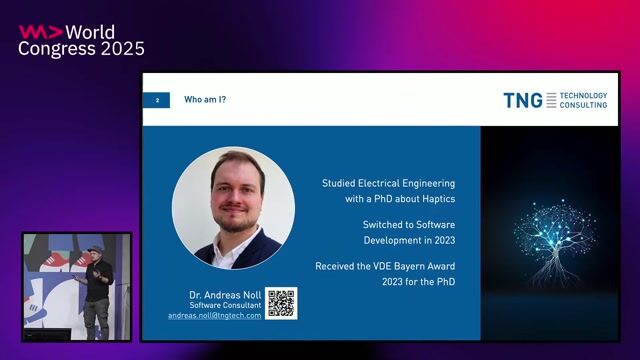
Can You Touch the Internet? A Journey in Remote Touch With Edge Computing and Haptic Coding
What if an AI could not only see and speak, but also hug you? This talk explores the technology making remote touch a reality.
#1about 4 minutes
Introducing remote touch and the field of haptics
Haptics aims to digitize the sense of touch, similar to audio and video, enabling applications from remote surgery to immersive gaming.
#2about 2 minutes
Understanding the two components of human touch
The human sense of touch is composed of the kinesthetic sense for forces and movement and the tactile sense for surface textures like roughness and warmth.
#3about 2 minutes
Exploring the hardware that digitizes touch sensations
Various devices, from force-feedback styluses to wearable finger sensors, are used to capture and reproduce both kinesthetic forces and tactile vibrations.
#4about 4 minutes
Solving latency and stability with edge computing
Transmitting kinesthetic data requires extremely low latency, which is achieved by reducing packet rates based on human perception and using edge computing for local stability control.
#5about 2 minutes
Compressing tactile data with haptic coding
A specialized haptic codec compresses tactile vibration data by removing non-perceivable signals and clustering similar channels, reducing data rates significantly.
#6about 2 minutes
Considering the future and philosophical impact of AI touch
As haptic technology advances alongside other AI capabilities, it raises profound questions about our future relationship with machines that can see, hear, and feel.
Related jobs
Jobs that call for the skills explored in this talk.
5 Reasons Why Attending Conferences in 2026 Matters More Than You ThinkIt’s 2026, and the “remote vs. office” debate has finally settled into a high-tech hybrid reality. While we’ve perfected the art of shipping production-grade code from decentralized hubs and home setups, something shifted. We realized that while AI c...
Luis Minvielle
5 Future Technologies Coming in 2025As we outlined last year, there are three reasons for making predictions: because planning things helps us make better decisions; because if we don’t make them, everything would surprise us; and, finally, because it’s just a fun thing to do. And sinc...















.webp?w=240&auto=compress,format)