World Congress 2025 Aug 20, 2025 Session details

Agentic AI - From Theory to Practice: Developing Multi-Agent AI Systems on Azure

Ricardo

Move beyond basic chat interfaces. Learn how to build, evaluate, and scale specialized multi-agent AI workflows on Azure using Semantic Kernel and robust CI/CD evaluators.

Pause
Mute Enter Fullscreen
#1 about 2 min

Shifting from chat interfaces to integrated AI agents

Embedding AI natively into business processes removes the need for manual chat interfaces.

#2 about 2 min

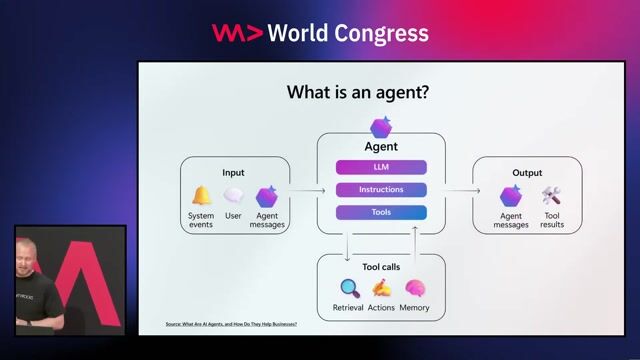
Core components of an AI agent architecture

Combining a large language model with specific instructions and tool access enables automated reasoning and execution.

#3 about 2 min

Resolving developer challenges in AI agent implementation

Identifying the right model, ensuring content safety, and maintaining observability are critical hurdles when bringing AI into production.

#4 about 2 min

Managing AI development with Azure AI Foundry

A centralized suite provides model catalogs, agent services, built-in integrations, and unified observability for enterprise AI development.

#5 about 2 min

Orchestrating enterprise agents via the Agent Service

An orchestration layer simplifies integration with existing SDKs, enterprise networks, knowledge bases, and industry protocols like MCP.

#6 about 2 min

Aligning AI projects across standard development phases

Creating successful AI products requires moving deliberately from ideation and rapid testing into robust implementation and operational monitoring.

#7 about 2 min

Testing AI models quickly using GitHub Models

A vast catalog of models can be explored and tested directly in the browser without requiring immediate infrastructure provisioning.

#8 about 3 min

Balancing prompt performance and model cost efficiency

Running systematic evaluations across different prompts, models, and datasets is essential to find the right balance between output quality and expense.

#9 about 2 min

Connecting agents to business tools and APIs

Configuring agents within Azure AI Foundry involves attaching them to internal REST APIs, existing files, and active workflow triggers.

#10 about 2 min

Automating quality testing through CI/CD evaluation pipelines

Embedding automated evaluations in deployment pipelines prevents prompt modifications or model swaps from degrading system reliability.

#11 about 3 min

Analyzing complex contracts using multi-agent workflows

Specialized agents sequentially extract, compare, and validate document compliance to accelerate manual contract reviews.

#12 about 2 min

Measuring AI agent performance within GitHub Workflows

Running nightly builds against test datasets provides concrete metrics on token usage, latency, and response quality.

#13 about 4 min

Sampling production traffic for end-to-end tracing observability

Applying performance sampling to a production subset allows teams to trace execution steps without incurring excessive overhead.

#14 about 3 min

Selecting communication patterns for multi-agent systems

Choosing between sequential, concurrent, and conversational patterns depends on whether process requirements are deterministic or probabilistic.

#15 about 2 min

Building scalable agent workflows using Semantic Kernel

Combining agent and process frameworks orchestrates complex AI logic for deployment across flexible cloud or on-premises infrastructure.

Matching moments

40 sec

Introduction to building real-world AI agent solutions

Dennis Zielke Dennis Zielke +1 · WWC 2025

4:21 min

Scaling operations using Azure AI Foundry tools

Maxim Salnikov Maxim Salnikov · WWC 2025

2:02 min

Shifting focus from isolated models to enterprise AI systems

Mohak Chadha Mohak Chadha · WWC Europe 2026

46 sec

Introduction to distributed multi-agent systems

Saoussen Chaabnia Saoussen Chaabnia · Europe 2026 Virtual

1:32 min

Architectural patterns for developing robust generative AI applications

Julián Duque Julián Duque · WWC 2025

2:06 min

Rethinking team structures around AI agent capabilities

Mike Mike · WWC 2025

Upcoming sessions on this topic

Open session

World Congress 2026 North America

When Agents Became Users: Rearchitecting Identity and Permissions for AI at Scale

Yoav Gal, Dor Cohen

Yoav Gal
Dor Cohen
Open session

World Congress 2026 North America

DeepAgents: Build Multi-Agent AI Systems That Actually Work

Anagha Rumade, Apoorva Jaiswal, Anjana Umapathy

Anagha Rumade
Apoorva Jaiswal
Anjana Umapathy
Open session

World Congress 2026 North America

Building Stuff with GenAI - The Open Minded Workshop beyond OpenAI

Andreas Erben

CTO for Applied AI and Metaverse at daenet

Andreas Erben
Open session

World Congress 2026 North America

AI Agents are Only as Smart as their Context: Building a Real-Time Context Engine at Intuit

Bharat Patel

Lead Software Engineer at Intuit

Bharat Patel
Open session

World Congress 2026 North America

Closing the Visibility Gap: Lessons from Safety Critical Agentic Systems

Vivek Pandit

Principal Engineer at Cadence

Vivek Pandit
Open session

World Congress 2026 North America

Securing AI Agent Infrastructure: Identity, Attestation, and Trust at Scale

Abdel Fane

Founder of OpenA2A

Abdel Fane