


World Congress 2025 Aug 20, 2025 Session details

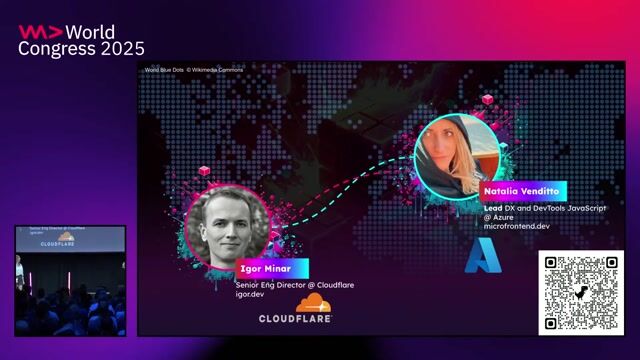
Web-Fragments: incremental micro-frontends migration approach for enterprise

Igor Minar , Natalia Venditto

Traditional micro-frontends lack true runtime isolation. Discover how Web-Fragments bring actual virtualization to the frontend, preventing one broken dependency from crashing your entire enterprise application.

Pause
Mute Enter Fullscreen
#1 about 2 min

Overcoming modernization challenges in aging monolithic codebases

Modernizing legacy applications requires strategies that decouple massive dependencies without forcing an unfeasible codebase rewrite.

#2 about 2 min

Applying backend microservice and virtualization patterns to frontends

Backend infrastructure solved scaling constraints by decoupling monoliths into microservices and isolating software dependencies via containerization.

#3 about 1 min

Solving frontend monolithic constraints using web fragments virtualization

Web fragments provide a unique micro-frontend architecture combined with critical environment encapsulation and browser-level isolation.

#4 about 2 min

Extracting and recomposing monolithic application parts independently

Legacy application scaling is achieved by decoupling independent features into standalone components that can be recomposed.

#5 about 3 min

Preventing application-wide fate sharing through developer environment isolation

Encapsulating module execution boundaries prevents isolated engineering errors from fundamentally crashing the shared global user experience.

#6 about 4 min

Modernizing legacy client-rendered components with server-side frameworks

Migrating heavy client-side React domains to server-side frameworks like Next.js and Qwik substantially improves initial page loading speed.

#7 about 2 min

Implementing routing middleware for seamless multi-fragment origination

Server-side middleware dynamically pipes distinct module requests back to independent origins without altering the expected end-user URL pathing.

#8 about 4 min

Isolating cascading styles and scripts using browser virtualization

Combining native shadow roots with reframed hidden iframes ensures complete script isolation while retaining full single-document interactivity.

#9 about 2 min

Prioritizing primary content rendering via server-rendered gateways

The web fragments gateway pattern selectively streams high-priority server-rendered data structures ahead of sluggish legacy legacy layouts.

#10 about 3 min

Debugging isolated contexts and managing dynamic browser memory

Developers can target virtualized javascript contexts within standard devtools and automatically garbage-collect unused dependencies by unloading modules.

#11 about 3 min

Escaping standard constraints of legacy iframe boundaries

Virtualized fragments break interface limitations by properly rendering dynamic full-screen modals outside the traditional framing area.

#12 about 2 min

Benchmarking performance overhead for isolated web components

Dropping stress-test tools inside web fragments proves that advanced browser boundary virtualization generates effectively zero runtime performance drag.

#13 about 3 min

Balancing shared platform resources with strict module encapsulation

Web fragments retain cooperative API mechanics like history navigation and caching while strongly isolating internal component states.

#14 about 2 min

Comparing virtualization with module federation and static iframes

Alternative workflows like module federation couple systems tightly to bundler limitations without addressing inherent javascript execution bleeding issues.

#15 about 4 min

Exploring the active roadmap and future web standard integrations

Future open-source features target comprehensive client dependency sharing alongside progressive integration with proposed W3C shadow domain standards.

Matching moments

1:43 min

Incremental frontend modernization avoiding full rewrites

Alexander Günsche Alexander Günsche · LIVE

2:07 min

Introduction to micro frontend architecture

Trishul Goel · JS Congress

13:09 min

Answering questions on micro-frontend adoption and tooling

Luca Mezzalira Luca Mezzalira · JS Congress

3:31 min

The reality of single-page applications versus legacy monoliths

Alexander Lichter · LIVE

2:13 min

Transitioning monolithic page structures to distributed front-end architectures

Luca Mezzalira Luca Mezzalira · WWC 2024

5:01 min

Layering frontend frameworks using progressive decoupling strategies

Shedrack Akintayo · LIVE

Upcoming sessions on this topic

Open session

World Congress 2026 North America

Offloading IoT State: Solving the Memory Crisis on Legacy Hardware

Pravin Nagare

Senior Software Engineer, Roku

Pravin Nagare
Open session

World Congress 2026 North America

Full Stack with Flutter - are we there yet?

Nemanja Stošić

Senior Flutter Developer

Nemanja Stošić
Open session

World Congress 2026 North America

Fast by Design: A Masterclass in High-Performance Web Engineering

Aaron Grogg

Senior web developer, committed to improving the user experience by improving web performance

Aaron Grogg
Open session

World Congress 2026 North America

One Repo, One Strategy: Scalable Full-Stack Testing in a Monorepo World

Bartosz Leczycki, Paweł Matynia

Bartosz Leczycki
Paweł Matynia
Open session

World Congress 2026 North America

Architecting AI in Angular: WebMCP, A2UI, and the Agent Experience

Ankita Sood

Sr. Principal Engineer @ Secureworks | Angular GDE

Ankita Sood
Open session

World Congress 2026 North America

It’s Alive! Taming the MLOps Franken-Stack: Write, Run, and Serve with Michelangelo

Eric Wang, Paul Zimmerman

Eric Wang
Paul Zimmerman