
World Congress 2025 Aug 20, 2025 Session details

How Robots Learn to be Robots

Alexander Schwarz

Training autonomous robots is bottlenecked by costly real-world testing. What if they could master kinematics inside photorealistic digital twins first? Discover how generative AI bridges the sim-to-real gap.

Pause
Mute Enter Fullscreen
#1 about 2 min

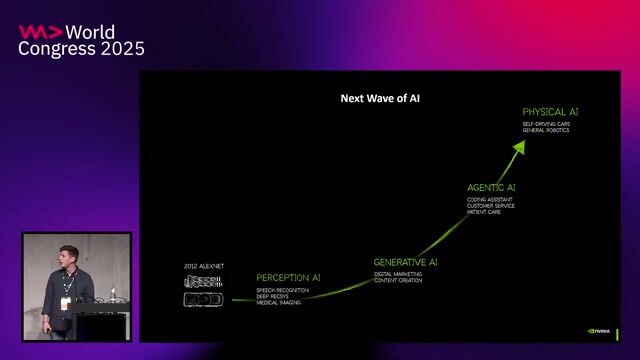
Transitioning from digital AI agents to physical AI

Defining physical AI systems that interpret 3D environments and physical behaviors.

#2 about 2 min

Translating sensory inputs into physical robot actions

How robots process camera inputs and language instructions to coordinate physical movements.

#3 about 2 min

Bottlenecks in capturing real-world operational data

The scalability and safety limitations of physical teleoperation and real-world testing.

#4 about 2 min

A three-computer paradigm for robotics development

Structuring workflows around neural network training, synthetic data generation, and digital twin simulation.

#5 about 2 min

Managing heterogeneous AI policies across robot embodiments

Deploying specific foundation models for separate skills like perception, navigation, and manipulation.

#6 about 2 min

Accelerating reinforcement learning through parallel simulation

Training trial-and-error behaviors exponentially faster by running thousands of environments simultaneously on GPUs.

#7 about 1 min

Bootstrap datasets via imitation learning and teleoperation

Capturing expert human trajectories to establish baseline behaviors for complex tasks.

#8 about 2 min

Establishing standardized 3D workflows using OpenUSD

Leveraging the OpenUSD framework to build interoperable, non-destructive digital twins.

#9 about 3 min

Scaling human demonstrations with domain randomization algorithms

Applying perturbations to small sets of simulated teleoperation runs to multiply synthetic training trajectories.

#10 about 3 min

Categorizing world foundation models for physical AI

Introducing models optimized for future state prediction, style transfer, and spatial reasoning.

#11 about 2 min

Bridging the sim-to-real gap with multi-control networks

Converting coarse simulation segmentations into photorealistic video datasets to improve model generalization.

#12 about 3 min

Hallucinating valid trajectories using video diffusion models

Post-training prediction models with robot kinematics to generate new training scenarios without full physics rendering.

#13 about 3 min

Fusing internet video and synthetic telemetry for foundation models

Combining massive unstructured external data with targeted simulated outputs to pre-train highly adaptable control policies.

#14 about 2 min

Validating deployed robotic policies in digital factory environments

Performing large-scale software-in-the-loop testing within virtual industrial spaces before physical rollout.

Matching moments

2:22 min

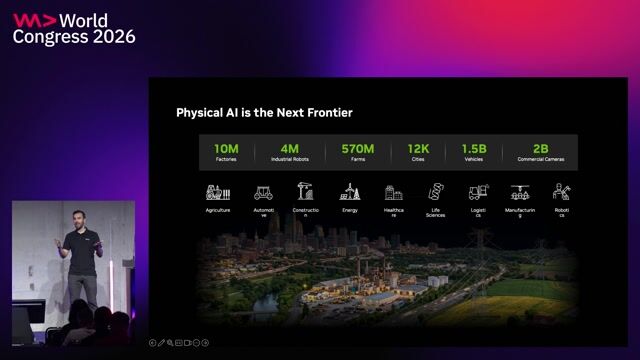
Introduction to physical AI and the physical world

Moe Sani Moe Sani · WWC Europe 2026

2:58 min

Introduction to Omniverse and Isaac Sim platforms

Teresa Conceicao · WWC 2022

1:20 min

Shifting focus from large language models to physical AI

Sergio Perez Sergio Perez · WWC Europe 2026

2:23 min

Development roadmap for world models and physical robotics

Joerg Krall Joerg Krall · WWC Europe 2026

1:40 min

The three essential phases for physical AI development

Sergio Perez Sergio Perez · WWC Europe 2026

2:55 min

Moving from AI software buzzwords to building actual robots

Iulia Feroli Iulia Feroli · WWC Europe 2026

Upcoming sessions on this topic

Open session

World Congress 2026 North America

You Can’t Re-Run Sunlight: Designing ML Data Architectures for Physical AI

An Phan

Senior Data Infrastructure Engineer @ Hippo Harvest

An Phan
Open session

World Congress 2026 North America

Building Stuff with GenAI - The Open Minded Workshop beyond OpenAI

Andreas Erben

CTO for Applied AI and Metaverse at daenet

Andreas Erben
Open session

World Congress 2026 North America

For Physical AI, data is the problem, but data is not the solution

Ashutosh Saxena

CEO at TorqueAGI

Ashutosh Saxena
Open session

World Congress 2026 North America

Engineering the Pivot: How Creative Strategy Solves the Hard Problems of AI Accuracy and Scale

Shruti Tiwari

AI/ML product manager, Dell

Shruti Tiwari
Open session

World Congress 2026 North America

From Software Agents to Physical Devices: Inside the Agentic Hardware Stack

Michael Yuan, Vivian Hu

Michael Yuan
Vivian Hu
Open session

World Congress 2026 North America

Building World-Aware Robots with Agent Memory and Context Graphs

Zaid Zaim

Developer Advocate EMEA at Neo4j | Microsoft AI MVP

Zaid Zaim