Client-Side State Management Reimagined – Think Outside the Box
What if your entire state management lived in a service worker? This talk explores a new architecture for faster, multi-tab synced, and offline-ready applications.
#1about 2 minutes
Exploring modern state management patterns beyond frameworks
State management concepts like signals and the Redux pattern are adaptable across various frontend frameworks, not just Angular.
#2about 3 minutes
Architectural strategies for enterprise frontend applications
Progress from a single component architecture to a scalable model with dedicated services for state management and data access.
#3about 4 minutes
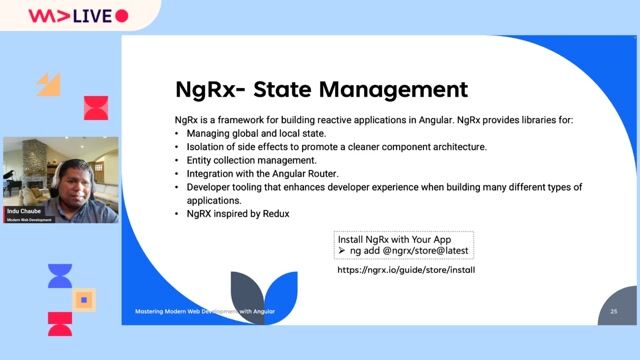
Using NgRx Signal Store for robust state management
The NgRx Signal Store provides a dedicated solution for managing shared and cached state, including an event-driven API.
#4about 3 minutes
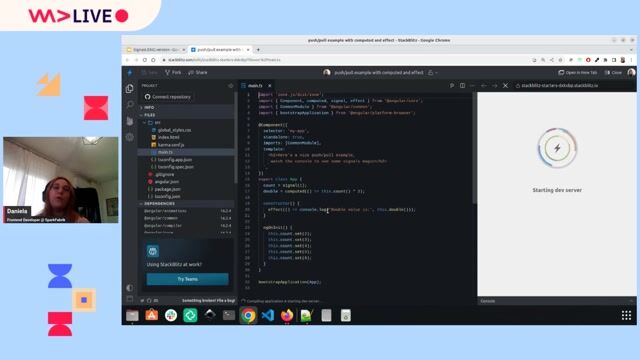
Understanding reactivity and the role of Angular Signals
Angular leverages multiple reactive APIs, with Signals becoming the primary mechanism for fine-grained DOM updates, replacing Zone.js.
#5about 2 minutes
How UI updates are triggered in a Zone-less future
Without Zone.js, UI synchronization is triggered by specific actions like signal updates, event bindings, and router navigation.
#6about 5 minutes
Implementing the event-driven NgRx Signal Store API
A practical look at using the experimental NgRx event API, including defining event groups, reducers, and handling side effects with RxJS.
#7about 3 minutes
Moving state management into a service worker
An experimental approach is proposed to move the entire state management layer into a service worker for better performance and new capabilities.
#8about 5 minutes
Challenges and an experimental service worker API
Overcoming challenges like dependency injection and cross-thread communication is key to implementing a service worker-based state management solution.
#9about 3 minutes
Benefits of a service worker-based architecture
This architecture enables a clean separation of concerns, improved performance, offline capabilities, multi-tab synchronization, and user re-engagement via push notifications.
Related jobs
Jobs that call for the skills explored in this talk.
Dev Digest 215: Agent Memory, JS2026, Googlebot Analysis & Canvas❤️HTMLInside last week’s Dev Digest 215 .
🗿 Make AI talk like a caveman
🧠 A guide to context engineering for LLMs
🤖 Simon Willison on agentic engineering
🔐 Axios supply chain attack post mortem
🛡️ Designing AI agents to resist prompt injection
🎨 HTML in c...
Daniel Cranney
Dev Digest 159: AI Pipelines, 10x Faster TypeScript, How to InterviewInside last week’s Dev Digest 159 .
🤖 How to use LLMs to help you write code
⚡ How much electricity does AI need?
🔒 Is your API secure? Learn all about hardening it…
🟦 TypeScript switches to go and gets 10 times faster
🖼️ An image cropper in your ap...
Chris Heilmann
Micro Components - a different approach to a simpler component-based webThere has been a lot of heated discussion lately in the web community about component based development. One side argued that Web Components are a standard we should follow whereas others complained that they still lag behind in what frameworks offer...
From learning to earning
Jobs that call for the skills explored in this talk.