Daniela Bonvini

Angular Signals: what's all the fuss about?

Angular Signals aren't replacing RxJS. Learn how they coexist for simpler, more performant UI state management without the boilerplate.

Angular Signals: what's all the fuss about?
#1about 4 minutes

The motivation for introducing Angular Signals

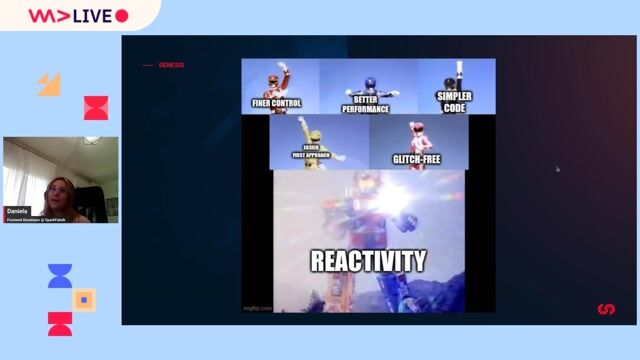
Angular Signals were created in response to user requests for better performance, simpler code, and more fine-grained control over UI updates.

#2about 8 minutes

Defining true reactivity in modern frameworks

True reactivity is characterized by immutable data structures, unidirectional data flow, and glitch-free updates, areas where traditional Angular had room for improvement.

#3about 3 minutes

Understanding Angular's change detection strategies

A comparison of Zone.js default change detection, the OnPush strategy, and the more efficient, component-level updates enabled by signals.

#4about 5 minutes

Core concepts of writable, computed, and effect signals

An introduction to the three main types of signals: writable for direct updates, computed for derived values, and effect for running side effects.

#5about 4 minutes

How the push-pull protocol ensures glitch-free updates

Signals use a two-phase push-pull mechanism to notify consumers of a change before they pull the final, updated value, preventing intermediate state issues.

#6about 9 minutes

Comparing signals with RxJS observables

Signals are ideal for synchronous state management, while RxJS observables excel at handling asynchronous event streams, making them complementary tools.

#7about 10 minutes

Refactoring an application from observables to signals

A practical code walkthrough demonstrates how refactoring a cart service to signals reduces boilerplate, simplifies logic, and cleans up template syntax.

#8about 3 minutes

Summary of benefits and the future of reactivity

Signals deliver on user requests for better performance and simpler code by providing fine-grained, glitch-free reactivity while coexisting with RxJS.

#9about 6 minutes

Audience Q&A on signals and Angular development

The speaker answers audience questions on topics including error handling, async operations, best practices, community adoption, and the impact on learning Angular.

Related jobs
Jobs that call for the skills explored in this talk.

Featured Partners

Related Articles

View all articles
BR
Benjamin Ruschin
The HTML Elements That You’re Probably Over-Engineering
As frameworks have become more and more commonplace in the world of web development, so too has the over-engineering of features made possible by our humble old friend, HTML. The mental models that come with using state management in React, Vue and o...
The HTML Elements That You’re Probably Over-Engineering
DC
Daniel Cranney
Dev Digest 213: Petrol Prices, Agentic Workflows, AI Skills and CODE100!
Inside last week’s Dev Digest 213 . 🤫 Don’t tell your LLM that it is an expert 👻 AI generated code is invisible 🔄 Learn about agentic workflows 🛡️ Linux Foundation sponsors fight against AI slop 🦠 1M users infected by Chrome extension 🫃 The why of J...
 Dev Digest 213: Petrol Prices, Agentic Workflows, AI Skills and CODE100!
DC
Daniel Cranney
Dev Digest 214: Claude Is Leaking, GitHub Is Listening & Axios Hacked!
Inside last week’s Dev Digest 214 . 🕵️ Claude source code leaked, analysed and re-written in 2 days 🐙 GitHub auto-opts users into feeding their code to train their AI 🌐 Pretext shows how to show complex text rendering in the browser 🤖 How to securin...
Dev Digest 214: Claude Is Leaking, GitHub Is Listening & Axios Hacked!

From learning to earning

Jobs that call for the skills explored in this talk.