
Coffee With Developers Nov 19, 2025

AI Killed DevOps... What Now? - Lee Faus

Lee Faus

Lee Faus argues that AI is killing traditional DevOps. Discover why the future of engineering relies on critical code review and using LLMs as architectural sparring partners.

Pause
Mute Enter Fullscreen
#1 about 4 min

Distributing best practices across enterprise software organizations

Sharing aggregated engineering knowledge helps companies effectively implement new tools and avoid isolated pipeline architectures.

#2 about 3 min

Defining the core pillars of modern DevOps practices

Combining collaboration, agility, and automation increases release velocity and provides junior developers with clear promotion pathways.

#3 about 2 min

How autonomous agents disrupt traditional agile methodologies

The shift toward rapidly generating disposable codebase applications challenges standard iterative software improvement cycles and planning stages.

#4 about 4 min

Managing non-deterministic code generation and token costs

Relying on generative artificial intelligence for broad application development introduces inconsistent UI structures and expensive context window usage.

#5 about 5 min

Using artificial intelligence for complex architectural decisions

Forcing models to analyze anti-patterns helps engineers overcome confirmation bias when designing highly scalable backend systems.

#6 about 6 min

The emergence of localized agentic development environments

Executing automation tasks on local machines enables artificial agents to bypass centralized platform pipelines and autonomously close pending backlog issues.

#7 about 3 min

Adapting tool pricing models for autonomous developer agents

The explosion of automated network interactions necessitates transitioning software ecosystems from per-user licenses to consumption-based roaming models.

#8 about 7 min

Transitioning developers from code creators to code reviewers

Engineers are shifting focus toward critical testing skills that review generated logic output for alignment with concrete business contracts.

#9 about 5 min

Elevating engineering roles through targeted skill augmentation

Applying educational frameworks helps reframe localized technical tasks into collaborative knowledge work augmented by specialized machine agents.

#10 about 8 min

Combatting confirmation bias in generative code models

Software engineers must specify algorithmic constraints proactively because generalized internet datasets inherently prioritize additive complexity over concise maintenance.

#11 about 8 min

Assessing data provenance and offline software coding challenges

Relying purely on metered cloud inferences complicates remote pipeline checks and raises regulatory concerns regarding source attribution origins.

#12 about 3 min

Blending human intuition with automated code generation

Experienced programmers bridge complex system gaps by manually overriding output instead of repeatedly churning tokens on failure adjustments.

#13 about 5 min

Preparing junior developers for an agentic job market

Applicants who configure personalized local tooling layers demonstrate superior technical competency during rigorous technology interviews compared to those using default integrations.

Matching moments

1:55 min

Shifting developer workloads and realistic AI productivity gains

Chris Heilmann +2 · LIVE

2:34 min

Balancing developer autonomy with the adoption of coding agents

Clemens Wasner Clemens Wasner +4 · World Congress 2026 Europe

3:06 min

Addressing the gap between coding assistants and complex workflows

Julia Kordick Julia Kordick · World Congress 2026 Europe

4:08 min

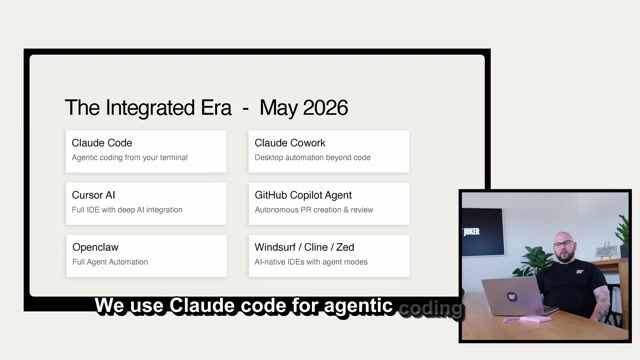
Transitioning software engineering teams to AI-native development workflows

Florian Deter Florian Deter +4 · World Congress 2026 Europe

3:42 min

The promise and risk of AI coding agents

May Walter May Walter · World Congress 2026 Europe

5:30 min

Developer role changes in the AI era

Zaak Chalal Zaak Chalal · World Congress 2026 Europe

Upcoming sessions on this topic

Open session

World Congress 2026 North America

September 24, 2026 · 11:10–11:15

Outdoor Stage

Architecting the 100X SDLC: Building Production Trust into AI-Assisted Delivery

Ranjan Parthasarathy

Founder, CPTO/CEO at AXIOMSTUDIO.AI

Ranjan Parthasarathy
Open session

World Congress 2026 North America

September 25, 2026 · 14:10–14:40

Stage 1

The Broken Rung: How AI is Rebuilding Software Development from the Ground Up

Tomislav Tipurić

Chief Technology Officer, Nephos

Tomislav Tipurić
Open session

World Congress 2026 North America

September 23, 2026 · 13:40–14:10

Stage 2

Building an AI-Native Development Workflow

Vanessa Minik

Senior Service Delivery Engineer, GitHub

Vanessa Minik
Open session

World Congress 2026 North America

September 24, 2026 · 16:50–17:20

Mainstage

Building AI Products vs. Building With AI

Aparna Dhinakaran, Rukmini Reddy, Tamar Bercovici

Aparna Dhinakaran
Rukmini Reddy
Tamar Bercovici
Open session

World Congress 2026 North America

September 24, 2026 · 15:30–16:00

Stage 7

Beyond Vibe Coding: Using CLI Tools as Your AI Counterpart in Pair Programming

Ron Veen

Java enthusiast and Special agent for Team Rockstars IT

Ron Veen
Open session

World Congress 2026 North America

September 25, 2026 · 12:55–13:25

Stage 7

The spectrum of agentic coding: From vibe coding to high-quality software engineering

YK Sugi

Developer Experience Manager at Eventual

YK Sugi