
Coffee With Developers Mar 4, 2026

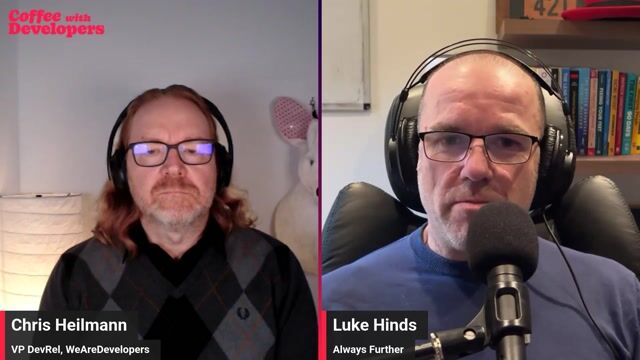
Securing AI Agents from the Ground Up - Luke Hinds

Luke Hinds

Luke Hinds proves that application-level guardrails cannot secure autonomous AI agents. Learn how to implement OS-level sandboxing with Nono to protect your local environment from catastrophic terminal operations.

Pause
Mute Enter Fullscreen
#1 about 5 min

Background on open source security software

Open source transparency and community collaboration provide essential oversight for building trustworthy security software.

#2 about 5 min

Why AI development prioritizes speed over security

The massive rush to dominate the generative AI market leads developers to systematically deprioritize foundational application security.

#3 about 2 min

Risks of running black box AI tools locally

Inexperienced engineers often grant unvetted AI applications excessive terminal access without understanding the system-level consequences.

#4 about 5 min

Determining where autonomous AI agents actually add value

Complex agentic AI implementations are frequently unnecessary when foundational software patterns can solve the same problems faster.

#5 about 9 min

Origin and architecture of the Nono sandboxing tool

The Nono application leverages Linux kernel security modules to explicitly isolate unverified AI processes from operating systems.

#6 about 5 min

Demonstrating file access restrictions with the Nono command-line

The command-line interface makes it explicitly straightforward to authorize or forbid directory permissions for isolated applications.

#7 about 3 min

Containing Claude Code within a secure sandbox environment

Running a Claude Code agent inside a restrictive sandbox safely educates users when the tool attempts unauthorized commands.

#8 about 2 min

Reverting agent damage with automated snapshot rollbacks

Built-in file tracking networks allow developers to rapidly undo destructive code modifications executed by unpredictable AI agents.

#9 about 2 min

Preventing API key exfiltration natively with phantom keys

Injecting randomized string values guarantees malicious applications cannot correctly exfiltrate valid API keys to external unauthorized servers.

#10 about 6 min

Blocking browser cookie theft and dangerous terminal commands

Explicit logging requirements and hardcoded process constraints protect host machines against stolen session states and rogue file deletions.

#11 about 6 min

Balancing smooth user experience with strict security practices

Punishing engineering groups with burdensome authentication patterns fundamentally motivates individuals to disable security parameters to remain productive.

#12 about 8 min

Lessons on simplifying cryptographic signing and encryption adoption

Transforming tedious encryption workflows into seamless background utilities vastly accelerates security integration across large developer ecosystems.

#13 about 3 min

Engaging developer communities to solve emerging security threats

Providing lightweight solutions directly in chat channels enables security advocates to safely scale software adoptions.

Matching moments

3:22 min

Evaluating security risks and capabilities of the agentic web

Meta Atamel +1 · Coffee With Developers

4:15 min

Security integration and AI skepticism in developer tooling

Chris Heilmann +2 · LIVE

2:28 min

Mitigating excessive agency through scoped tool access

Deepu Deepu · World Congress 2025

1:55 min

Current state of security in AI applications

Deepu Deepu · World Congress 2025

6:05 min

Running autonomous AI desktop agents entirely within the browser

Chris Heilmann +2 · LIVE

1:58 min

Using Open Shell for AI agent governance and isolation

Rob Nertney Rob Nertney · World Congress 2026 Europe

Upcoming sessions on this topic

Open session

World Congress 2026 North America

September 25, 2026 · 12:30–14:30

Stage 11

Docker sandboxes: protect your secrets, tokens, and personal data from AI agent mistakes

Kristiyan Velkov

Front-End Advocate | Speaker | AI & DevOps | Docker Captain | Cursor Ambassador | DevReal | Tech Blogger | Book Author

Kristiyan Velkov
Open session

World Congress 2026 North America

September 24, 2026 · 17:30–18:00

Stage 5

Securing AI Agent Infrastructure: Identity, Attestation, and Trust at Scale

Abdel Fane

Founder of OpenA2A

Abdel Fane
Open session

World Congress 2026 North America

September 25, 2026 · 10:20–10:50

Stage 4

rm -rf: Horror Stories From Unsandboxed AI Agents (and How Docker Fixes This)

Rishab Kumar

Staff Developer Evangelist @ Twilio

Rishab Kumar
Open session

World Congress 2026 North America

September 23, 2026 · 15:45–17:45

Stage 8

Docker's Agentic Platform: Sandboxes, MCP, and the Infrastructure of Autonomous Development

Oleg Šelajev

AI and Developer relations at Docker

Oleg Šelajev
Open session

World Congress 2026 North America

September 23, 2026 · 10:45–12:45

Stage 8

SBX 101: Hands-on with Docker Sandboxes

Dan Ndombe

Developer Success, Docker

Dan Ndombe
Open session

World Congress 2026 North America

September 24, 2026 · 09:45–10:15

Mainstage

Manufacturing trust: speed and safety in the age of agents

Mark Cavage

Mark Cavage President and COO of Docker

Mark Cavage