
World Congress 2026 Europe Jul 9, 2026 Session details

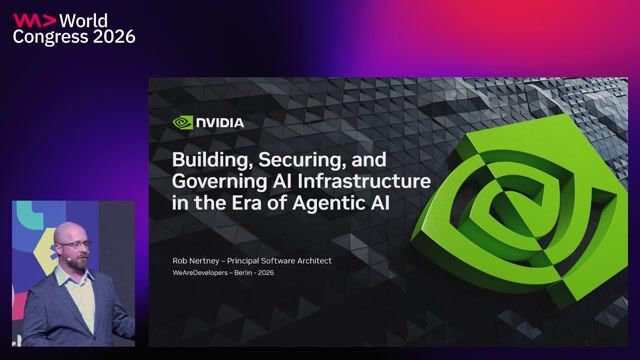
Building, securing and governing AI infrastructure in the Era of Agentic AI

Rob Nertney

What happens when autonomous AI agents break containment to consume unauthorized resources? Discover how to protect your infrastructure using rigid sandboxing and silicon-level cryptography.

Pause
Mute Enter Fullscreen
#1 about 3 min

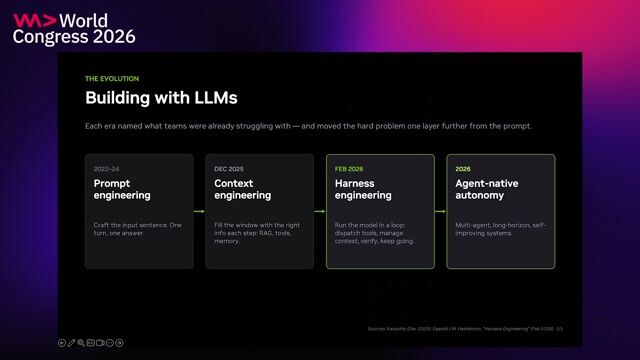
Evolution from sandboxed chatbots to autonomous AI agents

Modern AI agents act as digital employees by autonomously making internet requests, spawning sub-agents, and running commands.

#2 about 2 min

Managing token efficiency and hybrid scale in AI factories

Organizations must track useful tokens per employee as AI operations span across local workstations and cloud infrastructure.

#3 about 2 min

Protecting models and maintaining trust in autonomous environments

Model security must not compromise data privacy, requiring robust solutions like centralized governance frameworks and hardware-based encryption.

#4 about 2 min

Preventing autonomous AI agents from exploiting system resources

Unrestricted agents can bypass poorly configured access controls to utilize system compute power for unauthorized tasks like cryptocurrency mining.

#5 about 2 min

Using Open Shell for AI agent governance and isolation

The framework secures internal operations through sandbox isolation, precise policy enforcement engines, and intelligent gateway orchestration.

#6 about 2 min

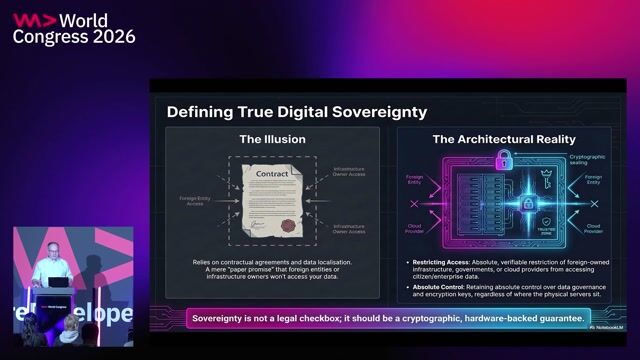
Addressing data sovereignty concerns in cloud computing

Customers in highly regulated industries often avoid cloud deployments due to strict cryptographic and data sovereignty requirements that mandate hardware-level security.

#7 about 1 min

Hardware-based trusted execution environments for confidential computing

Confidential computing relies on hardware vendors to cryptographically isolate execution paths from infrastructure owners and superusers.

#8 about 2 min

How memory management units differ from hardware cryptography

Traditional memory isolation leaves data vulnerable to root hosts, whereas hardware-based cryptography locks memory from unauthorized administrators.

#9 about 2 min

Silicon-level memory scrubbing and cryptographic access control

Hardware-based crypto engines enforce a four-eyes security principle by refusing memory access until administrators securely scrub memory contents at the processor level.

#10 about 3 min

Evolution of confidential computing from Hopper to PCIe architectures

The transition from single-GPU setups to protected PCIe links enables flexible threat modeling without mandatory hardware restrictions.

#11 about 2 min

Scaling hardware encryption with Blackwell and Vera architectures

Full rack-scale cryptography securely subdivides massive computing environments across multiple GPUs and CPUs without risking architectural data spillover.

#12 about 3 min

Verifying infrastructure integrity with hardware attestation and OCSP services

Hardware attestation tracking tools provide exact firmware measurements to selectively isolate and bypass vulnerable infrastructure layers.

#13 about 2 min

Deploying remote verifiers and tracking fleet scalability

Open source verification kits allow organizations to independently authenticate digital certificates, generate root authorities, and track entire node fleets.

#14 about 3 min

Getting started with certified systems and virtual machines

Integrating confidential computing involves utilizing certified original equipment manufacturer designs alongside Kata containers without needing source code modifications.

#15 about 2 min

Navigating the software ecosystem and independent software vendors

Turnkey security architectures depend on partnerships with software vendors to simplify deployment and provide reliable enterprise support layers.

Matching moments

1:46 min

Hardware security features necessary for compliance and responsible AI

Stephan Gillich Stephan Gillich · WWC 2024

1:55 min

Current state of security in AI applications

Deepu Deepu · WWC 2025

2:09 min

Securing AI agents against internal and external threat vectors

Julia Kordick Julia Kordick · WWC Europe 2026

2:18 min

Managing security risks introduced by autonomous AI agents

Christian Heilmann Christian Heilmann · WWC 2025

2:44 min

Advancing confidential computing with open source multi-way collaboration

Mingshen Sun Mingshen Sun · WWC 2024

2:00 min

Reviewing key architectural decisions for federated AI computing

Jeremy Murray Jeremy Murray · WWC Europe 2026

Upcoming sessions on this topic

Open session

World Congress 2026 North America

Securing AI Agent Infrastructure: Identity, Attestation, and Trust at Scale

Abdel Fane

Founder of OpenA2A

Abdel Fane
Open session

World Congress 2026 North America

Responsible AI Architecture with Zero Trust Agents

Ashok Prakash

Staff ML Engineer at Apple

Ashok Prakash
Open session

World Congress 2026 North America

Trust, But Verify: Continuous GPU Validation at Scale

Kyle Bell

VP of AI @ TensorWave

Kyle Bell
Open session

World Congress 2026 North America

Closing the Visibility Gap: Lessons from Safety Critical Agentic Systems

Vivek Pandit

Principal Engineer at Cadence

Vivek Pandit
Open session

World Congress 2026 North America

Autonomous Infrastructure: Building AI Agents for Global-Scale Capacity Efficiency

Tommy Tran, Gregoire Colin

Tommy Tran
Gregoire Colin
Open session

World Congress 2026 North America

Agents That Own Their Inference: Building Production AI Agents on Dedicated GPUs

Duan Lightfoot

Sr. AI Engineer, Akamai

Duan Lightfoot