





SH
Severine Hierso
World Congress 2021
•
Jun 28, 2021
Concurrency with Go
Frank Müller
- Discuss this with your agent
- Open in Claude
- Open in ChatGPT
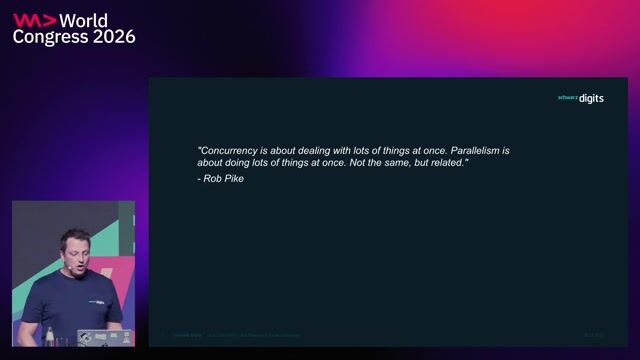
Stop fighting error-prone threads and mutual exclusion locks. Go's native concurrency primitives let you build elegant, thread-safe architectures by communicating across channels instead of sharing memory.
Matching moments
2:31 min
Introduction to Go concurrency and parallelism
 Rick Rackow · World Congress 2026 Europe
48 sec
Key takeaways on Go container performance optimization
Rick Rackow · World Congress 2026 Europe
3:21 min
Introducing goroutines and the Go scheduler
Rick Rackow · World Congress 2026 Europe
4:00 min
Sequential execution versus concurrent execution in Go
Rick Rackow · World Congress 2026 Europe
4:24 min
Leveraging the Go programming language for scalable infrastructure
Natalie Pistunovich · LIVE
2:03 min
Building scalable applications with reactive programming
Josh Long · World Congress 2022
More from World Congress 2021
Related videos
Related articles
.gif)
BB
Benedikt Bischof
.gif)
AA
Ali Alp

BB
Benedikt Bischof
.gif)
From learning to earning
Jobs that call for the skills explored in this talk.
27 days ago
•
Verified
Staff Software Engineer, Developer Experience

Docker, Inc.
Expert
Remote
Go
27 days ago
•
Verified
Senior Software Engineer, Secure Build
Docker, Inc.
Expert
Remote
Go
27 days ago
•
Verified
Principal Backend Engineer, Hub
Docker, Inc.
United States
Expert
Remote
Go
Kubernetes
Cloud (AWS/Google/Azure)
27 days ago
•
Verified
Manager, Engineering, Secure Build and SCS Services
Docker, Inc.
Expert
Remote
Team Leadership
about 2 months ago
Software Engineer, Infrastructure Platform
Docker, Inc.
Madrid, Spain
€72k–123k
Remote
Istio
Linux
Docker
about 1 month ago
•
Verified
GPU Cluster Engineer, Systems & Platform

Sciforium
San Francisco, United States
Expert
$150k–220k
Kubernetes