


WeAreDevelopers LIVE Oct 5, 2022

Concurrency in Python

Fabian Schindler

Is your Python app struggling to scale? Master asyncio to bypass the Global Interpreter Lock and build high-performance services that handle thousands of concurrent clients.

Pause
Mute Enter Fullscreen
#1 about 2 min

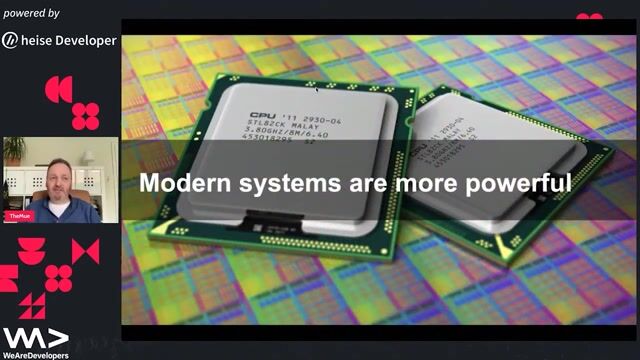
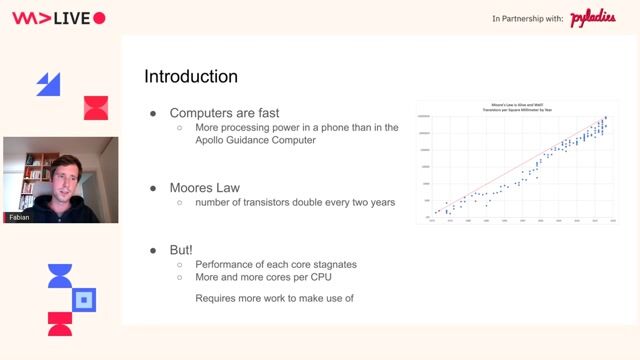
The shift from single-core to multi-core processing

The historical plateau of single-thread processor speeds necessitates programming techniques utilizing multiple CPU cores.

#2 about 2 min

Differences between concurrency, parallelism, and multitasking models

Overlapping tasks provide concurrency while actual simultaneous execution enables true parallelism across separate processing units.

#3 about 4 min

Weighing the benefits and complexities of multitasking

Multitasking improves service capacity and lowers operations costs but introduces significant synchronization overhead and execution unpredictability under Amdahl's Law.

#4 about 4 min

Threading and processing concepts across operating systems

Isolated processes offer safety at the cost of high creation overhead while threads provide fast shared memory access but risk synchronization bugs.

#5 about 3 min

Implementing threads and processes using Python modules

Python provides high-level abstractions like thread pools and executors to map the same functions across multiple parallel targets.

#6 about 5 min

Race conditions and memory synchronization risks

Simultaneous memory access creates race conditions unless variable modifications are protected by mutual exclusion locks.

#7 about 3 min

How the global interpreter lock limits thread execution

Python's internal memory management inherently prevents true execution parallelism by forcing sequential bytecode evaluation within a single active thread.

#8 about 4 min

Event-driven programming to overcome operating system limits

Serving massive concurrent connections mandates avoiding costly threaded configurations in favor of lightweight asynchronous task schedulers.

#9 about 4 min

Asynchronous programming syntax and event loop execution

The async and await keywords permit non-blocking yielding of tasks directly to the internal runtime execution loop.

#10 about 4 min

Achieving concurrency and practical asynchronous implementations

Aggregating asynchronous tasks simultaneously enables modern web framework backends to drastically scale their concurrent request handling.

#11 about 3 min

Considerations for application architecture and system optimization

Evaluating whether to deploy threads, processes, or asynchronous event loops requires careful profiling of computing bottlenecks and external limitations.

Matching moments

2:59 min

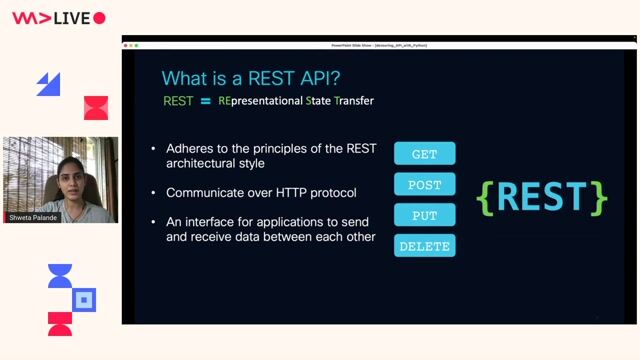
Parallel execution through multiprocessing and multithreading concepts

Shweta Palande · LIVE

2:10 min

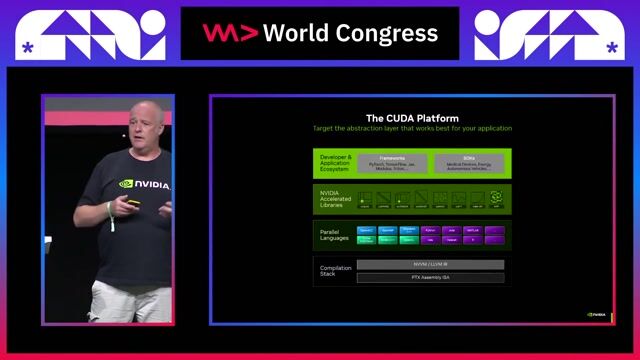
Overcoming threading challenges for Python on GPUs

Stephen Jones · Coffee With Developers

2:34 min

Achieving high concurrency throughput comparable to compiled languages

Sebastián Ramírez · World Congress 2022

9:07 min

Discussion on scalability and concurrent application performance

Christian Woerz · LIVE

2:31 min

Introduction to Go concurrency and parallelism

Rick Rackow Rick Rackow · World Congress 2026 Europe

1:34 min

Understanding concurrency against parallelism in application execution

Frank Müller · World Congress 2021

Upcoming sessions on this topic

Open session

World Congress 2026 North America

September 25, 2026 · 09:00–09:30

Stage 3

Your Thread Pool Is Lying to You — Sizing Concurrency from Rate Limits and Latency, Not Guesswork

Ratul Ghosh, Sesha Chennupati

Ratul Ghosh
Sesha Chennupati
Open session

World Congress 2026 North America

September 23, 2026 · 13:00–13:30

Stage 2

Parallelize Your Development with GitHub Copilot

Pamela Fox

Principal Cloud Advocate, Microsoft

Pamela Fox
Open session

World Congress 2026 North America

September 25, 2026 · 11:00–11:30

Stage 5

Managing GPUs by Just Asking, Infrastructure in the Age of MCP

Jessica Garson Beauchemin

Developer Relations Lead, Community at Runpod

Jessica Garson Beauchemin
Open session

World Congress 2026 North America

September 24, 2026 · 14:10–14:40

Stage 1

Anatomy of an AI Request: Where Latency and Cost Are Really Born

Dan Fu

VP of Kernels at Together AI

Dan Fu
Open session

World Congress 2026 North America

September 24, 2026 · 16:10–16:40

Outdoor Stage

When Humans Stop Writing Code: Rethinking Languages, Compilers, and Responsibility

Simon Auer

Organizer of flutter vienna meetup and CEO of marqably

Simon Auer
Open session

World Congress 2026 North America

September 24, 2026 · 17:30–18:00

Stage 3

Scaling Distributed Queues for AI workloads

Jasmit Kaur Saluja

Software Engineer at Meta Platforms Inc

Jasmit Kaur Saluja