




World Congress 2021 Jul 1, 2021

Developing an AI.SDK

Daniel Graff , Andreas Wittmann

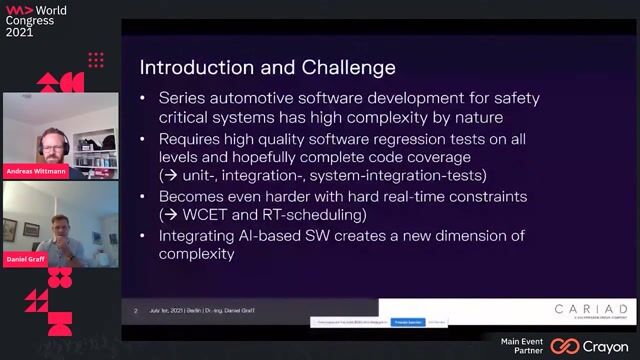
Deploying safety-critical AI to millions of vehicles requires bridging cloud-native scale with embedded constraints. Explore how CARIAD's dual-component AI SDK optimizes neural training and in-car execution.

Pause
Mute Enter Fullscreen
#1 about 3 min

Navigating automotive complexity with AI runtime environments

High complexity in safety-critical vehicle components requires abstraction layers for reliable machine learning deployments.

#2 about 3 min

Executing the data-driven development loop in the cloud

Cloud-based processes from data labeling to model training establish the foundation for deploying reliable artificial intelligence.

#3 about 2 min

Optimizing AI model execution for in-car inference

Centralizing hardware abstractions enables model monitoring and shadowing directly within the physical vehicle environment.

#4 about 1 min

Unifying toolchains across AI development pipelines

Centralized algorithms and execution pipelines reduce complexity while offering unified validation models for diverse engineering teams.

#5 about 4 min

Structuring hardware interactions with the Volkswagen operating system

Consolidating disparate compute units into full-fledged components driven by middleware lowers the volume of physical interconnects.

#6 about 3 min

Comparing cloud-compiled versus platform-agnostic model deployments

Choosing between deploying standardized formats or optimized binary inference engines determines where massive compute resources occur.

#7 about 2 min

Evaluating open source possibilities for runtime technologies

Opening core architecture frameworks to external developer communities can rapidly accelerate optimization benchmarks in functional inference.

#8 about 3 min

Streamlining disparate workflows with a unified AI SDK

Automating training pathways via standardized toolsets mitigates the friction of testing software across heterogeneous landscapes.

#9 about 2 min

Mapping the machine learning framework and lifecycle coverage

Clearly segregating data preparation and evaluation stages establishes clear boundaries between analytical environments and runtime execution interfaces.

#10 about 4 min

Managing data ingestion and pipeline quality checks

Standardizing preprocessing formats guarantees reliability while actively archiving raw telemetry structures inside cloud environments.

#11 about 4 min

Evaluating custom metrics using deep neural network libraries

Executing continuous automated robustness assessments filters highly capable networks before transitioning assets into production environments.

#12 about 3 min

Shrinking memory footprints for embedded model productionization

Applying hardware-based quantization alongside transparent architecture searches drastically reduces deployment size parameters without deteriorating speed.

#13 about 7 min

Defining critical competencies for automotive AI engineering

Handling enormous quantities of vehicle telemetry demands a cross-functional synthesis of massive data systems and embedded deployment optimizations.

#14 about 2 min

Leveraging modern frameworks across the machine learning lifecycle

Integrating established vendor data tools guarantees robust execution pipelines natively supported across external provider environments.

Matching moments

2:21 min

Introduction to machine learning in the automotive industry

Jan Zawadzki · LIVE

3:16 min

Driving developer productivity with AI in automotive tech

Mike Butcher Mike Butcher +3 · World Congress 2024

1:53 min

Unified tech stack and hardware for Volkswagen

Liang Yu · World Congress 2022

10:40 min

Evaluating automotive software architectures and backend technologies

Georg Kühberger +1 · LIVE

2:52 min

Introduction to safety-critical machine learning in automotive contexts

Jan Zawadzki · World Congress 2022

1:41 min

Building a governed ecosystem for AI adoption

Daniel Geisel Daniel Geisel +1 · World Congress 2026 Europe

Upcoming sessions on this topic

Open session

World Congress 2026 North America

September 24, 2026 · 11:00–11:30

Tech Leaders Stage

Building AI for the Physical World

Alex Spinelli, Eystein Stenberg, Gerardo Pardo-Castellote

Alex Spinelli
Eystein Stenberg
Gerardo Pardo-Castellote
Open session

World Congress 2026 North America

September 24, 2026 · 14:10–14:40

Stage 5

Edge AI: Running Agentic Intelligence Where Internet Can't Reach

Nitin Eusebius

AWS - Principal Solutions Architect

Nitin Eusebius
Open session

World Congress 2026 North America

September 24, 2026 · 14:10–14:40

Stage 1

Anatomy of an AI Request: Where Latency and Cost Are Really Born

Dan Fu

VP of Kernels at Together AI

Dan Fu
Open session

World Congress 2026 North America

September 23, 2026 · 13:40–14:10

Stage 2

Building an AI-Native Development Workflow

Vanessa Minik

Senior Service Delivery Engineer, GitHub

Vanessa Minik
Open session

World Congress 2026 North America

September 25, 2026 · 13:30–14:00

Mainstage

A Hands-On Developer Guide to Inference Engineering

Ankit Patel, Philip Kiely

Ankit Patel
Philip Kiely
Open session

World Congress 2026 North America

September 25, 2026 · 11:40–12:10

Stage 9

You Can’t Re-Run Sunlight: Designing ML Data Architectures for Physical AI

An Phan

Senior Data Infrastructure Engineer @ Hippo Harvest

An Phan