
World Congress 2026 Europe - Virtual Stage • Jul 3, 2026 • Session details

Why Most AI Features Fail After the Demo

Akshay Nagpal

Why do flawless AI prototypes fail in production? It rarely stems from the LLM. Learn to build resilient, integrated AI tools using confidence gating and the TRUST framework.

Pause
Mute Enter Fullscreen
#1 about 8 min

Why AI features fail after successful initial demos

The significant gap between cherry-picked demo environments and messy production realities is the primary driver behind severe user churn.

#2 about 3 min

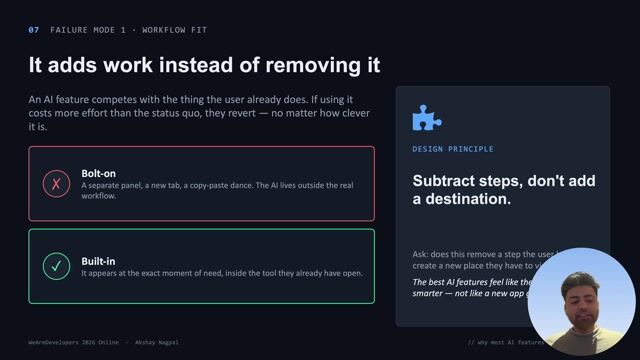
Integrating AI natively into existing user workflows

Features must remove steps in an existing workflow rather than forcing users into new applications to maintain long-term adoption.

#3 about 2 min

Building user trust through calibrated reliance and reversible actions

Since trust takes time to build and breaks easily, AI mistakes must clearly cite sources and remain cheap to undo.

#4 about 3 min

Designing graceful human handoffs based on AI confidence levels

Models should evaluate request boundaries and route out-of-scope tasks to human reviewers by calculating internal confidence scores.

#5 about 2 min

Balancing user control between AI suggestions and autonomous actions

High-risk product features should default to suggesting rather than acting autonomously until sufficient production data proves their capability.

#6 about 2 min

Implementing feedback loops and automated evaluations for continuous improvement

Capturing production usage data and employing language models as evaluators helps expand testing datasets beyond underlying initial assumptions.

#7 about 5 min

Applying the TRUST framework to AI product architecture

Integrating task fit, recovery protocols, user control, signals, and trust calibration directly into the application layer creates a resilient technical stack.

#8 about 2 min

Evaluating AI prompts as code with automated CI pipelines

Adding prompt verifications, confidence gating, and golden datasets directly into automated deployment pipelines ensures continuous model reliability.

#9 about 5 min

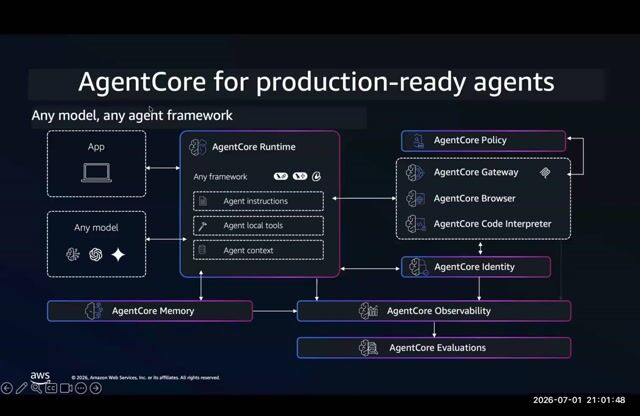
Architecture walkthrough of a production Slack automation agent

An internal tool deployment demonstrates secure infrastructure gating, human-in-the-loop intent confirmation, and scalable background workers using containerized cloud services.

#10 about 3 min

Checklist for shipping durable and trustworthy AI features

Executing a pre-launch review of edge cases, confidence boundaries, and override metrics guarantees repeatable user value beyond initial novelty.

Matching moments

6:03 min

Managing reliability and trust when artificial intelligence enters production

Him Raj Singh Him Raj Singh · World Congress 2026 North America

3:04 min

Building trust and transparency into AI interactions

Ekaterina Streltsova Ekaterina Streltsova · Europe 2026 Virtual

1:45 min

Navigating the impact of AI on team trust

Daksh Gupta Daksh Gupta +3 · World Congress 2026 North America

2:28 min

Introduction to building reliable AI agents in production

Max Tkacz Max Tkacz · World Congress 2025

2:03 min

Addressing institutional inertia and AI pilot failures

Alexandre Guenoun Alexandre Guenoun +3 · World Congress 2026 Europe

6:51 min

Defining proven AI in high-stakes environments

Bharat Melag Bharat Melag +4 · World Congress 2026 North America

Upcoming sessions on this topic

Open session

Beware of Strangers Bearing Code: Open Source Trust in the Agent Era

  • Vikram Vaswani

    Consultant

Open session

Teaching AI Coding Agents to Build It Right the First Time

  • Sajeetharan Sinnathurai

    Microsoft

    Principal Product Manager

Open session

Autopsy of an Autonomous Incident: When the Agent Made It Worse

  • Navin Pai

    StackGen

    Director of Engineering

Open session

AI Is the Easy Part: Why Faster Engineers Don't Make Faster Businesses

  • Bharat Sharma

    Booking

    Senior Engineering Manager

Open session

Prompt Debt: Why Your AI System Is Frozen in Time

  • Suriya Prakash B

    Red Hat

    Principal Software Engineer

Open session

What If AI Helps Us Build the Wrong Product Faster?

  • Sekhar Burra

    Sain Innovation

    CEO