World Congress 2026 North America • Sep 24, 2026 • Session details

I Don't Trust AI Agents (And Neither Should You): Building Production-Ready Architectures

Darko Mesaros

Are your AI agents exposing sensitive customer data? Stop trusting unpredictable models blindly. Build resilient, production-ready architectures with strict guardrails to contain the blast radius.

Pause
Mute Enter Fullscreen
#1 about 4 min

Recognizing creative failures and risks in AI agents

Real-world agent failures highlight the need to build robust safety systems around large language models.

#2 about 1 min

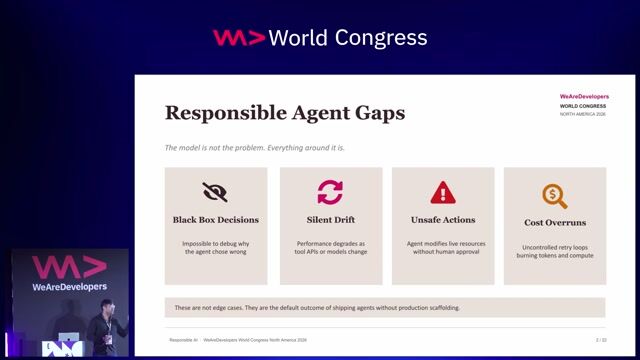
Categorizing common failure modes in AI agents

Agents typically fail by providing incorrect information, executing harmful actions, or succumbing to prompt injection attacks.

#3 about 2 min

Defining the fundamental AI agent loop architecture

A standard agent architecture combines a large language model, an MCP server for tools, and specific routing SDKs.

#4 about 1 min

Adopting a layered approach to agent safety systems

Designing secure AI applications requires multiple defense dimensions rather than relying solely on the language model.

#5 about 2 min

Implementing guardrails to prevent user abuse and injection

Applying specific guardrails automatically redacts sensitive data and restricts unsafe topics from reaching the underlying model.

#6 about 3 min

Enforcing reliable responses using a steering agent

An intermediate steering language model intercepts and reviews agent responses to catch hallucinations or forgotten tool calls.

#7 about 4 min

Securing data access through deterministic MCP interceptors

Intercepting tool calls to deterministically inject customer authentication prevents agents from hallucinating parameters and leaking cross-account data.

#8 about 6 min

Controlling high-stakes transactions with deterministic policy languages

Evaluating every tool call against defined rules using policy languages prevents agents from executing unauthorized or out-of-order actions.

#9 about 4 min

Establishing robust observability and batch evaluation loops

Implementing continuous tracing and periodic evaluations against chat logs ensures accountability and measures ongoing agent performance.

#10 about 3 min

Combining probabilistic and deterministic controls for AI trust

Trust is established by building layered safety pipelines around the agent rather than inherently trusting the underlying model.

#11 about 6 min

Managing general purpose compute and sub-agent architecture

Limiting agent scope through specialized sub-agents mitigates context limits and improves overall system security and observability.

Matching moments

1:47 min

Why tool-using AI agents require behavioral governance

Sachin Gupta Sachin Gupta · World Congress 2026 North America

2:43 min

Best practices for implementing reliable AI agent frameworks

Marcel Scherenberg Marcel Scherenberg · World Congress 2025

3:34 min

Architecting autonomous agents for production lifecycle management

Sebastian Kister Sebastian Kister · World Congress 2026 Europe

7:41 min

Shattered security assumptions in the age of AI

Javier Garza Javier Garza +4 · World Congress 2026 North America

1:09 min

Resolving developer challenges in AI agent implementation

Ricardo Ricardo · World Congress 2025

4:15 min

Security integration and AI skepticism in developer tooling

Chris Heilmann Chris Heilmann +2 · LIVE