World Congress 2021 Jun 29, 2021

Seven Myths, Three Reasons, One Goal

Stefan Priebsch

Blindly layering a REST API over a legacy database creates a fragile distributed monolith. Learn to leverage use-case-driven architectures to modernize systems without triggering expensive, boil-the-ocean rewrites.

Pause
Mute Enter Fullscreen
#1 about 11 min

Comparing legacy architecture to the evolution of cities

How the continuous development of ancient cities provides a parallel for working with legacy systems.

#2 about 6 min

Failing to understand the intent of legacy code

Why the instinctive developer reaction to legacy code actually highlights a lack of communicated business intent.

#3 about 3 min

Dealing with outgrown assumptions in successful software systems

How software that drives business growth eventually breaks due to architectural assumptions that no longer scale.

#4 about 4 min

The lack of responsibility over technical debt

How placing technical debt into a product backlog diffuses responsibility and prevents architectural progress.

#5 about 3 min

The danger of adopting default REST APIs

Why defaulting to REST for internal communication often leads to the anti-pattern of a distributed monolith.

#6 about 4 min

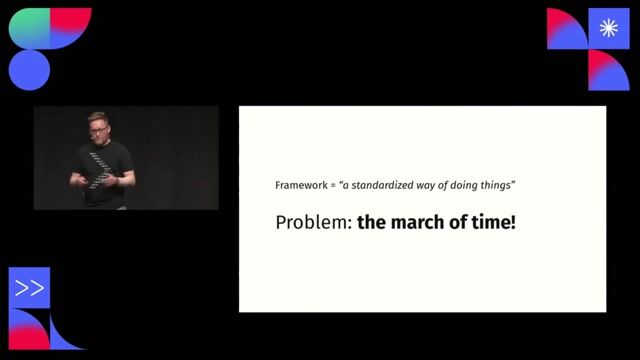
Refuting the immediate need for newer frameworks

How wholesale technology replacements often just swap known problems for unknown ones without adding clear business value.

#7 about 4 min

Avoiding the temptation to rewrite legacy systems entirely

How to introduce new features without rewriting existing business cases by focusing on specific software use cases.

#8 about 4 min

Embracing polyglot persistence versus strictly relational databases

Why defining clear data working sets and canonical sources of truth defeats the requirement for strict database normalization.

#9 about 5 min

Overcoming the perceived expense of major system migrations

How separating functional platform migrations from code refactoring efforts helps consistently keep software upgrade costs manageable.

#10 about 6 min

Eliminating unnecessary layers of abstraction inside microservices

Why self-contained units of deployment do not require the internal layered abstractions typical of large enterprise applications.

#11 about 3 min

Introducing beneficial architectural patterns like event sourcing

How to gradually integrate new methodologies transparently by safely bridging the architectural gap between legacy and greenfield systems.

Matching moments

1:44 min

Strategies for modernizing and mitigating legacy system risks

Leszek Włodarski Leszek Włodarski · World Congress 2026 Europe

5:02 min

Transforming legacy monoliths into modern software systems

Henning Schwentner · LIVE

5:06 min

Modernizing legacy applications through proactive leadership

Babette Wagner Babette Wagner · Coffee With Developers

2:20 min

Five core strategies for handling legacy applications

Niklas Heidloff · LIVE

3:28 min

Managing technical debt in legacy web applications

Robby Russell · Coffee With Developers

3:00 min

Refactoring a complex legacy monolith into microservices

Andrew Holway · LIVE

Upcoming sessions on this topic

Open session

World Congress 2026 North America

September 25, 2026 · 09:40–10:10

Stage 3

Still on 4.8 or lower? A Practical Guide to Moving Your "Un-Migratable" .NET Apps

Isaac Levin

Developer Advocate

Isaac Levin
Open session

World Congress 2026 North America

September 25, 2026 · 10:20–10:50

Stage 2

API = Some REST and HTTP, right? RIGHT?!

Rustam Mehmandarov

Passionate computer scientist

Rustam Mehmandarov
Open session

World Congress 2026 North America

September 25, 2026 · 12:55–13:25

Stage 5

Content Platforms: The Bottleneck Is Responsibility, Not Tech

Daniel Fau, Tom Warwick

Daniel Fau
Tom Warwick
Open session

World Congress 2026 North America

September 25, 2026 · 12:20–12:50

Stage 9

Designing APIs That Survive AI Agents at Scale

Phani Pendurthi

Mastercard, Principal Software Engineer

Phani Pendurthi
Open session

World Congress 2026 North America

September 24, 2026 · 16:10–16:40

Outdoor Stage

When Humans Stop Writing Code: Rethinking Languages, Compilers, and Responsibility

Simon Auer

Organizer of flutter vienna meetup and CEO of marqably

Simon Auer
Open session

World Congress 2026 North America

September 24, 2026 · 14:50–15:20

Stage 9

How to generate business value through performance optimizations

Nikolai Sidiropulo

Software Engineer at Meta

Nikolai Sidiropulo