World Congress 2022 Jun 15, 2022

Graph Neural Networks: What’s behind the Hype?

Ekaterina Sirazitdinova

Most real-world data is unstructured, so why limit deep learning to images and text? Discover how Graph Neural Networks unlock complex relationships in sparse datasets using message passing.

Pause
Mute Enter Fullscreen
#1 about 3 min

Structured versus unstructured data domains in machine learning

How convolutional networks handle structured domain grids compared to the complex vertices of unstructured information.

#2 about 1 min

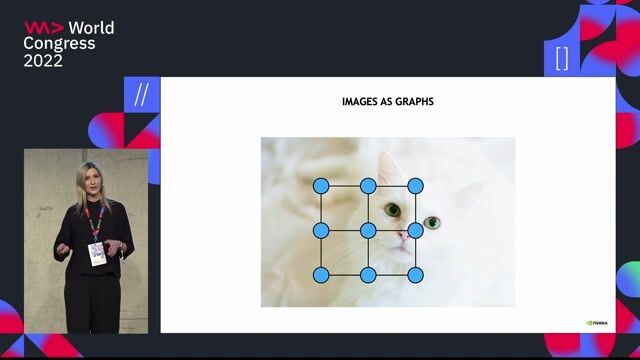
Modeling structured images as specialized grid graphs

Pixel structures can be formatted as computational grids by treating individual pixels as nodes connected by imaginary edges.

#3 about 2 min

Core graph theory constructs and connectivity models

The foundational mechanisms governing directional properties and node degrees across diverse physical and logical frameworks.

#4 about 1 min

Homogeneous and heterogeneous data network mapping

Distinguishing between networks featuring uniform entity types and multifaceted e-commerce environments filled with varied behavioral actions.

#5 about 1 min

Exploring single and multi-hop local neighborhoods

How immediate adjacent connections extend their interaction boundaries through multiple depths to define relevant topological proximity.

#6 about 2 min

Representing connections explicitly via adjacency matrices

Storing active relationships and specific edge weights symmetrically to evaluate smaller and predictable molecular node configurations.

#7 about 1 min

Scaling sparse network architecture through adjacency lists

Overcoming array capacity limitations and spatial inefficiencies by substituting basic matrices with edge-tuple permutation structures.

#8 about 2 min

Neural classification training and network inference basics

Identifying patterns using targeted data extraction to continuously update stateful learning weights prior to production deployment.

#9 about 2 min

Ground truth reliance across distinct learning paradigms

The fundamental operational constraints shaping supervised mapping functions, unsupervised clustering actions, and semi-supervised geometric tasks.

#10 about 1 min

Extracting representations to fuel varied predictive levels

Transforming localized raw features into cohesive components that effectively facilitate distinct and hierarchical analytical prediction outputs.

#11 about 2 min

Categorizing molecular capabilities through graph-level tasks

Labeling sweeping structural sets sequentially to systematically predict continuous chemical properties or targeted global characteristics.

#12 about 2 min

Mapping localized node splits over temporal attributes

Classifying discrete relational fragmentation and yielding spatial forecasts using targeted and independent focal network nodes.

#13 about 2 min

Uncovering link opportunities using edge-level analytics

Flagging anomalous transaction activity while accurately projecting personalized media recommendations and dynamic geospatial travel durations.

#14 about 3 min

Embedding dynamic characteristics sequentially via message passing

Building informational depth by continuously aggregating and mathematically updating relevant behavioral signals sourced from bordering node groups.

#15 about 1 min

Fine-tuning stacked message-passing configurations for optimized learning

Utilizing baseline activation logic and gradient-driven optimization strategies throughout subsequent layers of progressively learned abstractions.

#16 about 1 min

Preventing data leaks via transductive topological separation

Isolating testing node samples systematically outside centralized network training loops to correctly preserve ongoing model accuracy metrics.

#17 about 2 min

Operating geometric pipelines with standard Python ecosystems

Harnessing established foundational frameworks and container computing layouts to dynamically accelerate comprehensive model architecture lifecycles.

#18 about 2 min

Systematically reviewing unstructured network prediction mechanisms

Summarizing optimal matrix configurations and structured sequential processing cycles strictly necessary to assemble functional topological inferences.

#19 about 3 min

Contextualizing code generation tooling and localized network vectors

Addressing procedural leak containment boundaries, broad semantic structural dependencies, and language-based parity within isolated graph deployments.

Matching moments

5:06 min

Applying geometric deep learning to generalized graph operations

Noah Weber · LIVE

1:27 min

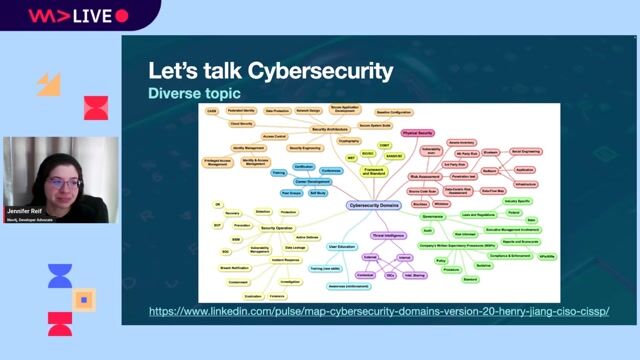
Modeling connected data using graph structures

Jennifer Reif · LIVE

2:33 min

Understanding graph databases and node relationship modeling

1:52 min

Fundamentals of graph databases and semantic relationships

Zaid Zaim Zaid Zaim +1 · WWC Europe 2026

3:45 min

Familiarizing with machine learning and neural network basics

Tillman Radmer +2 · WWC 2021

2:37 min

Educational resources for building graph-backed AI applications

Stephen Chin Stephen Chin · WWC 2024

Upcoming sessions on this topic

Open session

World Congress 2026 North America

Building Stuff with GenAI - The Open Minded Workshop beyond OpenAI

Andreas Erben

CTO for Applied AI and Metaverse at daenet

Andreas Erben
Open session

World Congress 2026 North America

Compute for your AI model: GPUs, LPUs, TPUs and beyond..

Kushaagra Goyal

Tech Lead at Rubrik, ex-CTO at Gan.AI, ex-Databricks

Kushaagra Goyal
Open session

World Congress 2026 North America

DeepAgents: Build Multi-Agent AI Systems That Actually Work

Anagha Rumade, Anjana Umapathy, Apoorva Jaiswal

Anagha Rumade
Anjana Umapathy
Apoorva Jaiswal
Open session

World Congress 2026 North America

Understanding LLM Architectures: Inside the Design of Modern Models

Jofia Jose Prakash

Enterprise AI Architect at American Chemical Society

Jofia Jose Prakash
Open session

World Congress 2026 North America

You Can’t Re-Run Sunlight: Designing ML Data Architectures for Physical AI

An Phan

Senior Data Infrastructure Engineer @ Hippo Harvest

An Phan
Open session

World Congress 2026 North America

Agents That Own Their Inference: Building Production AI Agents on Dedicated GPUs

Duan Lightfoot

Sr. AI Engineer, Akamai

Duan Lightfoot