An unoptimized 10MB website requires 28 trees to compensate for its carbon output. Discover how to shrink your bundle size and build a more sustainable web.
#1about 1 minute
The growing impact of websites on the climate
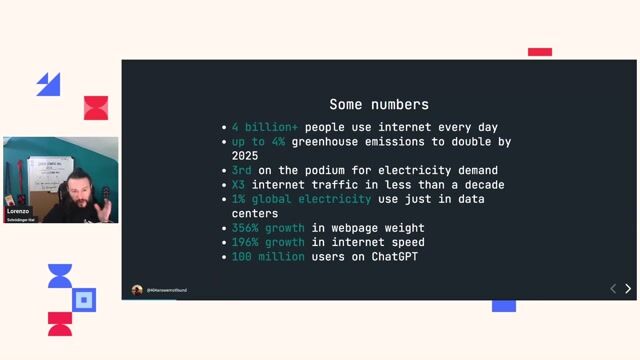
The increasing size and usage of websites have a direct and growing impact on global energy consumption and the climate.
#2about 3 minutes
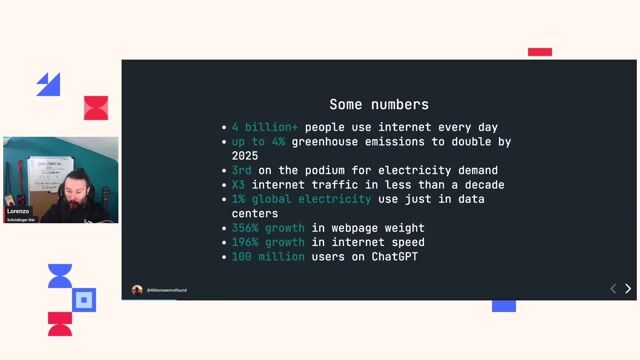
Website size and data center energy consumption are exploding
The average website is four times larger than a decade ago, and data centers now account for a significant percentage of national energy usage.
#3about 6 minutes
How modern internet usage habits drive data consumption
Increased daily screen time, the shift to mobile-first browsing, and the rise of e-commerce are key drivers of higher internet data consumption.
#4about 4 minutes
Why large JavaScript bundles are bad for users and the planet
Large JavaScript bundles not only create slow user experiences by consuming bandwidth but also strain device CPUs, increasing energy use on both ends.
#5about 4 minutes
Comparing the simple web of the past to today's complex sites
A look back at websites from a decade ago reveals a shift from simple text and low-res images to today's media-rich, interactive, and heavier applications.
#6about 6 minutes
The shift from jQuery to modern JavaScript frameworks
Web development has evolved from using jQuery for simple interactions to building entire applications with powerful but heavier frameworks like React, Angular, and Vue.
#7about 5 minutes
Measuring a website's carbon footprint with online tools
Tools like Website Carbon estimate a site's environmental impact by analyzing data transfer, CPU intensity, and the data center's energy source.
#8about 5 minutes
Case study of a bloated website's high carbon footprint
Analyzing a deliberately heavy website with a 10MB bundle reveals a massive carbon footprint, equivalent to driving an electric car for thousands of kilometers.
#9about 4 minutes
Case study of a minimal website's low carbon footprint
In contrast, a simple static HTML site with a tiny 20KB footprint is shown to be extremely energy-efficient, requiring almost no carbon offset.
#10about 5 minutes
Using static site generators and Jamstack for efficiency
Building websites with static site generators (SSGs) and the Jamstack architecture pre-renders pages, resulting in smaller bundles and faster performance.
#11about 4 minutes
Understanding Jamstack architecture and incremental static generation
The Jamstack decouples the frontend from backend services, and incremental static generation (ISG) optimizes build times for very large sites.
#12about 3 minutes
Compressing assets with Gzip and Brotli for smaller transfers
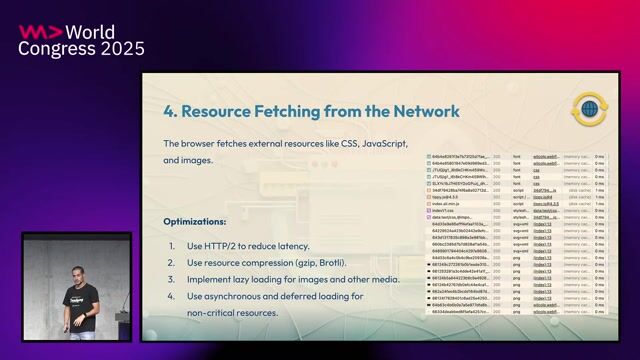
Implementing server-side compression like Gzip, and especially the more efficient Brotli, significantly reduces the amount of data transferred to the user.
#13about 3 minutes
Implementing code splitting and lazy loading for faster initial loads
Code splitting with dynamic imports and lazy loading components ensures that users only download the JavaScript they need for the current view.
#14about 2 minutes
Choosing a hosting provider that uses green energy
The final step in reducing a website's environmental impact is to host it in a data center that is powered by renewable, green energy sources.
Related jobs
Jobs that call for the skills explored in this talk.
The HTML Elements That You’re Probably Over-EngineeringAs frameworks have become more and more commonplace in the world of web development, so too has the over-engineering of features made possible by our humble old friend, HTML.
The mental models that come with using state management in React, Vue and o...
Daniel Cranney, Chris Heilmann
Dev Digest 215: Agent Memory, JS2026, Googlebot Analysis & Canvas❤️HTMLInside last week’s Dev Digest 215 .
🗿 Make AI talk like a caveman
🧠 A guide to context engineering for LLMs
🤖 Simon Willison on agentic engineering
🔐 Axios supply chain attack post mortem
🛡️ Designing AI agents to resist prompt injection
🎨 HTML in c...
Chris Heilmann
Getting started with hosting HTML/CSS/JavaScript demos/web sites on GitHub PagesHosting HTML/CSS/JS on GitHub
People often ask for a simple place to hos HTML, CSS and JavaScript and forget that the place where we store our source code can also be used for hosting of simple web solutions. Here’s a quick reminder how to use GitHub...
SciChart
The Fastest JavaScript Charts - Built for React and BeyondFor most developers, browser charting works fine — until it doesn’t. Once you push beyond tens of thousands of points, add live streaming, or need advanced interactions, the story changes: frame drops, frozen dashboards, memory issues.
That’s where S...
From learning to earning
Jobs that call for the skills explored in this talk.