Is your perimeter security obsolete? Learn the architectural patterns that contain attackers who are already inside your network and prevent lateral movement.
#1about 2 minutes
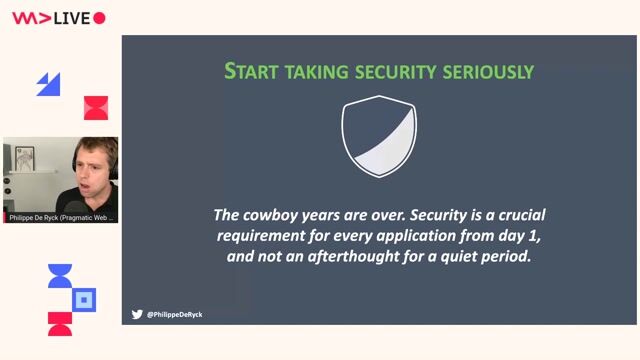
The urgent need for API security from day one
Recent studies show widespread vulnerabilities like hard-coded keys and authorization failures, highlighting the necessity of designing for security from the start.
#2about 1 minute
Focusing on secure architecture over just code
The OWASP API Security Top 10 reveals that many critical risks, like broken authorization, are best addressed through architectural design rather than just secure coding practices.
#3about 2 minutes
A typical API architecture overview
A common API architecture consists of clients, an API gateway acting as a single entry point, and various backend APIs or microservices handling specific responsibilities.
#4about 6 minutes
Why perimeter security is no longer enough
A compromised internal service, such as a vulnerable image processor, can breach the entire trusted zone, demonstrating that a single perimeter defense is insufficient.
#5about 5 minutes
Using compartmentalization for defense-in-depth
By isolating high-risk services like image processors into separate trust zones, you can contain the damage from a potential breach as part of a defense-in-depth strategy.
#6about 3 minutes
Isolating both untrusted and sensitive services
Compartmentalization applies both to sandboxing untrusted components and to creating secure enclaves for highly sensitive services like authentication or payments.
#7about 5 minutes
Authenticating internal API-to-API calls
To prevent a compromised internal service from moving laterally, enforce authentication between all internal APIs and define strict policies on which services can communicate.
#8about 5 minutes
Propagating user context to internal APIs
Internal services need user context to make authorization decisions, which can be achieved by forwarding the user's authentication state from the gateway via a token relay.
#9about 4 minutes
Using reference tokens instead of raw JWTs
To avoid exposing large or sensitive JWTs to clients, an API gateway can issue a small, opaque reference token and translate it back to the full JWT for internal API calls.
#10about 2 minutes
Following JWT security best practices
JSON Web Tokens are not a complete security solution and require careful implementation to avoid common pitfalls related to signature validation, algorithm choice, and revocation.
#11about 2 minutes
Key architectural takeaways for API security
Improve your API security by planning for compromise, choosing simple and robust solutions, and using the API gateway to shield internal implementation details from clients.
Related jobs
Jobs that call for the skills explored in this talk.
Dev Digest 214: Claude Is Leaking, GitHub Is Listening & Axios Hacked!Inside last week’s Dev Digest 214 .
🕵️ Claude source code leaked, analysed and re-written in 2 days
🐙 GitHub auto-opts users into feeding their code to train their AI
🌐 Pretext shows how to show complex text rendering in the browser
🤖 How to securin...
The Overflow: 5 Security and Privacy Tools for DevelopersWe’re back again with another edition of the Overflow, where we share some of the best tools we’ve found from around the web that we just couldn’t cram into the already jam-packed editions of the Dev Digest.
So let’s take a look at five security and ...
From learning to earning
Jobs that call for the skills explored in this talk.