

World Congress 2022 Jun 15, 2022

To New Frontiers: The Future of Frontend Development

Rainer Hahnekamp

The relentless pursuit of speed is pushing frontend development back to the server. Zero-size compilers and advanced hydration are rapidly redefining modern web architecture today.

Pause
Mute Enter Fullscreen
#1 about 3 min

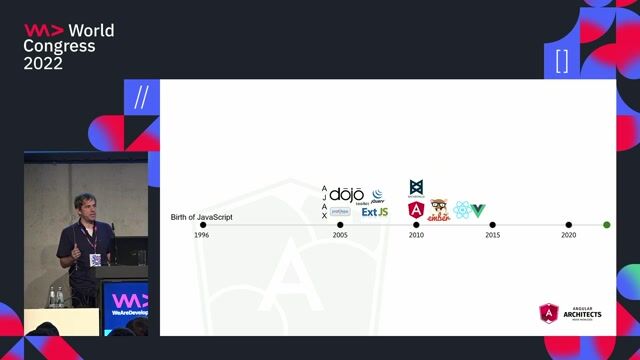
Early evolution of frontend development frameworks

The history of web development transitions from rapid framework turnover to more stable choices.

#2 about 2 min

Dominance of the big three frontend frameworks

Angular, React, and Vue have established unprecedented longevity and industry adoption.

#3 about 2 min

Improving performance with advanced compiled language tooling

Moving build processes to compiled languages significantly decreases compilation and setup times.

#4 about 3 min

Understanding runtime interpretation overhead in web applications

Heavy reliance on browser-side interpretation requires downloading and parsing large framework bundles.

#5 about 3 min

Compiling code to eliminate frontend framework runtime

Generating optimized code ahead of time removes the overhead of processing complex virtual structures entirely.

#6 about 4 min

Optimizing client logic with server-side hydration strategies

Selective and just-in-time loading methods constrain bundle sizes by shipping only essential interactive behaviors to browsers.

#7 about 5 min

Reducing client dependencies through backend data fetching

Executing data-heavy operations initially on servers prevents massive utility library downloads from bogging down user connections.

#8 about 2 min

Future expectations for frontend architecture and tooling

Future web development will prioritize faster background systems rather than completely replacing existing structural frameworks.

#9 about 3 min

Comparing developer hype against actual framework usage

Survey excitement frequently misrepresents the reality of corporate download counts and ongoing production deployments.

#10 about 3 min

Addressing framework compilation and subsequent career shifts

Shifting more operational weight to server components naturally blurs the lines separating frontend engineering from full-stack development.

Matching moments

2:28 min

Expected features and performance defaults in modern JavaScript frameworks

Sasha Shynkevich · LIVE

2:52 min

Introduction and motivation for exploring new frontend frameworks

Benjamin Glusa · LIVE

2:14 min

Exploring frontend development choices beyond standard JavaScript frameworks

Stacy Cashmore · WWC 2022

48 sec

Exploring alternative build tools and experimental web components

Sasha Shynkevich · LIVE

3:49 min

The evolution and complexity of the modern frontend stack

JS Congress

1:27 min

Summary of modern Next.js web development toolchains

Marius Obert Marius Obert · WWC 2023

Upcoming sessions on this topic

Open session

World Congress 2026 North America

Full Stack with Flutter - are we there yet?

Nemanja Stošić

Senior Flutter Developer

Nemanja Stošić
Open session

World Congress 2026 North America

Architecting AI in Angular: WebMCP, A2UI, and the Agent Experience

Ankita Sood

Sr. Principal Engineer @ Secureworks | Angular GDE

Ankita Sood
Open session

World Congress 2026 North America

Fast by Design: A Masterclass in High-Performance Web Engineering

Aaron Grogg

Senior web developer, committed to improving the user experience by improving web performance

Aaron Grogg
Open session

World Congress 2026 North America

When Humans Stop Writing Code: Rethinking Languages, Compilers, and Responsibility

Simon Auer

Organizer of flutter vienna meetup and CEO of marqably

Simon Auer
Open session

World Congress 2026 North America

Beyond Vibe Coding: An AI Builder’s Guide to Migrating 10k+ React Components

Shubham Chaurasia

Senior Software Engineer @ Meta

Shubham Chaurasia
Open session

World Congress 2026 North America

How to generate business value through performance optimizations

Nikolai Sidiropulo

Software Engineer at Meta

Nikolai Sidiropulo