
World Congress 2022 β€’ Jun 15, 2022

C++ in constrained environments

Bjarne Stroustrup

Stop defaulting to restrictive C subsets for embedded systems. Expressive C++ abstractions actually help the compiler generate highly efficient code. Shift your computation to compile time today.

Pause
Mute Enter Fullscreen
#1 about 3 min

Defining hardware limitations inside varying constrained environments

How varying restrictions like power, memory capacity, and processing hardware continuously impact software scaling decisions.

#2 about 3 min

Dispelling common optimization and runtime performance misconceptions

Why subsetting language feature sets or fearing class hierarchies ultimately produces strictly unoptimized and error-prone configurations.

#3 about 2 min

Designing versatile software interfaces using the onion principle

Providing clean abstraction layers directly enables maintaining high-level interfaces while permitting unconstrained hardware access later.

#4 about 4 min

Mapping structural hardware models around fundamental storage mechanics

The straightforward mechanism of memory composition reliably maps objects onto compact sequential layouts across designated storage boundaries.

#5 about 5 min

Accelerating structured resource acquisition across customized object properties

Employing constructors and destructors guarantees resource destruction scales inherently through basic types alongside customized object configurations.

#6 about 3 min

Substituting restricted language constructs with standardized type constraints

Replacing structurally dangerous types like unions with standardized variants permanently enforces strict type validity and runtime scrutiny.

#7 about 5 min

Eradicating implicit array bounds faults deploying parameter spans

Combining pointers tightly to array parameters completely eradicates redundant bounds checking loops and hidden iteration flaws.

#8 about 7 min

Migrating advanced mathematical computation safely into compile evaluations

Shifting evaluation toward constant expressions and customized literal operators moves validation delays strictly to standard compile periods.

#9 about 7 min

Modernizing legacy programming architectures using iterative core guidelines

Enforcing specialized rules via static checkers separates modern safe components seamlessly without damaging established codebases.

#10 about 12 min

Constructing deliberate error handling paradigms matching variable dependencies

Selecting actively between system exceptions, native error returns, or execution termination depends definitively on environmental validation context.

#11 about 4 min

Preventing data races executing isolated lock-free standard structures

Standardized formal memory models enforce that lock-free atomic routines interact transparently alongside integrated standardized worker threads.

#12 about 3 min

Implementing modern language feature advancements carefully alongside readability

Creating readable standard logic proactively improves integration capabilities by assisting automated compilers tracking sequential execution steps.

#13 about 8 min

Exploring runtime testing validations and scheduled upcoming iterations

Assessing when developers should execute expected local state testing while identifying scope adjustments postponing updated release timelines.

Matching moments

4:59 min

Mastering algorithms and data structures for performance

Michele Riva Β· World Congress 2023

1:42 min

Navigating emerging hardware standardization in vendor programming ecosystems

Paul Graham Paul Graham Β· LIVE

4:40 min

Optimizing execution with compact layouts and compile-time computation

Bjarne Stroustrup Β· World Congress 2022

13:57 min

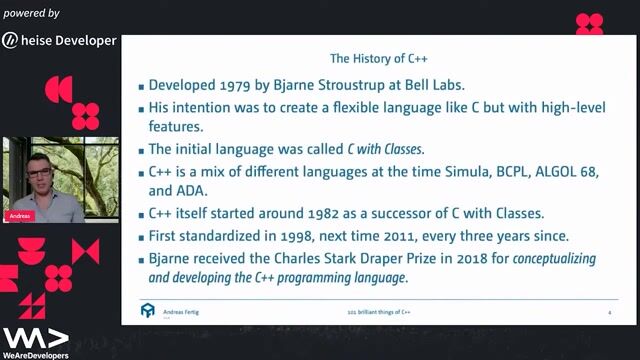
History of C++ technical debt and language design

Stefan Baumgartner Β· LIVE

7:45 min

Bridging hardware manipulation and high-level object abstractions

Andreas Fertig Β· World Congress 2021

1:21 min

Key principles for engineering compliance and speed

Martin Reynolds Martin Reynolds Β· World Congress 2025

Upcoming sessions on this topic

Open session

Beware of Strangers Bearing Code: Open Source Trust in the Agent Era

  • Vikram Vaswani

    Consultant

Open session

Teaching AI Coding Agents to Build It Right the First Time

  • Sajeetharan Sinnathurai

    Microsoft

    Principal Product Manager

Open session

Prompt Debt: Why Your AI System Is Frozen in Time

  • Suriya Prakash B

    Red Hat

    Principal Software Engineer

Open session

What I Got Wrong Shipping an MCP Server for Live Infrastructure

  • Pritesh Kiri

    Harness

    Developer Relations Engineer

Open session

Designing for Every Direction: Logical CSS for Global, Adaptive, and Effortlessly Reversible UIs

  • Vidhya Krishnamoorthy

    Morgan Stanley

    VP, Software Engineering Manager

Open session

How We Cut Our API's p99 Latency from Minutes to Under a Second

  • Deepak Agrawal

    Atlassian

    Principal Software Engineer