



World Congress 2022 • Jun 15, 2022

Intro to FastAPI

Sebastián Ramírez

Sebastián Ramírez reveals how FastAPI uses Python type hints to eliminate boilerplate and rival Go's performance. Skip the redundant validation code and build lightning-fast, enterprise-ready APIs.

Pause
Mute Enter Fullscreen
#1 about 2 min

Introduction to the fast API web framework

Overview of a high-performance Python framework for building web APIs.

#2 about 3 min

Leveraging open API standards and python type hints

Adhering to data standards and type annotations enables built-in validation and documentation.

#3 about 2 min

Building a basic web application routing setup

Creating a simple endpoint uses function decorators to return serialized data.

#4 about 3 min

Handling path variables and query parameters efficiently

Declaring variables directly in function signatures automates URL extraction and type conversion.

#5 about 2 min

Generating interactive web API documentation automatically

Accessing a built-in interactive user interface immediately tests endpoints and verifies parameter requirements.

#6 about 4 min

Defining request payloads using standard data validation models

Processing HTTP requests relies on custom declared classes inheriting from primary base models.

#7 about 2 min

Combining request bodies with optional query parameters

Defining multiple parameter types in a single function signature seamlessly structures complex client interactions.

#8 about 2 min

Parsing deeply nested data structures for complex requests

Utilizing standard built-in typing parses arrays of deeply nested json objects successfully.

#9 about 4 min

Handling missing fields and nested validation errors

Returning exact error locations and missing field requirements directly to the client reduces debugging time.

#10 about 2 min

Preventing bugs through continuous editor type checking

Exposing standard annotations grants editors immediate auto-completion abilities inside complex coding iterations.

#11 about 3 min

Achieving high concurrency throughput comparable to compiled languages

Leveraging modern asynchronous tools beneath the hood maximizes concurrency speeds against compiled equivalents.

#12 about 3 min

Exploring dependency injection and supplementary framework features

Activating extra functionalities integrates background tasks and security configurations securely out of the box.

#13 about 1 min

Deploying applications into serverless cloud computing environments

Hosting frameworks utilizing community extensions simplifies deployment across cloud platforms.

#14 about 2 min

Managing community support using repository issue templates

Structuring templates restricts inbound tickets to facilitate focused troubleshooting and community resolutions.

#15 about 2 min

Navigating language evolution and type annotation updates

Collaborating directly with language core developers prevents architectural modifications from breaking runtime processes.

#16 about 1 min

Exporting open API specifications without running web servers

Generating raw structural files programmatically bypasses manual schema drafting entirely.

#17 about 2 min

Configuring development environments for optimal code completion

Leveraging standardized typing rules unlocks advanced tooltips across mainstream code editors.

#18 about 2 min

Disabling automatic endpoints and exporting static documentation

Modifying initialization arguments directly bypasses interactive rendering or offloads specs appropriately.

#19 about 2 min

Evaluating runtime execution and framework iteration speeds

Contrasting framework capacities against older designs demonstrates optimizations created after architectural shifts.

#20 about 3 min

Combining modern asynchronous servers with legacy protocol apps

Supporting updated server interfaces maintains high speed protocols alongside backward compatible logic.

#21 about 2 min

Comparing runtime validation capabilities against typescript frameworks

Referencing original type assignments directly guarantees payload integrity without repeating data structures manually.

#22 about 2 min

Designing an approachable and developer friendly open framework

Minimizing the learning curve relies heavily on verbose markdown files and predictable integrations.

#23 about 2 min

Integrating future language annotations and asynchronous database clients

Upgrading logic implementations reduces verbose dependencies whilst introducing parallel execution database connectors.

Matching moments

1:22 min

Key features and advantages of using FastAPI

Ashmi Banerjee · World Congress 2022

2:41 min

Prerequisites for building backends with FastAPI

Ashmi Banerjee · World Congress 2022

1:50 min

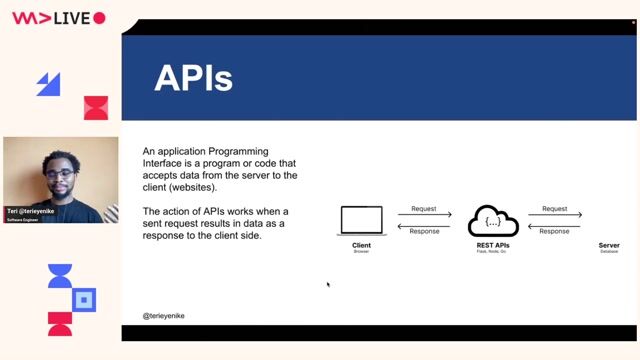
Introduction to building APIs with Flask

Teri Eyenike · LIVE

6:04 min

Comparing Python backend frameworks for web development

Ashmi Banerjee · World Congress 2022

3:56 min

Accelerating frontend implementation with api contracts and concise documentation

Hans Hosea Schäfer · LIVE

1:33 min

Model serving options and asynchronous function requirements

Ashmi Banerjee · World Congress 2022

Upcoming sessions on this topic

Open session

AI Is the Easy Part: Why Faster Engineers Don't Make Faster Businesses

  • Bharat Sharma

    Booking

    Senior Engineering Manager

Open session

How We Cut Our API's p99 Latency from Minutes to Under a Second

  • Deepak Agrawal

    Atlassian

    Principal Software Engineer

Open session

Build a Zero-Cost AI Agent in Your Browser

  • Aishwarya Mathuria

    Adobe

    Computer Scientist

  • Nishant Thakur

    Adobe

    Senior Computer Scientist

Open session

Teaching AI Coding Agents to Build It Right the First Time

  • Sajeetharan Sinnathurai

    Microsoft

    Principal Product Manager

Open session

From Prompt Engineering to Harness Engineering: Building Observable and Governed GenAI Systems

  • Lakshmi Devi Prakash

    JPMorgan Chase

    VP, Applied AI/ML Lead

Open session

React Under Fire: Rendering Performance for Streaming Agent UIs

  • Abhirupa Mitra

    Slack

    Senior Member of Technical Staff