




SH
Severine Hierso
WeAreDevelopers LIVE
•
Oct 5, 2022
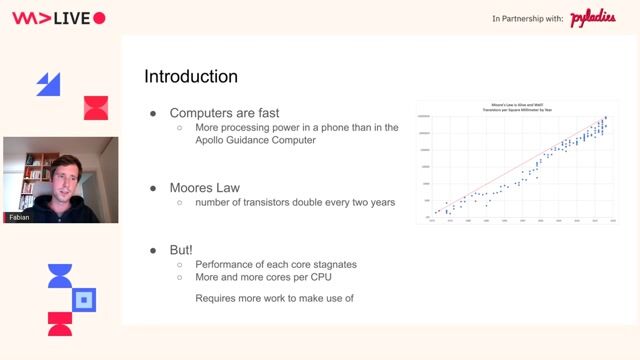
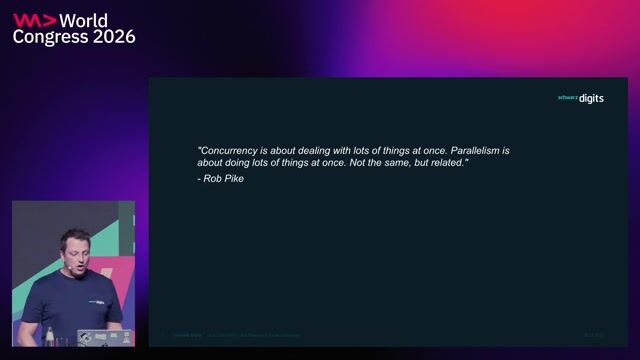
Concurrency in Python
Fabian Schindler
- Discuss this with your agent
- Open in Claude
- Open in ChatGPT
Is your Python app struggling to scale? Master asyncio to bypass the Global Interpreter Lock and build high-performance services that handle thousands of concurrent clients.
Matching moments
2:59 min
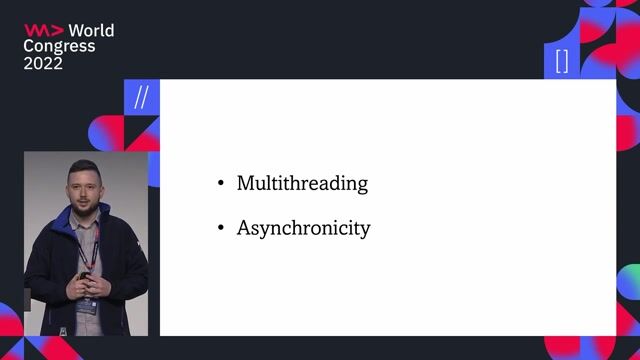
Parallel execution through multiprocessing and multithreading concepts
Shweta Palande · LIVE
2:10 min
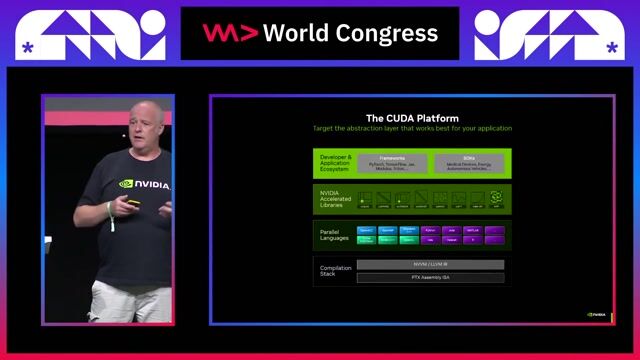
Overcoming threading challenges for Python on GPUs
Stephen Jones · Coffee With Developers
2:34 min
Achieving high concurrency throughput comparable to compiled languages
Sebastián Ramírez · World Congress 2022
9:07 min
Discussion on scalability and concurrent application performance
Christian Woerz · LIVE
2:31 min
Introduction to Go concurrency and parallelism
 Rick Rackow · World Congress 2026 Europe
1:34 min
Understanding concurrency against parallelism in application execution
Frank Müller · World Congress 2021
More from WeAreDevelopers LIVE
Related videos
Related articles
.gif)
DA
Dr. Andy R. Terrel - NVIDIA


BB
Benedikt Bischof
.gif)
From learning to earning
Jobs that call for the skills explored in this talk.
20 days ago
Software Engineer, Python (Asset Pricing & Hedging)

Bitpanda
Laza, Spain
Remote
NoSQL
Backend
Fastapi
about 1 month ago
•
Verified
Software Engineer, Fullstack

Sciforium
San Francisco, United States
Expert
$165k–210k
Python
about 1 month ago
•
Verified
Lead Software Engineer, Model Serving Platform
Sciforium
San Francisco, United States
Expert
$230k–300k
Python
about 1 month ago
•
Verified
Senior AI Serving Engineer, Backend
Sciforium
San Francisco, United States
Expert
$190k–250k
Rust
Python
16 days ago
Principal Software Engineer, AI Inference Runtime

ARM
Seattle, WA, United States
Expert
$262k
Compilers
Low Latency
Concurrency
about 1 month ago
•
Verified
LLM Training Engineer
Sciforium
San Francisco, United States
Expert
$155k–220k
Python