
World Congress 2023 Sep 27, 2023

Reality and Beyond: Coding a Drone Using {Unity 3D .NET} and ChatGPT AI!

Zaid Zaim

Move beyond a printed hello world and control a physical drone. Master mixed reality by combining Unity 3D, .NET, and ChatGPT to build spatial computing apps.

Pause
Mute Enter Fullscreen
#1 about 5 min

Introduction to coding hardware with mixed reality

Integrating mixed reality headsets with programmable drones provides tangible physical feedback for initial coding experiments.

#2 about 3 min

Development tools for spatial computing and drones

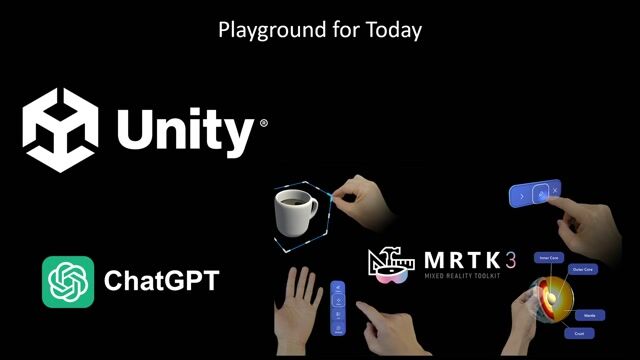
Unity 3D, the MRTK framework, and generative language models serve as the technical foundation for spatial applications.

#3 about 3 min

Telemetry and hardware capabilities of the Tello

The Tello provides telemetry data and autonomous flight capabilities similar to an airborne IoT device.

#4 about 4 min

Understanding boundaries between augmented and virtual realities

Differentiating environmental overlays from fully immersive simulations clarifies the specific requirements of true spatial computing.

#5 about 6 min

Enterprise capabilities and transparent displays of HoloLens

Unobstructed physical vision and hands-free interaction models support remote engineering diagnostics and medical operations.

#6 about 3 min

Sending network commands via the Tello UDP

Unreliable datagram protocols negotiate specific network ports for sending programmatic maneuvers and receiving state telemetry.

#7 about 2 min

Scaffolding initial UDP network connections via LLMs

Generative text interfaces provide multi-threaded baseline functions for binding ports and encoding datagram messages.

#8 about 5 min

Binding spatial input scripts using Unity components

Custom drone handler dependencies translate simulated virtual hands into UDP network transmissions within the game engine.

#9 about 7 min

Live mixed reality flight execution and control

Deploying spatial interfaces connects the physical hardware to holographic views for real-time directional manipulation.

#10 about 2 min

Testing interactive virtual menus in outdoor deployment

Selecting actions from floating holographic panels translates into complex synchronized drone movements across real physical spaces.

#11 about 3 min

Technical trade-offs between game engines and headsets

Alternative mixed reality devices, engine optimizations, and environmental awareness systems differentiate the available spatial computing solutions.

Matching moments

5:48 min

Demonstrating holographic artificial intelligence copilot live interactions

Zaid Zaim Zaid Zaim · World Congress 2024

56 sec

Core technology stack for mixed reality copilots

Zaid Zaim Zaid Zaim · World Congress 2024

2:39 min

Transitioning toward immersive spatial computing technologies

Bastian Schütz Bastian Schütz · World Congress 2024

2:31 min

Outlining the hardware and software architecture of mixed reality

Nahed Hatahet Nahed Hatahet · World Congress 2024

4:24 min

Exploring the capabilities of mixed reality headsets

Bastian Schütz Bastian Schütz · World Congress 2024

1:48 min

Role of immersive technologies in AI copilots

Zaid Zaim Zaid Zaim · World Congress 2024

Upcoming sessions on this topic

Open session

World Congress 2026 North America

September 24, 2026 · 16:10–16:40

Stage 5

From Software Agents to Physical Devices: Inside the Agentic Hardware Stack

Michael Yuan, Vivian Hu

Michael Yuan
Vivian Hu
Open session

World Congress 2026 North America

September 25, 2026 · 10:20–10:50

Stage 5

Physical AI: 5 Things You Can Build That Aren't Another Chatbot

Vini Senger

Senior Technical Evangelist for Startups

Vini Senger
Open session

World Congress 2026 North America

September 25, 2026 · 14:50–15:20

Stage 4

Intelligence in Motion: Building the Next Generation of AI-Powered Apps on Zoom's Developer Platform

Brendan Ittelson

Chief Ecosystem Officer of Zoom

Brendan Ittelson
Open session

World Congress 2026 North America

September 23, 2026 · 10:00–17:00

Stage 11

Building Stuff with GenAI - The Open Minded Workshop beyond OpenAI

Andreas Erben

CTO for Applied AI and Metaverse at daenet

Andreas Erben
Open session

World Congress 2026 North America

September 25, 2026 · 16:50–17:20

Stage 1

Honey, look! I vibe-coded an OS!

Ian Smith

CTO of LYOS

Ian Smith
Open session

World Congress 2026 North America

September 25, 2026 · 09:40–10:10

Stage 5

Vibe Coding Accessibility

Karl Groves

Focused on actively fixing accessibility

Karl Groves