


World Congress 2023 Oct 6, 2023

How We Built a Machine Learning-Based Recommendation System (And Survived to Tell the Tale)

Dora Petrella

A data science team replaced their underperforming SQL recommender with a Meta-Prod2Vec neural network. Learn how injecting article metadata solved long-tail recommendations and boosted product coverage by 45 percent.

Pause
Mute Enter Fullscreen
#1 about 2 min

Identifying the need for product replacement recommendations

Out-of-stock items drive customers to competitors unless relevant alternatives are immediately surfaceable.

#2 about 2 min

Understanding data sources in a complex b2b environment

Combining internal systems, website events, and purchase histories provides the foundational data for machine learning models.

#3 about 3 min

Defining multiple business use cases for recommendations

A flexible recommendation architecture serves diverse needs ranging from customer-facing web pages to internal order management tools.

#4 about 3 min

Evaluating limitations of legacy sql-based recommenders

Statistical formulas calculated continuously in sql struggle to provide accurate recommendations for newly listed or unpopular items.

#5 about 3 min

Adapting natural language algorithms for product recommendations

Applying prod2vec logic to user interaction sessions allows engineers to derive implicit training labels using sliding context windows.

#6 about 2 min

Training a neural network with one-hot encoded vectors

Feeding product combinations into a hidden layer model generates probability scores for items appearing within the same session.

#7 about 2 min

Improving long-tail predictions using meta-prod2vec algorithms

Concatenating category and brand metadata into product vectors significantly improves alternative matching for infrequently purchased items.

#8 about 1 min

Calculating vector distances to generate final alternatives

Measuring cosine similarity between geometric array representations allows the system to surface the most contextually relevant product replacements.

#9 about 2 min

Building the machine learning engineering pipeline

Connecting dbt transformations with vertex ai and orchestrating regular automated training runs ensures clean data flows into the elasticsearch storage.

#10 about 3 min

Evaluating model performance through offline metrics mapping

Testing against a production-like distribution utilizing ndcg and shadow traffic analysis confirms improvements in latency and catalog coverage.

#11 about 4 min

Visualizing product embeddings to validate clustering logic

Plotting multidimensional vectors in an open-source 3d projector tool confirms that related product attributes cluster accurately.

#12 about 2 min

Establishing pragmatic business baselines for model evaluation

Implementing a simple heuristic baseline metric sets a measurable quality gate and builds trust with non-technical stakeholders.

#13 about 2 min

Automating exploratory data analysis within training pipelines

Embedding automated html plotting directly into the model training pipeline prevents bad data from silently corrupting updated training runs.

#14 about 2 min

Team composition and realistic product launch timelines

Delivering an end-to-end recommendation system requires cross-functional collaboration and often exceeds initial baseline timeline estimates.

Matching moments

1:50 min

Real life recommendation systems and final project conclusions

Lutske van der Meer Lutske van der Meer · WWC 2024

2:40 min

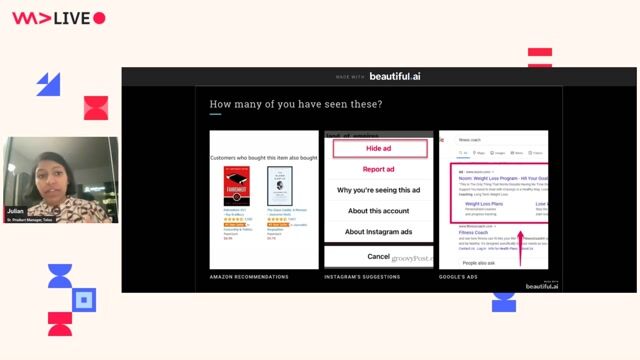
Understanding real-world recommendation systems in common platforms

Julian Joseph · LIVE

2:14 min

Assessing the future of AI in web performance optimization

Perf + AI

4:42 min

Predicting future retail experiences and avoiding technology hype

Alejandro Saucedo Alejandro Saucedo +2 · WWC 2025

57 sec

Implementing predictive prefetch with machine learning

Jessica Janiuk · JS Congress

2:50 min

Driving subtle product enhancements with historical platform data

Alejandro Saucedo Alejandro Saucedo +2 · WWC 2025

Upcoming sessions on this topic

Open session

World Congress 2026 North America

Engineering the Pivot: How Creative Strategy Solves the Hard Problems of AI Accuracy and Scale

Shruti Tiwari

AI/ML product manager, Dell

Shruti Tiwari
Open session

World Congress 2026 North America

You Can’t Re-Run Sunlight: Designing ML Data Architectures for Physical AI

An Phan

Senior Data Infrastructure Engineer @ Hippo Harvest

An Phan
Open session

World Congress 2026 North America

Proactive AI That Doesn’t Annoy Users: Building Context-Aware Notification Systems

Raju Dandigam Dandigam

Engineering Manager at Navan

Raju Dandigam Dandigam
Open session

World Congress 2026 North America

Agentic commerce's dirty little secret, and what to do about it.

Joe Monastiero

Founder & CEO at visualAI

Joe Monastiero
Open session

World Congress 2026 North America

AI Agents are Only as Smart as their Context: Building a Real-Time Context Engine at Intuit

Bharat Patel

Lead Software Engineer at Intuit

Bharat Patel
Open session

World Congress 2026 North America

Beyond Vibe Coding: An AI Builder’s Guide to Migrating 10k+ React Components

Shubham Chaurasia

Senior Software Engineer @ Meta

Shubham Chaurasia