
World Congress 2023 • Oct 23, 2023

From 0 to 1.000.000: How to build a serverless raffle service for hyperscale

Marco Plaul , Martin Sakowski

Synchronous serverless APIs fail during extreme traffic spikes. Learn how a store-first architecture decoupling API Gateway and SQS effortlessly scales past 100,000 requests per second without upfront provisioning.

Pause
Mute Enter Fullscreen
#1 about 4 min

Overcoming traffic burst challenges in hyperscale web applications

Unexpected traffic spikes require robust architectures capable of processing millions of concurrent user registrations seamlessly.

#2 about 6 min

Analyzing concurrency bottlenecks in standard serverless architectures

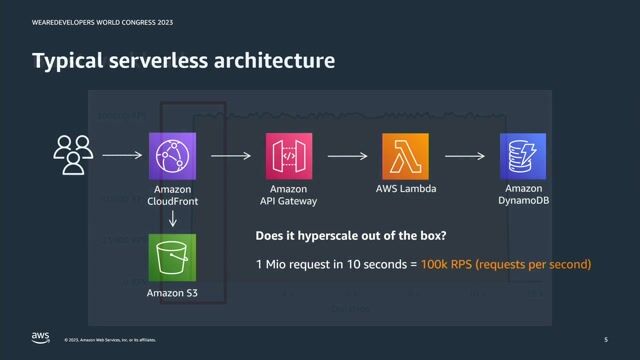
Synchronous architecture patterns struggle to scale instantly due to default account quotas and burst concurrency limitations.

#3 about 2 min

Addressing synchronous invocation flaws between API Gateway and Lambda

One-to-one synchronous lambda invocations for initial requests rapidly exhaust account concurrency and reduce database write efficiency.

#4 about 3 min

Decoupling frontend requests using Amazon SQS integrations

Direct service integrations capture high-volume API requests into a buffer queue to prevent immediate backend overload.

#5 about 2 min

Processing queue messages efficiently with event source mapping

Batching queue messages into single lambda invocations drastically minimizes compute concurrency and optimizes database write operations.

#6 about 5 min

Configuring distributed load testing for serverless applications

Leveraging distributed functions to simulate extreme traffic scenarios helps validate upstream infrastructure configurations prior to launch.

#7 about 5 min

Monitoring backend ingestion during a simulated traffic burst

Live telemetry dashboards reveal how queueing mechanisms effectively absorb millions of incoming requests without dropping data.

#8 about 2 min

Best practices for implementing durable hyperscale serverless systems

Building asynchronous workflows and proactively managing resource quotas ensures reliable application stability during critical high-traffic business events.

#9 about 5 min

Navigating caching and downstream throttling in event-driven setups

Accommodating immediate client feedback requirements necessitates fast caching layers while exponential backoff configurations safeguard vulnerable legacy downstream components.

Matching moments

2:20 min

Exploring auto-scaling benefits inside event-driven cloud ecosystems

Developersteve · LIVE

2:16 min

Resolving resource scaling challenges with dynamic serverless deployments

Daniel Oh Daniel Oh +1 · World Congress 2024

3:27 min

Scaling serverless agents with AWS Lambda MicroVMs

Luca Bianchi Luca Bianchi · World Congress 2026 Europe

4:38 min

Architecting common use cases via serverless design

Oliver Arafat · LIVE

2:15 min

Controlling billing spikes in serverless and AI adoption

Josip Stuhli Josip Stuhli · World Congress 2026 Europe

2:27 min

Handling agent traffic spikes with serverless data platforms

Tomislav Tipurić Tomislav Tipurić +3 · World Congress 2026 North America

Upcoming sessions on this topic

Open session

How We Cut Our API's p99 Latency from Minutes to Under a Second

  • Deepak Agrawal

    Atlassian

    Principal Software Engineer

Open session

How 8 GPUs Became 16: Rethinking LLM Inference Through Parallelism, Memory, and Runtime Design

  • Purnima Kumari

    DigitalOCean

    Sr. Solutions Architect II

Open session

Shipping MCP to Real Users: Scaling, Auth, and the PII Leak You Didn't See Coming

  • Hadar Geva

    Myop

    CTO & Co-founder

Open session

React Under Fire: Rendering Performance for Streaming Agent UIs

  • Abhirupa Mitra

    Slack

    Senior Member of Technical Staff

Open session

Multi-Cloud Isn't a Project. It's a Side Effect.

  • Antonio Mendoza Pérez

    Temporal Technologies

    Staff Developer Success Engineer

  • Gaurav Thadani

    Temporal

    Staff Developer Success Engineer

Open session

What I Got Wrong Shipping an MCP Server for Live Infrastructure

  • Pritesh Kiri

    Harness

    Developer Relations Engineer