


WeAreDevelopers LIVE • Mar 22, 2024

Wasm Deep Dive - A Glance Behind the Scenes

Rainer Stropek

Think WebAssembly is universally faster than JavaScript? Look under the hood of its stack-based virtual machine, linear memory isolation, and host imports to see how it truly operates.

Pause
Mute Enter Fullscreen
#1 about 3 min

Obtaining compiler tools and exploring WebAssembly environments

A provided GitHub repository and Docker instance supply developers with necessary development environments and compiler tools.

#2 about 3 min

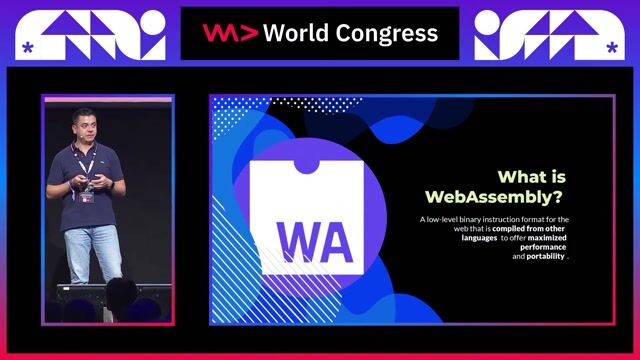
Understanding WebAssembly as a portable compilation target

WebAssembly serves as a portable target that translates higher-level code architectures into universally executable binary instructions.

#3 about 3 min

Writing the first basic module using WebAssembly text format

Compiling a foundational text module relies on the WebAssembly binary toolkit to establish generic execution structures.

#4 about 6 min

Defining functions and handling parameters on the stack

An exported WebAssembly text method processes integer variables and pushes evaluated results to a virtual instruction stack.

#5 about 4 min

Instantiating WebAssembly modules from a Node environment

A Node.js driver script loads imported binary files into memory and triggers exported WebAssembly functions asynchronously.

#6 about 6 min

Parsing string inputs using WebAssembly text logic loops

Custom parsing logic safely processes numeric characters within string buffers using fundamental conditional statements and looping labels.

#7 about 5 min

Reading bytes from linear memory to process stack operators

WebAssembly characters read from memory directly evaluate dynamic index buffers via fundamental multi-value stack pop operations.

#8 about 4 min

Decompiling binary modules into readable WebAssembly text

Decompiling binary instruction files into textual layouts clarifies how arbitrary stack operations translate into nested logic expressions.

#9 about 5 min

Securing environments through isolated linear memory allocation

A dedicated block of continuous memory bits proactively secures physical hosts by restricting low-level operational pathways.

#10 about 4 min

Bridging WebAssembly constraints via functional host imports

External callback events securely extend WebAssembly capabilities to restricted local interfaces and isolated network drive endpoints.

#11 about 4 min

Executing WebAssembly functions natively across distinct programming languages

Host wrappers configured in Rust, TypeScript, and C establish independent environments to efficiently handle linear memory transfers.

#12 about 7 min

Utilizing the WebAssembly system interface for native outputs

The standardized WASI execution interface grants restricted WebAssembly files limited accessibility to native operating system outputs.

#13 about 4 min

Evaluating performance differences between WebAssembly and JavaScript

Developers must benchmark computational boundaries to identify if low-level compilation performs strictly faster than local JavaScript environments.

#14 about 4 min

Managing structured object exchanges with interface type models

Interface typing extensions actively bypass linear memory restrictions to support structured object parsing across heterogeneous language infrastructures.

#15 about 2 min

Selecting debugging strategies for distinct compilation toolchains

Built-in browser features and dedicated IDE capabilities precisely troubleshoot variable configurations across abstracted code executions layers.

Matching moments

1:48 min

Introduction to WebAssembly as a compilation target

Niels Tanis Niels Tanis · World Congress 2023

4:54 min

The origins and design principles of WebAssembly

Maurice Brinkmann · World Congress 2023

1:32 min

Core principles and security model of WebAssembly

Stefan Schöberl · World Congress 2023

2:51 min

Understanding the WebAssembly binary format and its execution sandbox

Önder Ceylan Önder Ceylan · World Congress 2024

2:40 min

Core concepts and execution mechanics of WebAssembly modules

Edo Edo · World Congress 2024

2:27 min

Introduction to WebAssembly in a cloud computing context

Edo Edo · World Congress 2024

Upcoming sessions on this topic

Open session

World Congress 2026 North America

September 24, 2026 · 16:10–16:40

Outdoor Stage

When Humans Stop Writing Code: Rethinking Languages, Compilers, and Responsibility

Simon Auer

Organizer of flutter vienna meetup and CEO of marqably

Simon Auer
Open session

World Congress 2026 North America

September 25, 2026 · 15:30–16:00

Stage 6

Small LLM in your Browser: Huge Opportunities for Web Applications

Daniel Ostrovsky

UI/UX Architect at Payoneer | AI Architect | Full Cycle Development Expert | Public Speaker | Open Source Contributor |

Daniel Ostrovsky
Open session

World Congress 2026 North America

September 24, 2026 · 10:20–10:50

Stage 1

The Browser Is Becoming an AI Runtime

Ajit Varma, Will Bryk

Ajit Varma
Will Bryk
Open session

World Congress 2026 North America

September 25, 2026 · 15:30–15:40

Outdoor Stage

Offloading IoT State: Solving the Memory Crisis on Legacy Hardware

Pravin Nagare

Senior Software Engineer, Roku

Pravin Nagare
Open session

World Congress 2026 North America

September 25, 2026 · 12:30–14:30

Stage 11

Docker sandboxes: protect your secrets, tokens, and personal data from AI agent mistakes

Kristiyan Velkov

Front-End Advocate | Speaker | AI & DevOps | Docker Captain | Cursor Ambassador | DevReal | Tech Blogger | Book Author

Kristiyan Velkov
Open session

World Congress 2026 North America

September 25, 2026 · 16:50–17:20

Stage 1

Honey, look! I vibe-coded an OS!

Ian Smith

CTO of LYOS

Ian Smith